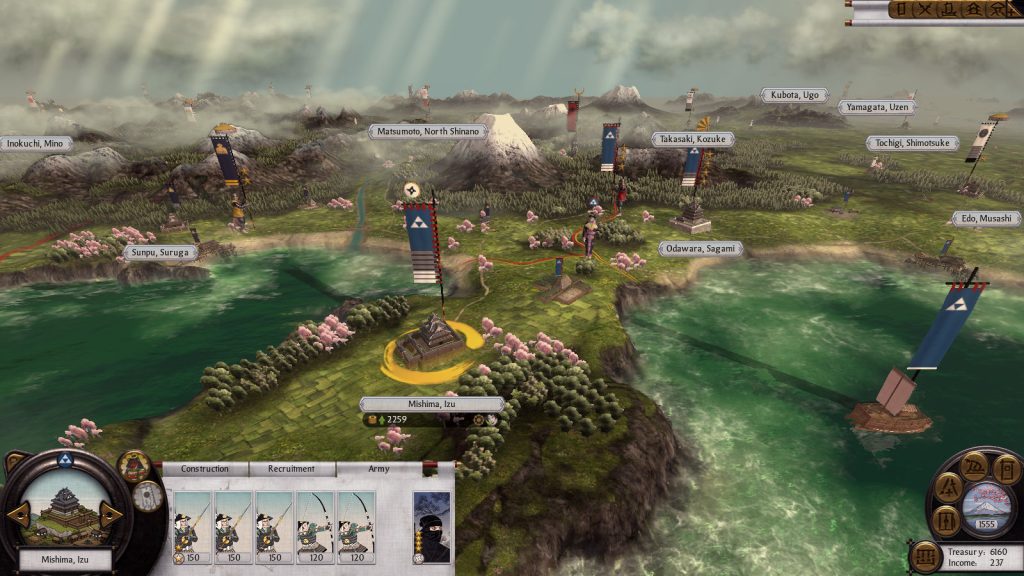
TL;DR: Total War Shogun 2 province development should give each holding a useful role: food and income, recruitment, naval access or frontier defense. Improve productive farms, preserve a food margin before castle and market upgrades, and connect specialist recruitment to the army’s route. Build what the campaign can use next instead of filling every slot with expensive projects. A strong province supports the realm through income, production or position, rather than needing every possible building.

The official manual describes provincial specialties, castle-town expansion, farm support, arts and the campaign economy. The food reference adds the value of surplus for town wealth growth. This guide uses the base Sengoku system, with conditional examples rather than a fixed build order for every clan.
On this page
Total War Shogun 2 province development: choose the role first
- Read the province’s location, income, food and specialty.
- Give it a primary economic, recruiting, naval or defensive role.
- Resolve damage and order problems that prevent useful development.
- Choose the next project that supports the assigned role.
- Check food, treasury and required arts before confirming it.
- Reassess after conquest, a new front or a major budget change.
The role is a priority, not a prohibition on other buildings. A recruitment province still needs a sustainable economy, and a profitable interior holding may later become part of the frontier. Use the label to make the next purchase intelligible.
1. Develop food before consuming the margin
The base food reference identifies farms as producers and castle development as a consumer. The manual explains that larger castle towns need more food, so expanding building capacity is a resource decision as well as a construction purchase.
Improve useful farm production before simultaneously buying several consumption-heavy developments. Keep a margin for the projects that the army and realm actually need. A province with unused castle space can be more useful than a developed town contributing to a shortage.
Surplus also supports town wealth growth across the faction in the food source. That gives food a wider economic role. Spending the last surplus on one province can affect development elsewhere, even when the local upgrade appears affordable.
For a hypothetical example, assume surplus is three and planned projects consume four. Funding them all creates a deficit. Add production, postpone a lower-priority project or reduce the simultaneous queue before treating the upgrades as a completed plan.
2. Give an economic province a useful income base
Compare current income, productive development and security. A province that can be retained and supported provides a steadier foundation than a lucrative border acquisition requiring repeated recapture. Keep its defense connected to the money it supplies.
The Market reference describes local commerce wealth and continuing growth, along with metsuke recruitment. An ordinary market can support an economic holding without the food consumption associated with its higher upgrades.
Compare an upgraded market with the wider food budget. The source distinguishes the ordinary building from food-consuming development. A larger local income opportunity can justify that cost in a suitable province, but it is not a reason to upgrade every market automatically.
Give the next purchase a defined use for its added income. If it should fund reinforcement, preserve the needed cash afterward rather than immediately consuming the gain on another optional development.
The Metsuke page identifies town oversight as a tax-income improvement. Place the agent where the contribution is useful, and count the market’s own production separately from oversight. Several agents in one town have diminishing returns, so compare another productive holding before stacking them.

3. Use the actual provincial specialty
The manual describes specialization in goods or unit types and relevant advanced construction requirements. A specialty provides a reason to examine the province’s role; it does not automatically determine every building the clan should buy there.
The Tosa reference gives the base province average fertility, a forest specialty and a coastal position. That makes naval production worth considering without turning Tosa into an exceptionally fertile farm by assumption.
The Satsuma reference identifies smithing in its base section. Such a province can support a useful specialist recruiting plan. Compare the unit or capability the army needs before spending on every possible training chain.
Separate a resource benefit from the conquest required to obtain it. A valuable specialty beyond the current border is not already part of your development budget. Decide whether taking and retaining that province supports the front and the recruiting route.
4. Build recruitment around delivery and replacement
Choose a recruiting center for a specific army role. A useful specialist province can produce better-supported forces when its location and facilities match the campaign. It becomes less convenient when the army has moved far beyond the route it can readily supply.
Consider how the unit reaches the front and how losses will be replaced. A strong formation trained at the far end of the realm does not instantly repair an army near Kyoto. Fund the journey or develop a suitable supporting recruiting location closer to the campaign.
Do not reproduce the entire recruitment infrastructure in every province without a need. Give the major centers complementary jobs and use inexpensive local units where they provide useful defense. That preserves resources for the formations the main army actually lacks.
Check what the training chain and unit access require. The manual links new capabilities to arts and provincial resources. An unfinished prerequisite means the final recruitment plan is still incomplete, even if the castle has an available slot.
5. Fund a coastal province for a defined naval task
The Trading Port reference identifies access to ordinary Trade Ships and added sea-trade opportunities. A port can support the economy when producing vessels, partners and a defensible route make the investment usable.
Decide whether the immediate coastal job is commercial access, ship recruitment or support for an overseas operation. Those goals can share infrastructure, but they still require different ships, protection and spending priorities.
The node reference says producing trade vessels and an unblocked trade port matter. A developed port alone does not guarantee a particular maritime income. Connect the provincial purchase to the whole route instead of counting a future node as automatic revenue.
Retain money for protection and replacement. A naval province that recruits traders without any way to defend them can create an exposed economic commitment. Compare the broader fleet cost with the land campaign’s immediate needs.

6. Develop a frontier holding for retention
The manual describes more developed castles having increasingly complex defensive layouts. An important frontier location can justify castle investment when its food demand and the defending force are funded.
Choose the fortress for the route or asset it protects. A key recruiting center or entrance into the realm can deserve stronger defense than a quiet interior town. Do not consume the same food and money everywhere simply because larger castles are available.
Repair captured holdings and address local order before treating them as self-sufficient. A province that continuously needs the field army to stay behind cannot yet provide the safe base assumed by the next offensive.
Plan the response if another army approaches. The castle’s layout supports a defense, but the existing garrison and nearby relief still determine what can be retained. Provincial construction should complement the military plan rather than replace it.
7. Coordinate arts and religious consolidation
The official manual permits one art to be studied at a time. Select research for a project the campaign can build and fund afterward. Switching between unrelated aspirations can delay the capability the provincial role actually needs.
The Buddhist Temple reference provides a concrete example: Zen, faction faith and building space affect access, while the temple supports conversion, monk recruitment and Chi research. The same project can serve several needs when the province and clan fit it.
Choose the religious chain appropriate to the controlling faction. A recent foreign-faith acquisition can need consolidation, but an available building slot does not make every temple type eligible. Keep order support during conversion and development.
Compare research support with the province’s immediate task. A useful temple in a consolidating region can be a better investment than a duplicate training facility the army will never use. An already stable province may have a more urgent food or recruiting project instead.
8. Use three conditional development choices
A stable interior economic holding
Improve productive income and food, consider a useful market and compare metsuke oversight. Retain the faction-wide surplus benefit before buying optional castle capacity.
A specialist recruitment province
Build the relevant chain and prerequisites, fund the unit role and identify its route to the army. Keep enough economic support for ongoing replacements rather than treating the first recruited unit as the whole project.
A newly acquired frontier province
Prioritize repairs, order and a supported defense. Develop the castle or recruitment access when it improves retention and the food budget permits it. Reassess once the acquisition becomes a functioning part of the realm.
These examples are conditional plans, not measured payback schedules. Province resources, clan access and the changing front determine the next useful project. Purchase the development that supports the present campaign and keep a reserve for the situation that follows it.
Frequently asked questions
Should every castle be upgraded immediately?
No. Food, treasury and the province’s defensive or production role should justify the project.
Does every coastal province need the same port plan?
No. Define its trading, recruiting or overseas-support task first.
Can one province perform every development role?
It can have several useful functions, but funding all possible chains rarely explains the best next purchase.
Sources and further reading
- https://www.feralinteractive.com/en/manuals/shogun2tw/latest/linux/
- https://totalwar.fandom.com/wiki/Food
- https://totalwar.fandom.com/wiki/Market_(Total_War:_Shogun_2)
- https://totalwar.fandom.com/wiki/Tosa_(Shogun_2_province)
- https://totalwar.fandom.com/wiki/Satsuma_(Shogun_2_province)
- https://totalwar.fandom.com/wiki/Trading_Port_(Total_War:_Shogun_2)
- https://totalwar.fandom.com/wiki/Trade_Node
- https://totalwar.fandom.com/wiki/Metsuke
- https://totalwar.fandom.com/wiki/Buddhist_Temple_(Total_War:_Shogun_2)
Keep exploring
Total War Shogun 2 Naval Bombardment: check the campaign first
The queried coastal bombardment and land-battle naval support belong to Fall of the Samurai, rather than base SHOGUN 2 naval combat.

Total War Attila vs Total War Shogun 2: survive or reunite?
ATTILA offers late-antique survival and destructive warfare; SHOGUN 2 centers a clan campaign on reunifying Japan.
Total War Rome 2 vs Total War Shogun 2: empire or clan?
ROME II suits classical empire building; SHOGUN 2 suits a focused Japanese clan campaign with growing generals and agents.