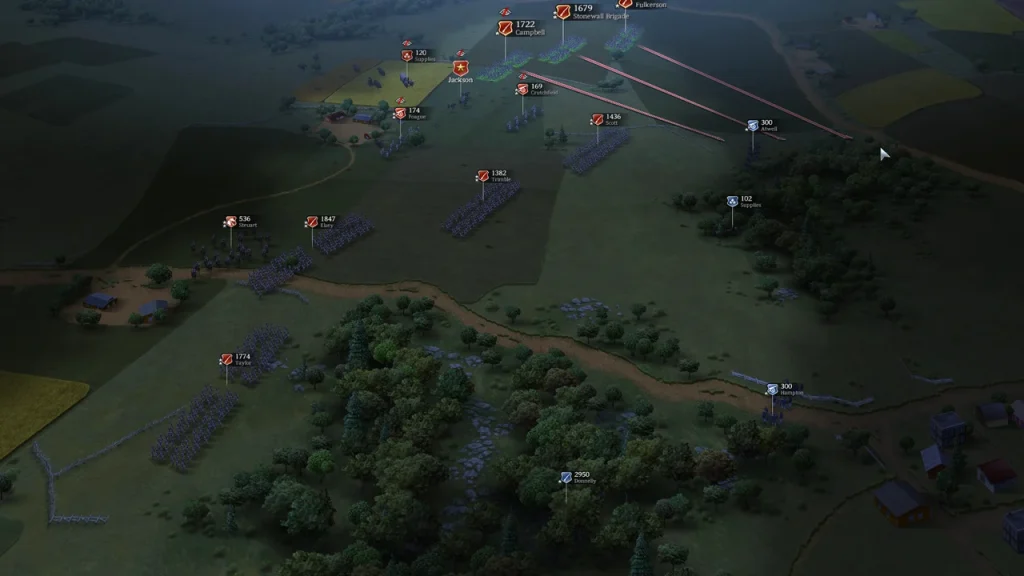
Ultimate General Civil War infantry brigade size should follow the unit’s role, its command capacity and the resources needed to keep it equipped. There is no single headcount that this guide can defend as best for every campaign. The official manual says that not all men fire simultaneously: an efficient medium-sized formation can deliver better fire than a larger one, while extra men provide numerical staying power. Compare those benefits before applying replacements.
Quick decision: define the brigade’s next job, inspect its officer and capacity, preview the proposed strength, compare skills and costs, then check the next deployment. Use the current camp values to decide. This guide draws on the official UGCW manual and the developer’s game overview; it does not supply an untested firing formula or claim that a historical screenshot shows today’s optimum.

On this page
Ultimate General Civil War infantry brigade size: start with the job
Write down what the brigade must do in the next mission. Holding an exposed objective through repeated pressure asks different questions from supporting a flank, covering artillery or arriving as a reserve. Size becomes meaningful when you can explain which part of the task benefits from more men.
For a holding formation, consider how long it must remain useful and whether another brigade can relieve it. For a firing formation, inspect efficiency, firearms skill, equipment and the position from which it can engage. For a reserve, consider where it can enter the line and whether its arrival requires a difficult march.
Do not use size to disguise a missing role. A larger brigade does not supply scouting, a protected wagon or a separate unit on an exposed flank. Start with the whole force’s assignments, then choose the strength of the formation that fills each one.
Check capacity before choosing a target strength
The camp’s Organization limits and officer requirements constrain what you can create and enlarge. Inspect the current limits before planning a target that the interface cannot support. Also check whether the next mission limits the corps and brigade slots you may deploy.
Capacity and affordability are separate checks. Even when a larger brigade is allowed, it still needs recruits and enough weapons of the selected type. A new formation also needs a suitable officer. Treat the permitted maximum as a ceiling shown by the current campaign, not a direction to fill every unit to that point.
If the force is too small for its next task, decide which constraint is responsible. More organization may help a formation limit. It does not solve missing recruits, unavailable equipment or an officer who cannot support the intended size efficiently. Resolve the actual bottleneck before spending elsewhere.
Compare command and efficiency as the slider changes
Open the brigade details and record the current strength, officer rank, command and efficiency. Move the replacement slider to the strength you are considering and inspect the preview. The manual connects command, rank and formation size with unit efficiency, so a higher headcount must be evaluated alongside the person commanding it.
Make the comparison at more than one plausible strength. A modest reinforcement and a major expansion may produce different costs and skill previews. If efficiency becomes unsuitable for the task, examine whether a better officer is available or whether keeping the brigade smaller fits the army better.
This is a live-interface check rather than a promise that a particular rank supports a universal number. Historical manual examples show how to inspect the fields, but their displayed soldiers, prices and skill values are not recommendations. Judge the combination in your current campaign.
Give larger brigades a task that uses their staying power
The manual recognizes the numerical resilience of larger units. Additional men can matter when a formation must sustain losses and remain useful. That can make a larger brigade a reasonable choice for an important holding role, provided its command, equipment and support remain adequate.
Ask where those men will operate. A formation assigned to a narrow approach may be unable to use the surrounding ground the way your plan assumes. A large unit in a poor position can take sustained fire without creating a useful exchange. Check its facing, cover and available support as carefully as its strength.
Preserve condition during the approach. A long run or repeated charge can consume the ability you hoped the larger unit would retain. The added headcount does not exempt it from morale, exhaustion or ammunition concerns. Give it a supported job and a relief option instead of treating it as an unlimited damage absorber.
Keep medium formations useful for firing and support
The manual explicitly warns against equating total men with simultaneous fire. It states that medium units with good efficiency can fire better than larger formations because not everyone fires at once. That supports comparing efficiency and unit quality; it does not prove a fixed current optimum for every weapon or difficulty.
A medium formation can also fill a separate support assignment. It may cover another brigade’s side, protect a gun position or remain available to replace a tired unit. These are tactical uses of an independent formation, not a claim that smaller units automatically maneuver better in every situation.
Keep the comparison concrete. If the brigade’s task is sustained firing from useful ground, inspect firearms, efficiency, weapon suitability and supply. If it needs to hold alone under pressure, consider the resilience lost by reducing its strength. Choose between actual needs rather than declaring one size class superior.

Decide between one enlarged brigade and another formation
Suppose you have enough recruits and weapons to improve the army. You can concentrate them in an existing brigade or allocate them to another formation. Compare what each option changes on the battlefield before considering the roster’s appearance.
Enlargement adds men to an established formation and its existing assignment. It can preserve a simple line, but it also concentrates the replacement expense and asks the commander to handle a larger unit. A new brigade can cover a second position or serve as a reserve, but requires an officer, organization and an available deployment slot.
Check the next briefing. If the new formation cannot be deployed, its immediate tactical benefit may not exist. If your current force leaves a flank without a unit, enlarging the center may not address that gap. Make the choice by the job gained and the costs incurred, including the officer and weapon purchases.
Budget recruits and weapons together
Adding infantry means equipping the recruits with the brigade’s selected weapon. Inspect Armory inventory and the shop before moving to a desired strength. When existing stock is insufficient, the camp may need to buy additional weapons; if the required equipment is unavailable in stock and shop, the current weapon choice limits further expansion.
Use the preview to separate the costs. Record the recruits required, the gold required for the selected replacement method and the equipment that must be purchased. Then check what remains for other brigades. A low replacement wage does not make expansion free if it requires a substantial weapon purchase.
Consider a different target strength when the stock falls short. You may decide to equip fewer men with the current weapon, switch equipment after comparing its role, or allocate available weapons to another formation. Read the live Equip and Apply consequences before confirming. Do not assume a future battle will supply the missing inventory.
Preserve veteran quality selectively
Rookie and Veteran replacement choices can produce different skills at the same size. The manual describes rookies as diluting the unit’s skills, while veterans maintain them at an additional gold cost. That cost rises with the average quality being preserved.
Compare both methods at your proposed strength. The rookie preview may turn a high-quality firing unit into something less suited to its assignment. The veteran preview may preserve the qualities you need but consume money required elsewhere. Neither result should be hidden behind the larger soldier count.
You can reconsider the size as part of this decision. A smaller repair may let you maintain a priority unit while funding command or equipment for supporting formations. If you choose rookies, inspect the final skills after applying them and adjust the job if necessary. Evaluate the usable brigade you created, not only the target headcount you reached.
Check ground and frontage after leaving camp
Camp decides what the brigade contains; deployment decides how it is used. Once the mission begins, inspect the ground where you plan to put it. Terrain hover information, visibility, facing and approach routes affect whether the formation can contribute as intended.
Do not pack several units onto a location simply because it has cover. Check whether each has a useful direction to engage and whether another friendly formation blocks the route you need. The named frontline, movement and rotation controls help set the position. Recheck facing after an advance or withdrawal.
Keep the formation supported on its vulnerable side and supplied for sustained fire. A larger brigade that is exhausted, flanked or short of ammunition is not delivering the benefit the camp budget purchased. Conversely, a medium unit with a clear firing position can contribute without needing to absorb the entire enemy attack alone.
Use the next battle to review the size decision
After the battle, compare what happened with the assignment you wrote in camp. Did the holding brigade remain useful until relief arrived? Did the firing unit have the position, condition and ammunition to engage? Did the reserve arrive where another formation was needed?
Inspect losses alongside the circumstances. High casualties do not establish that the brigade was too small if it crossed exposed ground or fought unsupported. Low casualties do not prove an ideal size if the unit never reached a useful position. Separate an equipment or command shortage from an order that created an avoidable problem.
Use the camp preview for the next repair with that lesson in mind. If the unit performed its job and still needs resources elsewhere in the army, there may be no reason to enlarge it. If it repeatedly ran out of useful strength despite sound support, additional men may deserve consideration. The next decision should answer an observed problem.
The Ultimate General Civil War guide hub covers the neighboring topics of army organization, weapons and replacements. Keep your size note short: assignment, proposed strength, command check, replacement method and equipment cost. Those five fields make the tradeoff reviewable before you apply it.
FAQ
Is the largest possible infantry brigade always best?
No. The manual distinguishes numerical staying power from effective firing, and it notes that not all men fire simultaneously. Inspect efficiency, officer command, skills and the brigade’s task before increasing strength.
Should every infantry brigade have the same size?
Different assignments and commanders can justify different strengths. Check the force’s roles, equipment stock and deployment slots rather than standardizing the whole army without a reason.
Can I use the manual’s displayed 1,500 soldiers as the optimum?
No. That is a historical replacement-interface example. It demonstrates where the Rookie, Veteran, skill and cost fields appear; it does not establish today’s optimal infantry headcount.
What should I check when a size increase looks cheap?
Check skill dilution, command and efficiency, recruits required and weapon stock. A cheap gold preview can still produce a less suitable brigade or consume equipment that another unit needs.
Sources and further reading
Keep exploring

Hearts of Iron 4 vs Ultimate General Civil War: nation or army command?
Pick HOI4 for national industrial and political war planning; pick Ultimate General: Civil War for tactical formation command and an army that carries battle consequences forward.
Gates of Hell Ostfront vs Ultimate General Civil War: which army campaign?
Choose Ostfront for a researched WWII force and direct control; choose Ultimate General: Civil War for brigade command and a campaign shaped by surviving soldiers and officers.
Games like Ultimate General Civil War: 3 clear choices
Criterion-based alternative selection for UGCW players: same-franchise focused battlefield, same-war national strategy, or different-period gunpowder regional campaign; explicit scope and evidence limits.