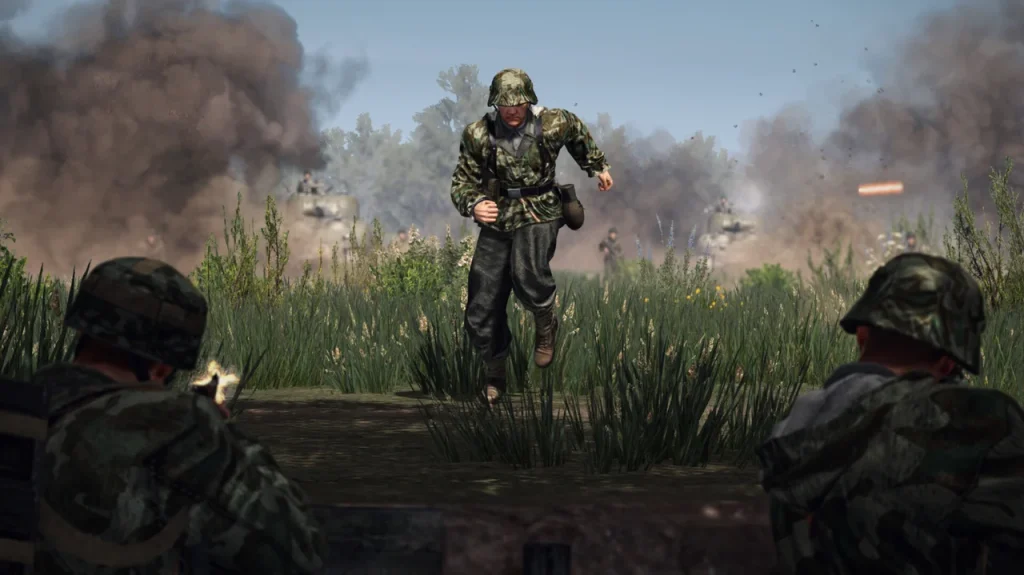
TL;DR: This Gates of Hell Ostfront review recommends it for players who enjoy individual equipment, vehicle damage and preserving a force across a dynamic campaign. Its Direct Control views and inventories provide detailed decisions, but those decisions also demand attention. Compare another RTS first if you mainly want broad army orders with less individual-unit management.
The strongest reason to choose Ostfront is the relationship between the soldier, vehicle and wider battle. A manual shot, a crew replacement or a recovered gun can change what your army can do next.

This is a source-based assessment of documented systems, not a hands-on performance test or a report of personal campaign hours. It draws on the current official store description, the complete September 2022 Field Manual and developer explanations. No numerical review score, frame-rate result or current multiplayer-population claim is invented.
On this page
Gates of Hell Ostfront review: the verdict
Choose it when managing the details is part of the enjoyment you want. Inspecting a gun’s ammunition, a vehicle’s damaged component or a soldier’s equipment is closely connected to tactical decisions rather than confined to a background menu.
Conquest adds a reason to care about those details between fights. You research and recruit an army, arrange its call-in stages and retain equipment owned at battle end. The force that wins the current engagement becomes the starting point for another planning decision.
The tradeoff is the number of contexts you need to understand. Squad selection, individual inventory, contextual action menus, different control views and campaign resources all answer different questions. That is a clear fit issue for a player who wants most actions to stay at one level of command.
What the setting and modes provide
Ostfront’s current product description places its core setting on the Eastern Front between Germany and the USSR from 1941 to 1945. It describes scripted singleplayer missions, Dynamic Conquest, PvE, PvP and cooperative play.
Those modes offer different reasons to return. A scripted mission provides objectives in a designed situation. Conquest provides a continuing army and research choices. Multiplayer brings lobby settings, war stages and doctrines that shape the available battle.
Do not treat every mode as the same campaign with different opponents. The manual distinguishes Battle Zones, Domination and scripted skirmishes, including their objectives and ending conditions. The activity you intend to play matters more than the total number of modes advertised.
Additional content can extend the game, but check the current edition and DLC listings for the missions or factions you want. This assessment does not count every expansion as part of a single unspecified purchase.
Vehicle damage gives equipment choices consequences
The developer’s Development Update 97 describes separate hitboxes for the chassis, turret, guns, engine, fuel, ammunition rack and transmission. A shot can affect a component or crew without producing the same result as a hit elsewhere.
That design makes target location and ammunition relevant. A clear firing line does not promise penetration, and penetration does not automatically mean immediate destruction. Players willing to investigate those differences have more decisions to make during an armored engagement.
The manual’s vehicle overview provides component condition, fuel, speed and terrain information. Trained crews operate more efficiently and repair more quickly than other soldiers. Preserving suitable crew and diagnosing a stopped vehicle are therefore part of using the equipment.
The drawback follows from the same design: a failed shot or movement order can have several explanations. You need to inspect weapon, ammunition, range, obstruction, crew and component state rather than assume a larger tank solves the problem.

Direct Control changes the attention cost
The documented defaults use E to enter Direct Control, WASD for movement and T to change available views. Ordinary infantry has third-person control; vehicles and certain infantry provide additional first-person capability.
This gives players a way to handle a particular shot or movement themselves. The first-person display reports ammunition, reload and line of fire. Green means clear, while red can mean obstruction or range according to the manual.
It is a useful fit for someone who wants to move between army orders and direct equipment operation. It also creates an attention choice: time spent lining up one shot is time when you still need a plan for the other units.
Not every vehicle weapon is available for manual control, and not every soldier has every view. Read the selected unit’s options. Treating Direct Control as a separate context to learn is more realistic than expecting a universal action-game camera on every unit.
Conquest makes preservation meaningful
Dynamic Conquest lets you compose an army, research new units and choose a path through battles. The current store supports campaign lengths from short to unlimited and confirms singleplayer and cooperative Conquest.
The planning interface separates research points, purchase resources, support points, ammunition points and command-point limits. A researched portrait still needs recruitment and a place in the call-in arrangement. This creates decisions about fielding the army, not merely reaching the next unlock.
The manual says units owned at battle end carry forward, including captured enemy equipment. A recovered weapon can become part of the next force, while losses leave restoration and purchase decisions.
That persistence suits players who enjoy keeping useful equipment alive. It also means a victory can leave an awkward next battle if the army returns depleted. Conquest rewards a readiness check after the result rather than treating winning as an automatic full reset.
A reasonable first approach is a short campaign with a small army and clear roles. Learn the complete loop before treating the longest campaign length as the default measure of value.
Infantry and logistics require deliberate management
Squads contain individual members with different weapons. The manual distinguishes the commander selecting the entire squad from icons showing member weapons. Inventory and examine actions let you inspect the soldier or equipment that needs attention.
This supports detailed decisions about a specialist weapon and compatible ammunition. It can also demand more checks than a player expects from a squad portrait. A group still present on the battlefield is not proof every weapon inside it is ready.
Contextual actions add repair, towing, smoke, automatic resupply, mines and emplacements where relevant. Their availability depends on the selected unit. Learning the action menu is part of learning what the current equipment can do.
Repair and supplies have practical limits. The developer damage explanation describes finite repair kits and distinguishes damaged components from destroyed ones. Restoring a useful vehicle asks for condition checks and protection for the repairer.
These systems are a strong reason to choose the game if recovery and equipment stewardship appeal to you. They are also a reason to compare first if inventory management feels like an interruption rather than tactical play.

Co-op and Workshop extend the ways to play
Cooperative Conquest can divide the work across a group, while scripted missions provide another shared activity. The manual explains the Conquest cooperative toggle, multiplayer hosting and handing units to other players through the Exchange Menu.
Check the actual mission’s participant limit. The manual says scripted skirmish capacity varies by mission, so a generic co-op label does not establish one universal group size.
The official Workshop page confirms ready-to-use subscribed items and notes that in-game activation or access can be required. The manual places the mod list under Extras.
Mods offer more ways to adapt the game, but compatibility is part of the decision. The manual warns that updates or added mods can affect saves. Preserve important campaigns and verify a new item separately rather than assuming every collection works together.
Historical detail and practical buying checks
Barbedwire Studios describes using blueprints, real vehicles and researched terrain in its account of historical research. The same article acknowledges that complete historical perfection is out of reach and that some issues remain.
That supports treating the game as researched historical entertainment without promising a complete simulation of every wartime condition. A multiplayer battle also does not reproduce a historical event merely because its equipment is based on real designs.
Before buying, read today’s Steam listing for edition, prerequisites, requirements and the specific content you want. The manual dates from 2022, so its old purchase and system-requirement wording should not replace the current product page.
For hardware suitability, compare the listed requirements with your system and seek a relevant current test if you need a performance answer. This review supplies no benchmark that proves how your hardware handles a large battle.
Who should buy and who should compare first?
Ostfront is a strong candidate if you want to care about the exact weapon, crew and damaged vehicle, and if a persistent army makes small recoveries meaningful. Start with training and a manageable force so those systems become understandable together.
Compare first if you want most decisions to remain at broad squad or army level, or if your priority is a different theater and scale. The published Company of Heroes 3 versus Gates of Hell comparison helps with the squad-RTS choice.
Choose according to the activity you expect to repeat. A player drawn to Conquest should evaluate research, restoration and stage planning; a cooperative group should check its intended missions and supported size. The useful purchase is the version that supports that actual plan.
FAQ
Is Ostfront mainly an RTS or a shooter?
Its documented design combines tactical army orders with Direct Control of individual units. You need to understand the wider battle even when operating one weapon manually.
Does it have a dynamic campaign?
Yes. Conquest supports army composition, research and continuing battles, including cooperative play.
Is every damaged vehicle repairable?
No universal claim is supported. Inspect components and current actions; the developer distinguishes damaged parts from destroyed ones.
Does this review include a hands-on performance score?
No. It assesses documented systems and player fit. Current performance needs an appropriate hardware and version test.
Sources and further reading
- https://store.steampowered.com/manual/400750/
- https://store.steampowered.com/app/400750/Call_to_Arms__Gates_of_Hell_Ostfront/
- https://store.steampowered.com/news/app/400750/view/6328093343576961288
- https://www.barbed-wire.eu/our-dedication-to-realism-and-history/
- https://steamcommunity.com/workshop/about/?appid=400750
Keep exploring
Gates of Hell Ostfront vs Ultimate General Civil War: which army campaign?
Choose Ostfront for a researched WWII force and direct control; choose Ultimate General: Civil War for brigade command and a campaign shaped by surviving soldiers and officers.
Gates of Hell Ostfront vs Steel Division 2: Conquest or Army General?
Pick Ostfront for researching and developing a Conquest army with switchable unit control; pick Steel Division 2 for battalion-map planning and battlegroup decks.
Men of War Assault Squad 2 vs Gates of Hell Ostfront: missions or Conquest?
Men of War Assault Squad 2 vs Gates of Hell Ostfront: compare varied skirmish missions, direct-control views and Conquest army development.