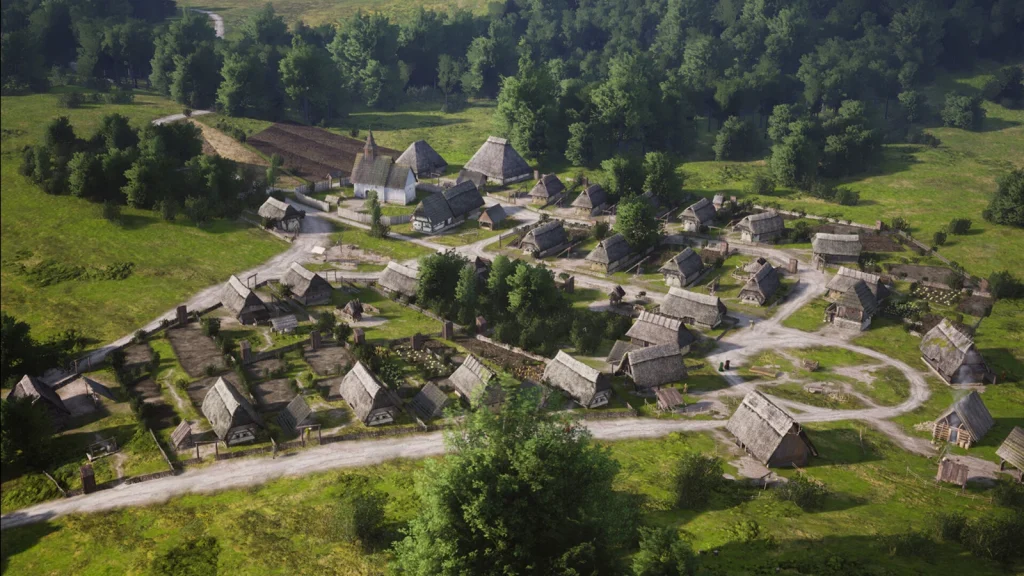
This Manor Lords review recommends the game most strongly to players who want to build a medieval settlement and solve its practical supply problems. Its battles add stakes to the town you have built, but the main attraction is the connection between homes, workers, goods and regional resources. Choose it for that village economy before choosing it for a military spectacle.
This is a research-based buying assessment using the official Steam description, the developer’s scope statement and release notes through the October 2026 default-branch update. It does not claim firsthand play time, tested frame rates or a scored review. The Steam listing read for this article still identifies the game as Early Access.

On this page
Manor Lords Review: The strongest reason to choose it is the settlement
Gridless building is more than a choice of street angle. The official description connects placement to terrain, trade routes, fertile ground, animal resources and the household plot system. That makes the settlement plan part of the economy rather than decoration added after a strategy match.
Burgage extensions matter because homes can contribute to production. A large yard or a useful artisan setup changes what a household can do, while household needs still have to be supplied. The appeal is a town whose shape reflects the jobs you have decided to support.
This suits players who enjoy noticing that a production problem is actually a transport problem, or that an attractive expansion needs more storage and fuel handling before it can work. If those small decisions sound tedious, the medieval setting alone may not sustain your interest.
The economy asks you to keep several obligations in view
Raw materials become useful through workers, transport and processing. Food, clothing, fuel, trade goods and armaments compete for the same settlement’s resources. A workshop icon does not finish a production chain, and a region’s stockpile does not tell you whether the next season is secure.
Seasonal planning is part of that appeal. The official description emphasizes winter preparation, and later updates continue to revise farming and livestock. You are encouraged to think beyond the immediate building queue and consider what the households and industries will need after expansion.
Regional specialization gives that economy room to grow. The game description contrasts fertile land with ore-rich regions and asks where influence should be spent. A second settlement can solve a constraint in the first, but also creates another place that needs a functioning labor and supply base.
The drawback is a larger set of connected checks. If a resource is missing, the cause can be production, staffing, input reservations, movement or consumption. Players who prefer a short build order and a clearly isolated resource counter should expect a different kind of work here.

Battles make the town vulnerable
The developer’s pre-launch statement called Manor Lords a city builder with battles and explicitly said most play would focus on city building and management. That remains the useful expectation to set against the store’s impressive battlefield imagery.
Militia is drawn from residents, so mobilization competes with civilian work and casualties have an economic cost. The official description also names a retinue and costly mercenaries as other parts of the military choice. That supports a defense plan built around what the town can afford to risk.
Fatigue, weather, equipment and positioning are presented as tactical considerations. They create reasons to prepare and deploy deliberately. They do not make the game a substitute for every player who wants large, frequent historical battles.
If your favorite part of Total War is repeatedly commanding armies while ignoring most town detail, inspect current Manor Lords gameplay before buying. If you want an occasional threat to make a carefully supplied settlement feel valuable, the mixture is a closer fit.
Early Access changes the buying decision
The December 2025 core rework changed family approval, resource choices, artisan systems and other fundamentals. The August 2026 update added more animal and construction systems, and version 0.8.117 became the default branch in October.
Those updates show active development and a meaningful risk for older advice. A launch-era approval threshold, workshop cost or animal plan may not describe the build a new buyer downloads. Read release dates when using guides, and distinguish a beta announcement from the default branch.
Early Access also limits what a buying recommendation can promise. Do not buy solely for an imagined future feature, a release date inferred from patch frequency or a mechanic visible in old promotional material. Decide whether the currently described settlement game already fits your interests.
Who should buy, and who should wait?
Buy when you enjoy organic medieval town planning, production chains and slower decisions about household supply. Be comfortable consulting building panels and adjusting a plan when labor or transport fails to match the layout. Accept that updates can require relearning part of the economy.
Wait if you need a finished, stable ruleset or want to judge campaign depth and late-game balance from a long independent playtest. This assessment has not tested those outcomes. Read recent footage and player reports for the current branch before using it as evidence for your own priorities.
Choose another game if you want direct character combat, a continent-wide dynastic campaign or a competitive RTS match as the central activity. The developer explicitly distinguishes those experiences from Manor Lords. The cosmetic visit mode is not a promise of first-person role-playing.
Check the current official store page for price and system requirements, then compare recent gameplay with the kind of decisions you want to make. For players ready to start, the Manor Lords guides hub covers the housing, food, transport and defense chains that define the settlement experience.
Sources and further reading
- https://store.steampowered.com/app/1363080/Manor_Lords/
- https://steamstore-a.akamaihd.net/news/externalpost/steam_community_announcements/5762994032386883137
- https://steamstore-a.akamaihd.net/news/externalpost/steam_community_announcements/1819386365095372
- https://steamstore-a.akamaihd.net/news/externalpost/steam_community_announcements/1842212951300554
- https://steamstore-a.akamaihd.net/news/externalpost/steam_community_announcements/1847920302241640
- https://store.steampowered.com/api/appdetails?appids=1363080&l=english&cc=us
Keep exploring
Manor Lords vs Crusader Kings 3: build a town or guide a dynasty?
Pick Manor Lords for a medieval settlement and its household economy; pick Crusader Kings III for rulers, relationships and a realm passed between generations.
Northgard vs Manor Lords: clan objectives or settlement planning?
Choose Northgard for clan-specific strategy and explicit victory routes; choose Manor Lords for the placement, households and production of a medieval settlement.
Manor Lords Retinue Management: Roster, Armor and Treasury
Manor Lords retinue management: budget recruitment and armor, assign a clear battlefield role, and protect the settlement economy behind it.