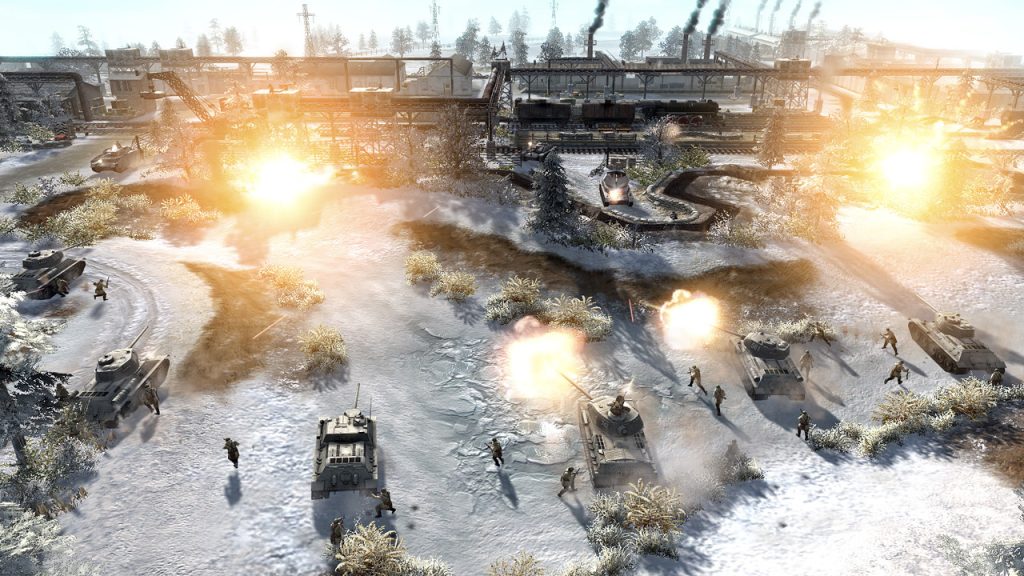
TL;DR: This Men of War Assault Squad 2 review recommends considering it if you want detailed WWII unit control, infantry inventories and recoverable battlefield equipment. Its documented mechanics offer many decisions inside a battle, but they also demand attention to individual soldiers, vehicle crews, ammunition and orders. Choose carefully if you prefer a simpler command layer.
Assault Squad 2’s strongest fit is a player who finds equipment management and occasional Direct Control interesting parts of tactics. Its weaker fit is a player who wants to issue a few broad orders and spend little time servicing units. That verdict is a source-based assessment of the design, not a claim of firsthand testing or a measured score.

This review uses the official Steam description and the official release-era manual. They support the features and control systems discussed here. They do not establish current performance, community activity, mod compatibility or a verified experience on your computer.
On this page
Men of War Assault Squad 2 review: who should consider it?
Consider it when the details of a small tactical situation appeal to you. The manual describes individual soldier inventories, weapon skills, different ammunition types, vehicle component damage and crew positions. These systems make the equipment and condition of a particular unit relevant to the next order.
A player interested in recovering an abandoned vehicle, finding ammunition for a specialist or changing a tank’s selected shell has clear reasons to look closer. Those are documented actions, not cosmetic systems surrounding a single generic unit-health bar.
The same detail creates a learning and management cost. You need to distinguish ammunition problems from fire orders, fuel shortages from component damage, and a crew shortage from an unusable hull. The design can reward attention while making a stalled force harder to diagnose than simply replacing a unit.
If you dislike small inventory decisions, that cost matters before buying. The right question is whether these tasks make the battle more interesting for you or interrupt the command decisions you prefer. More documented mechanics do not automatically mean a better fit for every strategy player.
Direct Control adds a second level of attention
Direct Control is a central reason to consider the game. The official description allows manual control of soldiers and vehicles, while the manual describes moving, aiming and reloading an individual unit directly. You can shift from commanding the force to acting through one selected unit.
The attractive part is control over a specific tactical moment. A difficult shot or movement can become a hands-on task rather than something handled entirely by a broad order. If that combination of command and individual action appeals to you, it is a meaningful part of the game’s identity.
The tradeoff is attention. The rest of the force still needs useful positions, supplies and protection while you concentrate on one unit. A player can become absorbed in an action and neglect the approach another squad was supposed to watch.
That tradeoff is an editorial inference from the documented controls, not a measured claim about how frequently players lose units. It suggests a sensible learning approach: use Direct Control for a defined task, then return to the wider force and check the objective and supporting units.
Players who want manual involvement alongside RTS commands should investigate this system first. Players who want to remain exclusively in a high-level command view should decide whether the underlying unit-management detail is still appealing without making Direct Control their main activity.
Infantry inventories make equipment part of tactics
Each unit has its own inventory. The manual documents searching bodies, containers and vehicles, moving items between two inventory windows, and sharing ammunition and grenades within a squad. This creates ways to maintain or change a force using equipment already on the battlefield.
The interesting decision is what capability you need. Ordinary infantry ammunition, supplies for a specialist and shells for a vehicle are different shortages. A successful transfer restores a specific weapon or role; collecting a large assortment of items is not automatically useful.
Captured firearms also have context. The manual describes individual weapon skills and ammunition compatibility. A different weapon can change the supply problem and its user’s suitability, so taking every available gun is not a complete plan.
The drawback is the number of checks involved. A new player needs to understand the selected soldier, the source inventory, the destination and the weapon that will use the supply. If you prefer reinforcement systems that abstract equipment away, this is a material design difference.
Squad sharing can reduce repetition, but it does not erase the need to preserve useful organization. Selection modes described in the manual can either preserve squads or regroup selected units. Learning how selection affects the force is part of learning how to manage supplies efficiently.
Vehicle recovery creates opportunities and work
Vehicle component damage and recovery are another strong fit for players who enjoy equipment detail. The manual documents kit-based repairs, crewed vehicles, fuel transfers and the ability to crew empty vehicles on the battlefield. A disabled vehicle is therefore something to inspect rather than always treating as finished.
That inspection can produce a useful recovery. A vehicle behind a defended line might regain a role after repairs, fuel or compatible ammunition. A captured empty hull can offer another capability if you can provide the missing operating conditions.
The limitation is that recovery has tactical requirements. The repairer can be exposed outside the vehicle, and the site can remain under enemy observation or fire. An impressive abandoned tank does not automatically justify moving soldiers into an uncontrolled approach.
Crew condition matters as well. The manual explains that incomplete crews switch positions as needed and that one person cannot drive, load and fire simultaneously. Restoring the hull alone does not necessarily restore all of its operating capacity.
This is appealing when you enjoy decisions about preserving or salvaging a force. It is less appealing when you want damaged units to be handled by one uniform recovery command. The systems require separate diagnosis of damage, crew, fuel and ammunition.

Skirmishes provide the documented single-player framework
The official description emphasizes single-player skirmishes and lists new and reworked missions across several theaters. The manual’s mission-selection workflow lets you choose missions and difficulty and describes an objective panel and message history during play.
That framework suits a player interested in solving battlefield objectives with the available force. The useful question before buying is whether you want this style of mission and its unit-management systems, not whether a store paragraph guarantees a particular campaign experience for everyone.
Do not assume every additional mission or DLC has identical requirements or structure. The content included in a purchase and the mission types you care about deserve separate inspection. This review does not treat a base-game feature listing as proof that every custom mission behaves the same way.
Difficulty also changes what a learner needs from the experience. Starting with a manageable mission can let you learn selection, cover and servicing without trying to understand every system during the same demanding battle. That is a learning recommendation, not a benchmark of how easy a named mission is.
Co-op and multiplayer depend on the chosen setup
The official Steam description advertises eight-player skirmish co-op and multiplayer modes. That makes cooperative command a relevant reason to investigate the game, especially if you want another player to handle a different front or specialist task.
The manual documents host configuration, team selection, readiness and transfers of units to allies. Those tools support a division of responsibilities: one player can manage an infantry approach while another handles a supporting weapon or recovery task.
Coordination is still required. A unit transfer should have a clear recipient and purpose, and a shared attack needs agreement on support and movement. More players do not automatically eliminate the management cost; they help when responsibilities cover the actual tasks.
Check the specific mission, content and session requirements your group plans to use. The advertised product feature is not proof that every Workshop mission supports the same number of players. This review also makes no claim about current queue times, active population or connection reliability.
Workshop and editor tools extend the design’s appeal
The official store lists Workshop integration and map and mission editor tools. Those features matter if learning the underlying scenarios or using community content is part of why you want the game.
The appeal is the possibility of choosing or creating content around the mechanics that interest you. A player who likes equipment-focused tactical scenes has reasons to examine what compatible community material is available.
The cost is another layer of learning and compatibility checking. A custom mission can have its own content dependencies and scope, while creating a scene requires understanding maps, mission data and test behavior. The existence of an editor does not guarantee that every player can create a complete mission quickly.
Inspect the actual content you want before treating Workshop availability as a buying guarantee. Read its requirements and date, and separate base-game mechanics from changes introduced by a particular mod. This review does not endorse an unverified mod pack or promise that all community content remains maintained.
Check the practical fit before buying
Read the current store package, system requirements and supported platform for your purchase. The old manual’s system requirements are historical, and this review provides no tested frame rate or compatibility result. Current price, sale availability and bundle contents should come from the storefront you will use.
Look at genuine gameplay or official screenshots with a specific question in mind: do the command panel, individual equipment and vehicle information look like decisions you want to make? Visual detail is less useful as a buying criterion than understanding the tasks the interface asks you to manage.
For co-op, agree with the group on the actual mission and content you plan to use. For editing, consider whether learning a tool is part of the appeal. For multiplayer, evaluate the current situation through up-to-date evidence rather than historical impressions.
The game hub connects the documented mechanics discussed here. If inventories, recovery and Direct Control are the reasons you are interested, read those workflows before deciding; if they sound like interruptions, use that reaction as part of the purchase decision.
FAQ
Is this a firsthand or benchmarked review?
No. It is a source-based fit assessment using the official game description and manual. It does not invent playtime, hardware tests, ratings or performance measurements.
Is Assault Squad 2 a fit for players who enjoy detailed unit management?
Its documented inventories, crew roles, ammunition and repair systems give those players concrete reasons to investigate it. The same systems require learning and attention.
Does the game support co-op?
The official store advertises eight-player skirmish co-op. Check the particular mission and content you want rather than extending that claim to every additional scenario.
What is the main drawback to assess?
The management workload. Individual equipment, orders and vehicle conditions can be interesting tactical decisions or unwanted interruptions, depending on the experience you prefer.
Sources and further reading
Keep exploring
Men of War Assault Squad 2 vs Steel Division 2: units or battlegroups?
Choose Assault Squad 2 for direct control and varied WWII skirmishes; choose Steel Division 2 for battlegroup preparation and battalion-level campaign decisions.
Company of Heroes 2 vs Men of War Assault Squad 2: squads or direct control?
Company of Heroes 2 vs Men of War Assault Squad 2: compare cover and combined arms with direct soldier control, skirmishes and the right game package.
Men of War Assault Squad 2 vs Gates of Hell Ostfront: missions or Conquest?
Men of War Assault Squad 2 vs Gates of Hell Ostfront: compare varied skirmish missions, direct-control views and Conquest army development.