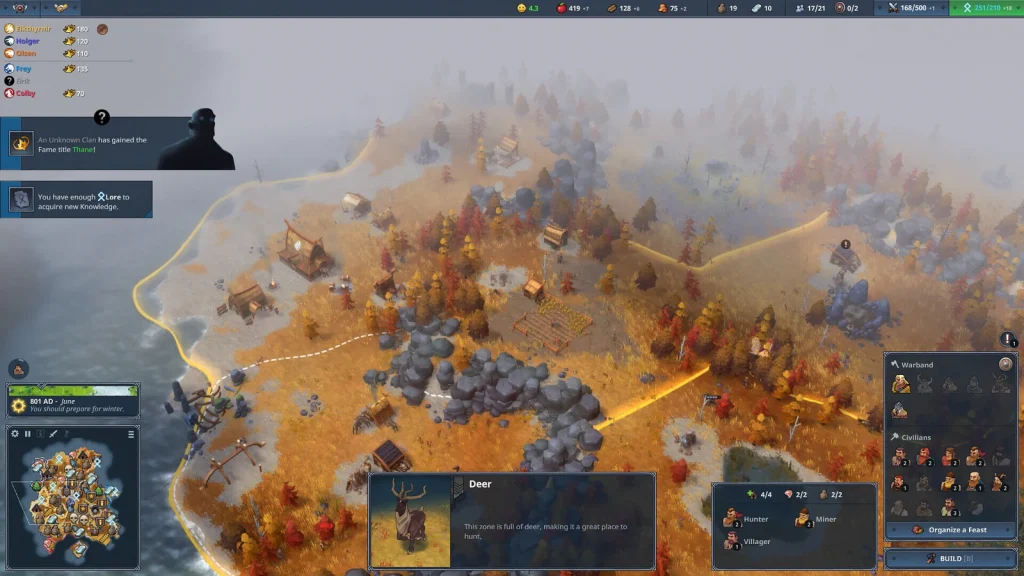
TL;DR: Northgard is a good fit if you want a real-time strategy game where a small settlement, winter preparation and territory choices matter as much as the army. Choose it for clan variety, solo challenges and cooperative Conquest. Expect recurring resource management, fights that require attention and a learning curve when a special clan changes the ordinary economy.
This Northgard review recommends the game to players who enjoy turning a modest workforce into a functioning economy under pressure. It is less suitable if your main goal is building a permanent decorative town or commanding enormous historical armies. The recommendation is based on the documented PC game and official updates; it is not a firsthand playtest, a performance benchmark or a ranked multiplayer assessment.

On this page
Northgard review: what you actually spend time doing
Northgard combines settlement jobs with territorial expansion and real-time fighting. The useful decision is often which project your workers and reserves can support next, rather than how many buildings you can place at once.
The official Steam description explains the central loop: assign Vikings to jobs, manage supplies through harsh winters, expand strategically and pursue different victory routes. Those goals compete for the same economy. Scouts reveal opportunities, food supports the settlement, wood enables construction and military recruitment takes workers away from their previous jobs.
Consider an ordinary clan that discovers deer behind hostile wildlife. That attractive zone is a sequence of commitments: reveal it, clear the defenders, afford the claim, construct the appropriate building and staff it. The food benefit arrives after the whole sequence. Claiming several zones without funding those follow-up jobs produces a larger border, but not necessarily a stronger settlement.
That is the game’s main attraction for an economy-minded RTS player. The map offers concrete choices with consequences you can inspect. It is also the reason a player looking for unrestricted city construction can find the game restrictive. Available land, resource jobs and the threat on the border shape the settlement more than an aesthetic street plan.
Winter makes preparation part of the strategy
The seasonal pressure gives ordinary economic decisions a deadline. A reserve that looks comfortable during productive conditions should be judged against the coming winter and your next spending commitment.
Before recruiting a larger army, inspect which civilians will leave food or wood work. Before claiming an optional zone, compare its cost with what must remain for the existing population. The decision becomes interesting because several attractive projects can be affordable individually while being unaffordable together.
This suits players who enjoy recovering from a bad plan. A warning on the resource bar is useful information: stop the optional commitment, return workers to essential production, and finish one useful source before beginning another. The recovery can preserve the match without requiring a perfectly memorized opening.
The drawback is repeated attention to the basics. After a fight, conversion or expansion, worker allocation matters again. If that feels like unwanted administration between battles, Northgard’s economy is likely to frustrate you. It is a central source of decisions, not a short introductory phase that disappears once the army exists.
Territory creates useful choices and visible constraints
The zone system makes expansion easy to read. You can see a resource, a route or a hostile border and ask what owning it would let you do. The limitations also mean your preferred plan cannot ignore the map.
A food zone can stabilize growth. A mineral zone can support a planned upgrade. A route toward an opponent can enable pressure while adding another exposed edge. These are different reasons to expand, and the strongest choice depends on the next objective.
New players should separate access from output. Owning a useful resource does not remove the need for construction and staff. Similarly, reaching the enemy does not make the army healthy or the food balance sustainable. The map gives the opportunity; the settlement must finish the project.
The tradeoff is less freedom to solve everything through placement. You work with the territories and resources the map supplies. Players who like adapting to those constraints will find a clear strategic puzzle. Players who want to choose any building site and develop one endless city should look more closely at a dedicated town builder.
Clans give the economy more than a new appearance
Clan variety is a strong reason to choose Northgard, but it also changes the amount you need to learn. The official description presents clans with different bonuses and features, introducing different methods of play and victory.
Start with one clan long enough to understand its ordinary jobs, early priorities and useful military preparation. When you change clans, read what actually replaces that framework. A special resource, recruitment system or worker rule can make a familiar instruction inappropriate.
The released Winds of Fate notes from April 2025 are a concrete example. Alongside changes to the ordinary military units, they describe a separate Dragon military path and changes to its thralls and knowledge. Learning the generic economy helps, but it does not substitute for those clan rules.
For replay value, this is useful: a different clan can change the question you solve with the same resource and territory framework. For accessibility, there is a cost. An older guide or a friend’s opening can assume systems your chosen clan does not use. Check the current in-game description before investing in that plan.

Combat asks for preparation and control
Northgard’s army should be evaluated as a funded, supported force. Unit choice matters, but so do health, positioning and what the economy can sustain after conversion.
The April 2025 released update explicitly strengthened the basic military relationship: Shield Bearers counter Axe Throwers, Axe Throwers counter Warriors, and Warriors counter Shield Bearers in the stated one-against-one comparison. The same update changed military upgrades, forges and recruitment costs. That supports an army-composition decision rather than the assumption that one ordinary unit answers every opponent.
It does not support treating the triangle as a guaranteed result for a whole battle. A damaged force, exposed ranged units or a fight near defensive support can change the engagement. Scout enough to understand the target, prepare the relevant unit tools, and decide when the objective has been achieved.
The main drawback for a quiet settlement player is that fighting competes with economic attention. Recruitment changes the workforce and losses create a recovery task. If you want the military to be an occasional spectacle while the town runs itself, Northgard asks for more involvement than that.
Conquest gives solo and cooperative players a clear reason to return
Conquest is the most useful mode to examine if you want repeated settlement challenges without making ranked multiplayer your main activity. It offers a sequence of separate battles with special rules and selectable favors.
The official Conquest introduction describes solo and cooperative play, a map of challenges, clan-specific battles and other battles drawn from a pool. Favors support the run, while each challenge has its own victory conditions and rules.
That structure gives a practical kind of variety. Instead of asking only whether a general build order is efficient, you read the battle and decide which jobs matter for its objective. The historical introduction gives examples such as hunting Wyverns and racing to Yggdrasil. Later released notes added scenarios such as No Cost, No Mercy, where recruitment being free comes with a different food problem.
Cooperation is also concrete. Two players can agree who clears a route, who develops the necessary production and when the combined force is ready. The benefit is a shared planning problem, not simply another player standing nearby.
Special rules are the drawback as well as the appeal. A favor or scenario can make ordinary advice misleading, so read the current battle text. This review does not claim a fixed campaign length or that every run includes the same challenges.
Story and multiplayer serve different goals
The story mode supplies a narrative route through Northgard, while multiplayer makes the opponent and coordination part of the problem. Pick the mode that matches the experience you actually want to repeat.
The official description identifies Rig’s story and the Cross of Vidar continuation. Those are relevant if you want a directed sequence and characters rather than only independent maps. This review does not treat the campaign as proof that every clan and competitive situation will be taught in depth.
For multiplayer, the attraction is adapting the economy to another player’s pressure and objective. In a team format, communicating the first clear or military move can be as useful as refining your own worker order. The April 2025 patch changed ranked clan selection by format, which is another reason to check current lobby rules.
No current queue-time, connection-quality or matchmaking claim is made here. If ranked play is your main purchase reason, examine the current format, recent official updates and the experience of players in your region before buying. Documented mode support is different from evidence of today’s population or latency.
Who should buy Northgard?
| Your priority | Fit | Reason |
|---|---|---|
| Small-settlement resource decisions | Strong | Jobs, reserves and expansion remain central |
| Repeated solo or co-op challenges | Strong | Conquest changes objectives and run bonuses |
| Learning several asymmetric factions | Strong if you enjoy reading clan rules | Distinct features can change the ordinary plan |
| Permanent decorative city | Limited | Territory and match objectives guide development |
| Large historical armies as the main focus | Consider another RTS | Northgard emphasizes a settlement and clan economy |
Before purchasing, check the current Steam package and the content included with it. A large clan catalogue does not establish that every clan or story expansion belongs to the base package. Current price, discounts and hardware results are outside the evidence used for this review.
If the resource-and-territory loop sounds appealing, use the Northgard guides hub to examine the actual decisions before committing. Start with a mode and clan you want to learn, then evaluate the next clan only after the first economy makes sense.
FAQ
Is Northgard mainly a city builder?
It includes settlement development, but its economy supports territorial competition and victory objectives. Choose a dedicated town builder if an enduring decorative city is your main goal.
Can I play Northgard without ranked multiplayer?
Yes. The official PC description includes story, Conquest solo and co-op, and other multiplayer options. Ranked play is one route rather than a requirement.
Does Northgard need a high number of actions per minute?
This review makes no tested input-speed claim. The decisions described here include job allocation, reserves and military control, so you still need to monitor the settlement and active fights.
Does a favorable unit counter guarantee a win?
No. The released ordinary-unit relationship is a starting point. Health, force size, positioning and support affect the actual battle.
Sources and further reading
Keep exploring
Northgard vs Manor Lords: clan objectives or settlement planning?
Choose Northgard for clan-specific strategy and explicit victory routes; choose Manor Lords for the placement, households and production of a medieval settlement.
Games Like Northgard: 4 Picks by Strategy Style
Games like Northgard: compare Banished, Against the Storm, Age of Empires IV and They Are Billions by economy, challenge structure and combat.
Northgard Neutral Faction Relations: 7 Essential Decisions
Northgard neutral faction relations: compare friendship with clearing, keep trade affordable and verify faction rewards, influence and scenario needs.