TL;DR: This Total War Shogun 2 review recommends the base Sengoku campaign for players who want a focused Japanese setting, readable army roles, and battles shaped by position, morale, and reserves. Its drawbacks are the shared core roster across clans and a late campaign that demands preparation for wider hostility. Choose it for battlefield decisions and regional conquest; choose a different strategy game if you mainly want extensive dynasty simulation or radically different faction armies.
Shogun 2’s strongest fit is a player who likes learning a compact tactical language and applying it across an entire campaign. Spears hold a direction, missiles need protection, cavalry needs an opening, and generals support morale. Those relationships give a basic army meaningful decisions before elite recruitment becomes available.

This is an assessment of documented game systems, rather than a claimed recent playtest or hardware benchmark. The official Feral manual supports the campaign and battle features discussed below. Performance, current multiplayer activity, and specific store packages require separate checks for your setup.
On this page
Total War Shogun 2 review: the central appeal
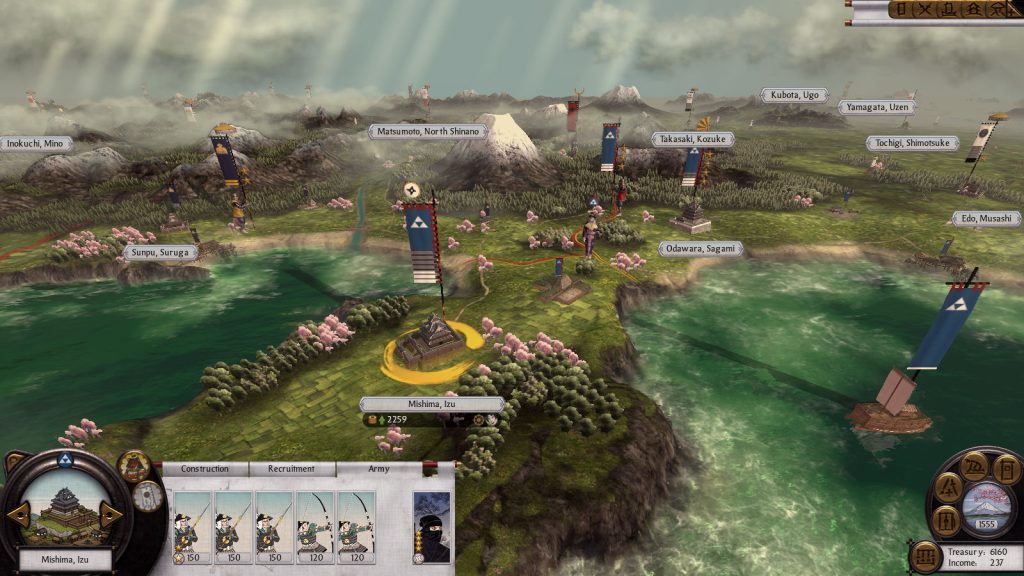
The appeal is the connection between a concentrated campaign map and battles you directly command. You manage provinces, recruitment, construction, agents, diplomacy, and research on the campaign layer, then decide how an army fights when armies meet.
That connection gives conquest a practical cost. Recruiting a stronger force is not enough if you cannot support its upkeep, replace losses, and defend the provinces behind it. A battle victory can open the next province, but an expensive victory can also leave the army unable to capitalize on it.
The Japanese setting keeps the strategic problem focused. Instead of constantly learning unrelated civilizations, you become familiar with recurring battlefield roles and the geography of a campaign directed toward the shogunate. This is useful for players who enjoy improving their execution across repeated situations.
The same focus limits variety. If your favorite part of a strategy game is discovering dramatically different faction mechanics and exotic rosters, the common Sengoku foundation can feel restrictive. Clan specialties and starting positions matter, but they do not turn every campaign into an entirely different genre of army management.
Battles reward a plan before they reward expensive troops
The manual emphasizes morale, the general’s influence, terrain, weather, and unit abilities. These systems support battles where deployment and timing matter. An army can lose coherence even while several formations still contain soldiers.
Consider a simple hypothetical engagement: your infantry holds the center, archers occupy a clear firing position, and cavalry waits outside the first clash. If you send the cavalry straight into prepared spears, the expensive unit is doing the wrong job. If you protect the flank and use that cavalry against an exposed missile unit or an engaged enemy’s rear, the same army has a more coherent plan.
Yari Ashigaru illustrates why ordinary units deserve attention. Their documented Yari Wall is directional and has vulnerabilities; it is not a universal answer to every attack. A player who understands facing and protection can get useful service from a basic formation, while careless placement can leave it exposed.
For more detail, the published Ashigaru Yari Wall guide explains that specific tactical job. The review implication is that early battles can teach skills you continue using later, instead of serving only as a waiting room for stronger units.
The general creates useful risk and responsibility
A general is valuable because he supports nearby morale and can help broken troops rally, according to the manual. His death damages the army’s morale. This creates a reason to position him actively without treating him as disposable frontline cavalry.
The decision is often about where his support matters most. Does the center need help holding? Can he remain safe while supporting a decisive flank? Is pursuing a fleeing unit worth leaving the main fight unsupported? These questions add a layer beyond ordering every unit forward.
There is also a campaign cost. The manual warns against risking the last members of the ruling family and explains honor, loyalty, and succession concerns. A commander can be a useful battlefield unit and an important political character at the same time.
This suits players who enjoy consequences attached to command decisions. It can frustrate players who want spectacular character charges with little concern for what happens afterward. Shogun 2 asks you to protect leadership as well as win the immediate engagement.

Province development asks for restraint
Castle towns provide building capacity, but upgrading them increases food demand. The manual specifically tells players to improve farms alongside castle expansion. This gives construction a tradeoff beyond simply spending whatever is in the treasury.
A useful campaign question is whether a province needs another castle upgrade now, or whether its existing capacity already performs its intended role. A recruiting center, a rich interior province, and an exposed border settlement do not need identical construction priorities.
The arts system adds another decision: research supports buildings, units, abilities, and broader clan development, but you cannot pursue everything simultaneously. A military unlock can help the next campaign, while economic improvement can support a larger force over time.
The advantage is a clear relationship between development and warfare. The drawback is that a player looking for a very elaborate city-management simulation may find the province layer too constrained. Its main purpose is to support the conquest campaign, not to become a separate industrial planning game.
Clan choice changes the opening more than the fundamentals
Pick a clan according to the opening you want to learn. A different starting region changes immediate enemies, expansion routes, defensive needs, and access to useful provinces. Clan strengths influence which units or strategies deserve early investment.
The published Oda opening guide and Shimazu opening guide provide concrete examples of how that starting problem can differ. They are better preparation than assuming one build order fits every clan.
However, much of the tactical knowledge transfers. Holding a flank, protecting missiles, preserving a reserve, and avoiding unnecessary fatigue remain useful across the core roster. This makes a second campaign easier to understand, but can also make later campaigns feel familiar sooner than in a game built around sharply different civilizations.
If you enjoy refining an opening and becoming better at the same rules, that familiarity is a strength. If you want each faction to overturn what you learned previously, it is a reason to compare alternatives before buying.
Realm Divide changes what a successful campaign needs
Realm Divide is a preparation test for expansion. The documented base-campaign system links rising clan fame and success with broader hostility. Do not plan a campaign around one supposedly universal province count or assume old alliances will remain dependable indefinitely.
This gives the campaign a strategic turn: growing successfully is not the same as being ready for the political consequences of that growth. A large army funded by vulnerable trade and weak internal income can be less sustainable than a smaller force backed by a secure economy.
The published Realm Divide preparation guide covers the practical response. For a review, the important point is fit: players who like preparing for a major late-game shift may appreciate the structure; players who want diplomacy to remain their primary long-term solution may find it limiting.
The system also encourages a useful pause before another conquest. Stabilize income, recruit where replacements are available, and decide which borders you can actually defend. The campaign rewards planning the next phase rather than measuring progress only in newly colored provinces.

Sieges have a different tactical problem from field battles
The manual describes Japanese castle layouts as defensible interiors with climbable walls and successive fighting areas. Attackers can capture towers and open gates, while upgraded castles produce more complex battlefield layouts.
This changes the value of units and routes. A cavalry-heavy field army may not be the ideal tool for fighting through confined defensive positions. Missile access, entry points, the condition of the attacking infantry, and the defender’s internal line matter.
Agents can affect the approach too: the manual describes a successful ninja sabotage action opening gates. That possibility creates another preparation tool, but should not be treated as guaranteed access in every siege.
The appeal is that a siege asks for a new plan instead of a simple repeat of the field deployment. The limitation is that players who dislike constrained assaults still need to account for settlement fighting in a conquest campaign. A strong open-field record does not eliminate that part of the game.
Keep the base game separate from Fall of the Samurai
The base Sengoku campaign should be assessed on its own unit relationships and campaign structure. Fall of the Samurai introduces a nineteenth-century setting and a different military and political context. Interest in rifle lines and modernizing armies does not automatically make the base campaign the right choice.
Before choosing a store package, decide which experience you actually want. Are you looking for samurai and ashigaru tactics in the base campaign, or the older-versus-modern warfare of Fall of the Samurai? Read the included campaign names rather than relying on a franchise label alone.
This review does not quote a current price or guarantee that every bundle includes the same content. Package contents can change, and the decision is more useful when you understand the desired campaign first.
A sensible first-session plan
Begin with the tutorial or a manageable campaign setting, then focus on a small set of goals. Learn to inspect unit roles, keep the general safe, preserve a reserve, and read the food consequences of construction. You do not need to master every agent interaction before fighting your first meaningful battle.
Use the published Shogun 2 beginner guide for the broader opening checklist. After a battle, examine where the line broke and what you committed too early. An expensive loss is more useful when you can identify the decision that caused it.
Do not use a current multiplayer population or an assumed hardware result as the basis for this recommendation. If those determine your purchase, verify them separately. The documented single-player systems provide a clear fit assessment without inventing a recent test session.
FAQ
Is Shogun 2 a good first Total War game?
It is a reasonable fit if you want a focused setting and recurring battlefield roles. You still need to learn campaign resources, morale, and deployment. Start with a manageable difficulty and the tutorial rather than expecting the compact roster to make every battle easy.
Is every clan effectively the same?
No. Starting position and clan strengths change the opening. The shared core roster makes much tactical knowledge transferable, which can help learning while limiting the degree of faction variety.
Does this review cover current performance?
No. It assesses documented systems and player fit. Hardware performance, operating-system support, and online services need current checks for your machine and intended mode.
Who should choose another game?
Choose another strategy game if your priority is extensive dynasty simulation, very different armies for every faction, or a modern firearms campaign. Choose the base Shogun 2 campaign when its focused Sengoku setting and tactical army management match what you want to play.
Sources and further reading
Keep exploring
Total War Shogun 2 Naval Bombardment: check the campaign first
The queried coastal bombardment and land-battle naval support belong to Fall of the Samurai, rather than base SHOGUN 2 naval combat.

Total War Attila vs Total War Shogun 2: survive or reunite?
ATTILA offers late-antique survival and destructive warfare; SHOGUN 2 centers a clan campaign on reunifying Japan.
Total War Rome 2 vs Total War Shogun 2: empire or clan?
ROME II suits classical empire building; SHOGUN 2 suits a focused Japanese clan campaign with growing generals and agents.