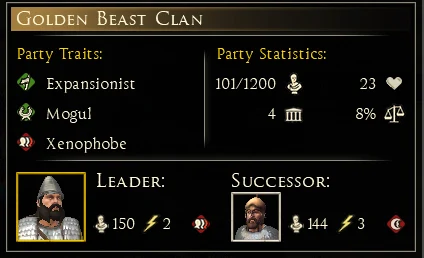
TL;DR: Total War Rome 2 political parties require two separate decisions: build the influence of your ruling group and keep rival parties loyal enough to avoid a political crisis. In the Power & Politics system, influence is not a substitute for loyalty. A powerful ruling family can still face a disloyal rival.
Use party traits and loyalty modifiers to identify the problem, then choose promotions, statesmen missions or temporary Secure Loyalty support for that specific cause. Before giving a rival an important army, consider both the commander’s military value and the party’s political condition.

Sources and version: This guide uses the dated Power & Politics community guide, the later family-politics guide, and Creative Assembly’s official update announcements. Reviewed November 9, 2026. The older influence-balancing civil-war explanation does not describe the loyalty system used here. Numerical effects and available actions can differ with faction, campaign and mods.
On this page
Total War Rome 2 political parties: separate the four systems
The faction overview brings together several related measures. They answer different questions, so reducing them to one political score creates poor decisions. A general’s battle experience, personal gravitas, party influence and party loyalty are not interchangeable resources.
Influence describes a party’s share of political power. Gravitas belongs to individual characters and contributes to political standing. Ambition affects the importance of gravitas to influence. Loyalty describes how supportive a rival political party is of the existing government, with associated risk displayed separately.
The sources disagree about the precise influence contribution of some family roles. This guide therefore does not give a universal arithmetic formula for spouses, statesmen and commanders. The useful management distinction survives that uncertainty: stronger personal standing does not automatically remove a rival party’s negative loyalty modifiers.
| Measure | Question it answers | Practical use |
|---|---|---|
| Influence | How much political power does the party hold? | Evaluate ruling-party development and government benefits |
| Gravitas | How much standing does a character have? | Assess political growth and action costs |
| Ambition | How strongly does personal standing matter politically? | Compare long-term character development |
| Loyalty | How supportive is this rival party? | Identify political instability and corrective actions |
| Military experience | What command skills has the character earned? | Select leadership for the actual battlefield task |
1. Identify parties before appointing commanders
Start with the party list, its leaders and their traits. Then connect those parties to the characters available for military and political work. This prevents appointing a capable commander without noticing that the army will be led by a member of a deteriorating rival group.
Party affiliation is not a measure of a commander’s tactical competence. A rival general can be valuable, while an inexperienced ruling-family member can be a poor replacement for a dangerous front. The appointment is a tradeoff rather than an automatic instruction to remove every rival from service.
Distinguish candidates, existing statesmen and active commanders. Recruiting someone into the political system changes the character pool; replacing an army leader changes who receives opportunities on that front. Keep both the political effect and the military capability in view when making either choice.
Keep a succession plan for important armies
A powerful older general can contribute command skills and political standing, but relying on one character creates a vulnerable transition. Develop another suitable commander before death or replacement forces a rushed appointment. Choose a quieter operation for development when an inexperienced leader would endanger the main invasion.
This is especially relevant when a single army carries most of the campaign’s offensive capability. Political convenience is a weak reason to remove its skilled commander immediately before a difficult assault. Prepare the replacement and the army’s next task together.
2. Read the loyalty breakdown rather than the party color
The loyalty breakdown identifies why a party supports or resents your government. The documented contributing factors include party traits, government type, difficulty, imperium and political actions or events. A red-looking party is a warning to investigate, not an explanation by itself.
Separate persistent conditions from effects with an expiry. A temporary penalty after a promotion needs a different response from a party trait that repeatedly conflicts with your expansion policy. Paying for support can cover the first situation while leaving the second unresolved.
Do not treat every unfavorable trait as an instruction to reverse the entire campaign. Compare the strategic value of the planned war with the cost of managing the party’s reaction. Sometimes delaying a diplomatic move is economical; sometimes a worthwhile conquest justifies budgeting more political support.
Understand what changes after expansion
Imperium is part of the political environment as the faction grows. Early campaign stability should not be assumed to persist after major expansion. Reassess party modifiers before starting another distant commitment, particularly when several armies already depend on long supply and reinforcement routes.
That reassessment is useful even if the loyalty number currently looks healthy. It reveals whether support depends on a temporary bonus, a particular leader or a favorable condition that is about to change. The next decision should account for that dependence.
3. Match statesmen missions to a useful job
The Power & Politics guide documents missions including Diplomat, Administrator and Organise Feast. These give inactive political characters work outside an army or fleet. Their targets differ: diplomacy, public order and food support are distinct needs.
Sending a rival statesman on a suitable mission can help that party’s loyalty. This provides a way to support a rival without automatically handing it your strongest army. It is most useful when the mission also addresses a genuine campaign problem instead of purchasing a redundant effect.
For example, a diplomat can be considered when relations with a neighboring faction matter to a planned agreement. An administrator belongs in the discussion when an important settlement needs control. A feast-related action should be evaluated against an actual food need and its displayed conditions.
Compare missions with direct financial support
Secure Loyalty is a temporary support tool, while a mission may offer an additional diplomatic or provincial benefit. Compare the cost, duration, eligible character and outcome before choosing. A mission is not automatically better just because it accomplishes two things; the extra effect must be useful now.
Missions can also have outcomes or risks beyond their advertised benefit. Avoid sending an irreplaceable character casually when another eligible statesman would meet the same need. The source describes possible negative diplomatic mission outcomes, so guaranteed success is an inappropriate assumption.

4. Promote characters with political costs in mind
Political career promotion is separate from the military skill points earned through experience. A career can improve a character’s standing and provide office-related effects. The available ranks and requirements depend on the faction and character rather than one universal Roman promotion list.
Promoting ruling-party members can impose loyalty costs on rivals. Promoting an appropriate rival member can improve that party’s support, according to the modern political guide. Read both sides of the transaction: what the character gains and which party relationship changes.
Schedule useful promotions when you can absorb the political effect. Advancing several ruling characters together may create a larger immediate loyalty problem than the campaign can afford. Conversely, withholding every promotion forever sacrifices development without resolving the underlying reason a rival is unhappy.
5. Treat influence growth as a separate objective
Developing ruling-party characters can increase your political position, and the faction interface shows benefits associated with influence. However, this is a long-term development objective. It should not crowd out urgent support for a party whose loyalty has become dangerous.
Hostile actions such as purges, assassinations or forced political changes have consequences. They are not a free method of clearing inconvenient numbers from the screen. This guide does not recommend the deliberate-secession exploits described in some older community advice.
A balanced plan does not require equal influence among every party. It requires recognizing when pursuing more ruling-party power creates a loyalty cost that matters more than the next incremental benefit. The appropriate decision depends on the current modifiers and military commitments.
6. Connect party support to territorial exposure
The political party affiliation layer shows the rival groups’ territorial power bases. Use it alongside the commander list to understand exposure. A party with a small influence share can still matter if its territory occupies an important route, port or recruitment area.
Do not assume that garrison strength, public order or cultural happiness is the same as party loyalty. Those provincial systems need their own solutions. Building a happier settlement does not necessarily remove a faction-wide political grievance caused by an intrigue or government condition.
For routine management, keep enough flexibility to respond without abandoning every external front. A nearby reserve or a less ambitious invasion schedule can make political stabilization affordable. The goal is a manageable faction, not simply an attractive influence percentage.
Example: choose between a promotion and a rival mission
Assume a ruling-party commander is eligible for a useful promotion, while a rival party has weak loyalty and a temporary penalty approaching expiry. Also assume that one border settlement needs public-order support. These are illustrative conditions, not a reported campaign result.
Promoting the ruling commander immediately may improve personal development while worsening the rival relationship. A suitable rival administrator mission could instead address the settlement problem and help support its party. Temporary Secure Loyalty is another option if the available mission does not fit the urgent situation.
The sensible sequence is to stabilize the rival, allow the identified penalty to expire, and then reconsider the promotion. That sequence does not promise permanent safety. It prevents an optional development action from making an already difficult political turn more expensive.
Frequently asked questions
Is high influence enough to stop political trouble?
No. Influence and loyalty answer different questions in the Power & Politics system. A dominant ruling family still needs to manage rival support. Judge instability from the relevant loyalty and risk indicators rather than using a universal influence target.
Should every army use my own family?
Not automatically. Party affiliation matters, but so do command skills and the army’s next mission. Replacing a skilled rival before a difficult battle can create a military problem. Develop suitable alternatives and consider the party’s actual condition.
Does Secure Loyalty permanently fix a party?
It supplies temporary support. Identify what happens when that support expires and whether the original negative modifier remains. Repeated payment can be justified in some circumstances, but it should be a deliberate budget decision.
Do old Rome II politics guides still apply?
Some character-development concepts remain useful, but the legacy influence-balance civil-war model should not be treated as the modern loyalty system. Match advice to the Power & Politics update, later family-tree changes and any active overhaul mod.
Sources and further reading
- https://steamstore-a.akamaihd.net/news/externalpost/steam_community_announcements/2143012757607640915
- https://steamcommunity.com/sharedfiles/filedetails/?id=1237207803
- https://steamcommunity.com/sharedfiles/filedetails/?id=1703689218
- https://steamstore-a.akamaihd.net/news/externalpost/steam_community_announcements/2454911758737041344
Keep exploring
Total War Rome 2 Diplomatic Expansion: protect your next conquest
Use diplomacy to support an expansion plan through reputation, understood treaty obligations and bounded allied war coordination.
Total War Rome 2 vs Total War Three Kingdoms: territory or characters?
Choose ROME II for classical civilizations and empire development; choose THREE KINGDOMS for Chinese warlords and relationships that connect statecraft with battle.

Total War Rome 2 vs Total War Attila: build an empire or survive?
Choose ROME II for classical empire growth; choose ATTILA for late-antique survival, a vulnerable Western Roman Empire and destruction mechanics.