TL;DR: Total War Attila fertility and food planning needs two calculations: what a province produces now and what its food base can produce after conditions worsen. Creative Assembly distinguishes flat food output from production that depends on soil fertility. Read the actual building branch before deciding which kind supports the province.
Keep local deficits separate from the national food total, include queued consumption, and preserve a margin for climate and seasonal change. Temporary fertility damage after razing is also different from the campaign’s broader climate decline.

Sources and scope: Creative Assembly’s fertility blog explains production types and the changing climate. The PC manual covers fertility damage from razing and abandonment. Dated economy and building guides support the provincial decisions. Reviewed November 9, 2026. Building values and climate timing depend on the current campaign; all budget figures below are illustrative rather than asserted game statistics.
On this page
Total War Attila fertility and food: identify the dependence
The official explanation divides food buildings into those with flat output and those whose production benefits from fertility. That difference matters as the land’s arable condition declines. A large current output can conceal how much the province relies on favorable soil.
Read the actual branch’s contribution and modifiers. Do not assume that every farm is identical or that every livestock option is completely independent of fertility. The building’s current effects, rather than the category name, establish the production plan.
Compare food with the province’s other needs. Agricultural branches can differ in income and recruitment support as well as output. A smaller reliable food contribution may serve one area well, while a fertility-sensitive branch can be useful in another under the present conditions.
1. Calculate local balance before relying on the national total
The dated economy guide distinguishes provincial food balance from the wider faction pool. A province with a local shortage can have penalties even while the national total is positive. A national surplus does not automatically mean every taxed province is functioning without food-related trouble.
Identify which area has the deficit and the consumption causing it. Settlement upgrades and other buildings can increase demand. More output in a distant province may improve the faction total while leaving the local issue relevant to control or income.
Separate a structural deficit from a short-term change. A queued upgrade that permanently adds consumption needs support. A seasonal reduction may require a margin or temporary response. The useful remedy depends on the cause, not just the color of the national food indicator.
Include the next construction queue
Count the food effect of all planned changes together. Two modest upgrades can create a larger combined demand than the province’s current surplus. Evaluate the final state before starting the work rather than fixing each completion independently afterward.
In an illustrative example, assume current production is 100 and demand is 90. Two upgrades add 10 consumption each. The final demand of 110 exceeds the current output even without climate decline. Postpone a consumer or add suitable production before treating the province as ready for development.
2. Stress-test fertility-dependent output
Compare the province under a less favorable production condition. You do not need an invented universal formula to see the risk. Identify which part of the food supply is sensitive to soil and compare the margin if that contribution falls.
For example, assume one branch currently supplies 80 food but would provide only 50 under a less favorable condition, while another supplies 40. With demand of 110, the current 120 output gives a margin of ten; the lower 90 output creates a deficit of twenty. These are hypothetical values illustrating the decision.
The response can be another production branch, reduced consumption or a delayed upgrade. Choose the option that fits the province’s long-term role. Replacing all development with one flat-output recipe is not automatically necessary or optimal.
Avoid comparing output in different conditions
A branch shown in a fertile province and another shown in damaged or poorer land are not a clean comparison. Compare the same relevant conditions and the complete effects. Otherwise, a location advantage can be mistaken for a universal building advantage.
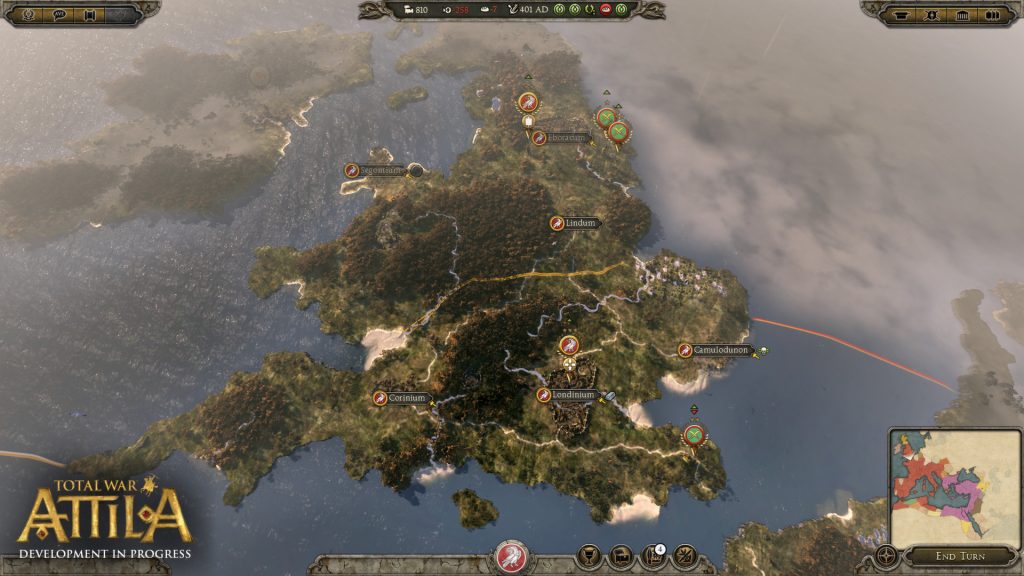
Use the campaign’s fertility information to identify the dependence. Creative Assembly specifically mentions a fertility filter on the strategic map. That provides a useful overview when deciding which regions should supply the wider state.
3. Distinguish climate decline from local destruction
The official manual says razing and abandonment reduce a region’s fertility, with time needed to remedy that damage. That is a consequence of destroying the settlement. It should not be treated as the same process as the wider climate change described in the design blog.
A desolate region can therefore have both a local recovery problem and a less favorable future climate. Rebuilding the city does not justify assuming that every former yield immediately returns. Compare the current land condition and the support needed before it becomes useful again.
This matters when selecting a destination or reclaiming territory. An empty location may be accessible, but food, rebuilding and defense costs can make it less attractive than the map suggests. Fertility is part of the resettlement calculation, not an afterthought.
Do not assume every shortage heals with waiting
If the problem is temporary destruction, recovery over time can be relevant. If the province’s old plan depends on a declining climate condition, simply waiting is not the same solution. Identify the cause before deciding whether the existing food base will become adequate again.
Plan production for the state you intend to maintain. A short occupation and a long-term food province can justify different investments. The complete campaign role should determine how much support the location receives.

4. Plan for changing winter pressure
Creative Assembly explains that winter can become harsher and longer as the campaign progresses, especially in exposed northern areas. Do not treat a fixed early-season sequence as a universal calendar guarantee across the entire campaign.
Keep food support ahead of the vulnerable period where possible. A construction plan that reaches exact balance only in the current favorable turn can become fragile when conditions change. Leave enough time for another investment rather than requiring an instant correction after the deficit appears.
The climate also affects military support. The official explanation links less fertile land with slower army replenishment and the consequences of poor food support. An offensive route through weak production may therefore create a recovery constraint as well as a provincial one.
Choose recovery locations before extending a march
If the army must spend several turns near the new front, identify the area supporting it. Consider food and the current climate alongside sanitation and stance. A nominally friendly province is not a complete guarantee that the army can recover usefully there.
A shorter operation can be more sustainable when the supply base is not ready. The food investment may enable the later advance without requiring the force to remain under-strength or consume the entire recruitment reserve.
5. Use consumption changes as a legitimate option
More production is not the only way to improve balance. An optional settlement upgrade or another consuming branch can be delayed, converted or reconsidered where the actual game options permit. Compare the function you lose with the food support you save.
The building guide describes tradeoffs among food, control, income and recruitment. A public-order consumer can help one cause while worsening a food-related penalty. Read the combined result rather than assuming any happiness effect makes the upgrade beneficial.
Keep the province’s role in view. A recruitment center may justify a support burden that an ordinary income region does not. A province expected to supply others should protect its production before adding unrelated consumers.
| Observed problem | Useful comparison | Weak assumption to avoid |
|---|---|---|
| Local shortage with national surplus | Local consumption and production | The national total removes every local penalty |
| Output falls with fertility | Flat support or lower demand | Current high yield remains permanent |
| Recently razed region | Recovery and rebuilding requirements | Resettlement instantly restores old production |
| Approaching climate pressure | Margin and construction timing | The early calendar never changes |
| Expensive consuming upgrade | The actual function and support cost | Higher tier is automatically better |
6. Treat tax exemption as a targeted tradeoff
The dated settlement guide describes tax exemption as changing a province’s participation in the national food system and removing its income contribution. Consider the current displayed effect before using it. A food problem can become more manageable locally while the wider faction loses useful output or revenue.
Compare a small troubled province with a major food producer. Exempting the latter may change the national balance more severely. Do not treat the option as free immunity for every deficit, and do not assume its exact effect remains identical in an overhaul mod.
Use the time gained to address the structural cause when necessary. Production, consumption or the province’s role may still need revision. An emergency response is useful when it produces a viable next step rather than hiding an unresolved obligation indefinitely.
Example: a northern province prepares an upgrade
Assume a province has a narrow surplus, relies heavily on fertility-sensitive output and plans another consuming upgrade. The next operation also needs it as a recovery base. These are illustrative conditions, not a reported campaign result.
Compare output under weaker conditions before beginning the consumer. A suitable additional food branch or delayed upgrade may preserve the province’s support. If the food plan remains inadequate, shorten the army’s operation until a better recovery location is available.
The investment should solve the combined constraint: local function and military support. Choosing only by current yield or only by the upgrade’s headline benefit can miss how the province must operate over several turns.
Frequently asked questions
Are flat food buildings always better?
They offer a different dependence on soil, but the full branch can have other tradeoffs. Compare food, income, recruitment and the province’s role. There is no universal recipe justified by the production type alone.
Will fertility return after every decline?
The manual describes recovery from razing-related damage over time. The wider climate change is a separate process. Diagnose which one affects the province before assuming waiting restores the old food plan.
Why should food matter to an army route?
The official explanation links fertility and food conditions with replenishment and force condition. A route needs a viable support area, not merely access to friendly territory. Plan the province and the military operation together.
Sources and further reading
Keep exploring

Total War Warhammer 3 vs Total War Attila: fantasy or survival?
Choose WARHAMMER III for fantasy races and Legendary Lords; choose ATTILA for late-antique survival, vulnerable territory and destructive warfare.

Total War Rome 2 vs Total War Attila: build an empire or survive?
Choose ROME II for classical empire growth; choose ATTILA for late-antique survival, a vulnerable Western Roman Empire and destruction mechanics.
Total War Attila vs Total War Shogun 2: survive or reunite?
ATTILA offers late-antique survival and destructive warfare; SHOGUN 2 centers a clan campaign on reunifying Japan.