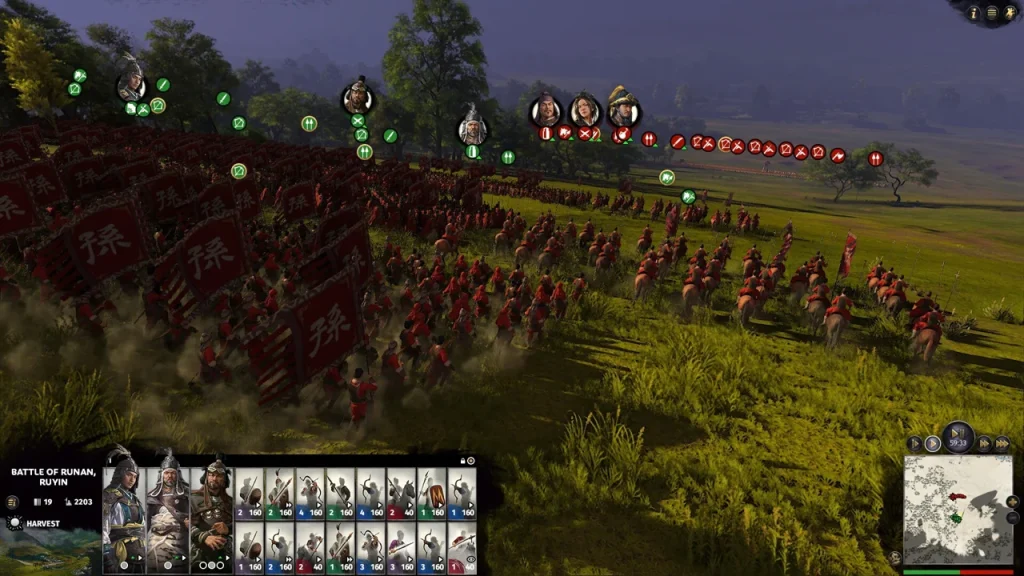
TL;DR: The Total War Three Kingdoms Liu Bei campaign opening in 190 CE begins without territory in Dong commandery. Defeat the nearby Yellow Turban commander Zhao Bo, establish a foothold at Dongping’s iron mine and preserve the army led by Liu Bei, Guan Yu and Zhang Fei. Use Unity deliberately: Han settlement integration is different from conquering Yellow Turban land, and early confederation access does not guarantee acceptance. Secure income and food before deciding whether to intervene for Tao Qian.

Liu Bei has capable companions but no established home economy at this start. Your first objective is a defensible base that supports them. The Liu Bei faction reference distinguishes the landless 190 CE opening from the later Donghai starts. This route follows Rise of the Warlords, with conditional choices rather than a guaranteed sequence of events or allied actions.
On this page
Total War Three Kingdoms Liu Bei campaign opening: build a first base
- Defeat Zhao Bo while preserving the starting army’s useful units and generals.
- Take the nearby Dongping iron-mine foothold and assess the cost of holding it.
- Recover if necessary before challenging a stronger settlement or another enemy army.
- Separate Han integration opportunities from Yellow Turban targets you must fight.
- Match spending to an immediate army, income or food requirement.
- Choose a manageable regional front before taking sides in Tao Qian’s conflict.
The distinction between first foothold and completed commandery matters. The Dong commandery reference places Dongping’s iron mine under the Yellow Turban Rebellion in 190, while Huang Shao holds Puyang. Defeating Zhao Bo is not the same as defeating Huang Shao or automatically owning all of Dong.
1. Win the first battle while keeping the brothers useful
Use the starting army to remove Zhao Bo and establish the first territorial opportunity. Liu Bei’s 190 CE roster includes Guan Yu, Zhang Fei and Jian Yong. That is a documented character roster, not a reason to invent a fixed unit count or assume every general begins with the same retinue in every modded campaign.
Give the force a stable front, protected ranged support and a flanking element. Keep the troops that hold contact from being surrounded while mobile forces attack a weaker position. The aim is to preserve the combination that can fight the next engagement, rather than finish this battle with only the named heroes healthy.
In Romance, Guan Yu and Zhang Fei can make aggressive actions attractive, but a valuable general remains worth protecting. Accept a duel because the matchup serves the battle, not simply because your commander is famous. In Records, maneuver the brothers’ bodyguard units with the same care you give other important troops.
Release captives when the actual post-battle choice provides the Unity benefit you want. The faction reference identifies releases after victories as a way to gain Unity. Balance that benefit against the available alternatives and the enemy’s future threat. The resource is useful, but one reward does not justify leaving your army in a worse strategic position.
If the first fight is costly, recover at the foothold instead of attacking Puyang immediately. Restore the front line or ranged support that took the damage. Buying an additional specialist while the existing army cannot hold contact often creates upkeep without solving the reason the next battle is dangerous.
2. Treat Dongping and Puyang as different decisions
Dongping gives you an iron-producing resource settlement. Puyang is the commandery capital held by Huang Shao in the cited 190 CE setup. Taking the iron mine starts your economy; completing Dong requires a separate military judgment.
The iron mine is not a general-purpose city with unlimited construction choices. Resource settlements have their own development chains. Invest in its actual productive upgrade if the cost fits your next military task. Do not plan a capital building layout in a slot the minor settlement does not offer.
Puyang is attractive because capital and resource production can form a coherent commandery. However, assaulting a defended city with damaged troops can convert a promising foothold into a recovery crisis. Assess the defending army and garrison together. If the assault would leave you exposed to another force, strengthen the foothold first or seek a better field battle.
The alternative is continued regional expansion that the same army can defend. Compare its travel and upkeep costs with the benefit of completing Dong. Avoid collecting distant settlements that create two vulnerable ends of the realm. A second income source helps only if protecting it does not repeatedly pull the army away from the first.

3. Keep Unity working for the opening
Unity connects Liu Bei’s character management to his campaign options. The faction reference describes passive gains from satisfied generals and court members, plus gains from appropriate post-battle releases. Higher Unity tiers grant faction benefits, while spending Unity on integration can reduce the amount retained for those tiers.
Keeping Guan Yu and Zhang Fei productive is therefore part of resource management. Their strong narrative bonds do not mean every future recruit will remain content regardless of office, salary or relationships. Add characters when you have an actual military or administrative role for them, and inspect dissatisfaction before it becomes departure.
Do not hand out promotions without comparing their continuing salary with the benefit. A promotion that solves a valuable character’s dissatisfaction can be worthwhile. Promoting several idle recruits while the first settlement struggles to pay the army can turn a character-management solution into an economic problem.
Before spending Unity, identify what the purchase accomplishes. A nearby Han settlement that completes a useful frontier can be worth the resource. An isolated acquisition that lowers your retained benefits and needs a long defensive march is harder to justify. Integration saves a battle; it does not remove the need to govern and defend what you acquire.
Integrate Han settlements; conquer other owners
Integrate lets Liu Bei bring Han Empire settlements into his faction using Unity. It depends on the settlement belonging to the Han Empire. Dongping’s Yellow Turban owner and Huang Shao’s Puyang are not eligible simply because they are Chinese settlements or lie near your army.
Follow the integration option and its actual requirements at a Han-owned target. Do not declare a separate war or fight a costly assault just to follow a generic conquest script if integration is available and fits your plan. Equally, do not march across several hostile approaches solely to use the mechanic on a remote county.
Unify is a diplomatic opportunity
Unify gives Liu Bei early access to confederation according to the faction reference. Access is not the other ruler’s consent. Compare the proposed terms and strategic consequences with ordinary expansion. Absorbing a faction can bring territory and commitments that exceed what your current economy can comfortably support.
4. Fund the foothold without creating a food problem
Dong’s iron resource supports an industrial direction, but it does not itself solve food supply. Separate the treasury, recurring income and food balance. You can afford a construction payment today and still be unable to sustain the army or a larger city afterward.
The Gamepressure food guide distinguishes food-producing settlements such as farmland and fishing ports from other resources. Use an actual producer, appropriate development or a workable food agreement when demand requires it. Do not assume that every territorial capture adds food.
After taking a capital, match its development to the commandery’s production instead of stacking unrelated percentage bonuses. A boost to industry has a practical foundation when local industrial income exists. A building that primarily adds another income type should be judged on its own cost and contribution, not on the belief that all yellow or purple buildings combine identically.
The Dong reference lists a harbor and manufacturing in Puyang’s 190 CE setup. That gives you existing production to assess if you capture it. Preserve useful income rather than demolishing the whole layout to follow a universal template. Compare repairs and a compatible improvement with a replacement’s cost, lost production and construction delay.
For an illustrative budget, suppose the army leaves 600 income each turn, and a proposed recruit adds 250 upkeep while a character promotion adds another 200 salary. You would retain only 150 before other changes. Those are hypothetical numbers, but the decision is real: the next recruit must make a battle sufficiently safer to justify reducing your development margin.
Keep cash available for damage and replacements. A newly won iron mine may need attention before delivering the income you expected. Building everything immediately leaves little flexibility if another army arrives, the next fight is costly or a food agreement needs renegotiation.
5. Choose your response to Tao Qian’s war
The 190 CE faction reference describes the dilemma created when Cao Cao attacks Tao Qian over Cao Song’s death. Liu Bei can support Tao Qian or continue building his own strength. Treat that as a decision about your current front; do not assume a fixed inheritance date, guaranteed alliance support or a scripted easy victory.
Stay local when the foothold is fragile
Assume Dongping is yours, the army needs recovery and Puyang remains contested. Staying focused on Dong is a reasonable opening. Improve the productive foothold, restore the damaged units and pursue diplomacy that reduces the chance of an additional front.
The drawback is surrendering an opportunity to influence the nearby conflict. Set a recovery goal so caution does not become endless delay. Once your army is functional and the economy supports a march, reconsider whether finishing Dong or helping Tao Qian gives the better position.
Intervene with a defined military purpose
Assume the home base is stable and the army can fight without leaving an exposed settlement behind. Supporting Tao Qian becomes more practical if you can name the enemy army or location your intervention addresses. Entering the war without that purpose can send your strongest force away while Huang Shao or another opponent threatens the original base.
Keep the intervention narrow. Protect an approach, fight a relevant enemy force or capture a defensible objective, then reassess. Your ally’s army is controlled by that faction, so your own plan should still work if it takes a different route or does not reinforce the expected battle.
What should Liu Bei do after the opening?
Turn the first foothold into a region the army can support, keep useful characters satisfied and spend Unity on acquisitions that improve that region. Advance when the next objective offers a better economy or frontier. Liu Bei’s special tools reward coherent growth more reliably than scattered expansion pursued simply because integration is available.
Frequently asked questions
Does Liu Bei start with a city in 190 CE?
No. The cited Rise of the Warlords reference starts him landless in Dong. Later campaign starts give him territory in Donghai.
Is Huang Shao the first army Liu Bei fights?
The faction reference names Zhao Bo as the nearby initial commander. Huang Shao holds Puyang in the Dong commandery reference and is a separate regional opponent.
Can Unity integrate Dongping’s Yellow Turban iron mine?
Han integration requires a Han Empire settlement. A Yellow Turban-owned iron mine is a military target rather than a Han integration opportunity.
Should I spend all my Unity on territory?
No automatic rule fits every opening. Compare the settlement’s position and production with the resource spent and the Unity-tier benefits you would retain.
Sources and further reading
- https://totalwar.fandom.com/wiki/Liu_Bei_(faction)
- https://totalwar.fandom.com/wiki/Dong_commandery
- https://www.gamepressure.com/total-war-three-kingdoms/food/z0c454
- https://www.gamepressure.com/total-war-three-kingdoms/developing-commanderies-districts/zcc450
- https://www.feralinteractive.com/en/manuals/threekingdomstw/latest/linux/
Keep exploring
Total War Three Kingdoms vs Total War Shogun 2: heroes or clans?
THREE KINGDOMS emphasizes heroic characters and Guanxi; SHOGUN 2 puts generals and agents inside a Japanese clan-unification campaign.
Total War Three Kingdoms vs Crusader Kings 3: battles or heirs?
THREE KINGDOMS fits direct tactical battle command; Crusader Kings III fits a ruling house whose playable heirs carry its story forward.

Total War Warhammer 3 vs Total War Three Kingdoms: who should lead?
Pick WARHAMMER III for fantasy race and lord identity; pick THREE KINGDOMS for Chinese empire strategy shaped by heroic characters and relationships.