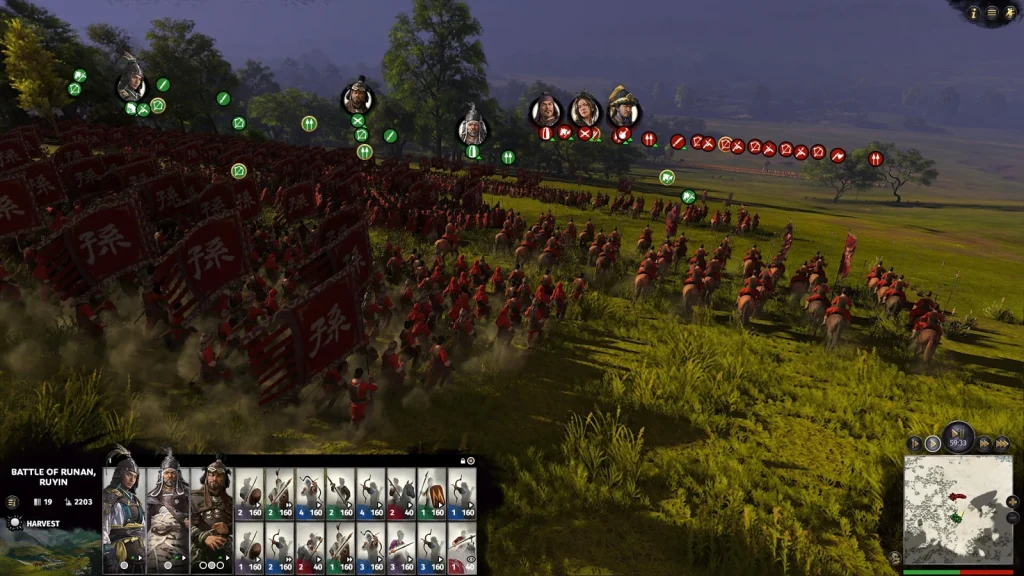
Pick THREE KINGDOMS if personally commanding tactical battles is essential. Pick Crusader Kings III if you want a ruling family’s story to continue through successive heirs. Total War Three Kingdoms vs Crusader Kings 3 compares two games with ambitious characters and political relationships, but the kinds of control they ask you to enjoy are different.
THREE KINGDOMS joins a turn-based empire campaign to real-time battles in ancient China. Crusader Kings III presents medieval grand strategy through a dynasty, with war alongside diplomacy, intrigue and governing. Shared themes of power and betrayal do not make their campaign experiences interchangeable.

On this page
What should you control personally?
THREE KINGDOMS is the natural choice when arranging and directing an army in a real-time battle is a central reason to play. The official description explicitly pairs battlefield command with statecraft and conquest. You are buying both halves of that Total War rhythm, rather than a political campaign that merely mentions armies.
Its heroic characters command armies and govern provinces. Guanxi gives them personalities, motivations and relationships, connecting the military side to a larger character story. For a player who wants memorable leaders but still needs direct tactical battles, that combination supplies a specific reason to choose THREE KINGDOMS.
Crusader Kings III’s official description instead begins with a noble house and a dynasty spanning generations. Choose it when your interest lies in how a ruler’s choices affect the family’s future. Armies matter, but its documented pitch does not supply the separately commanded Total War battlefield that makes THREE KINGDOMS attractive to a tactical player.

A useful leader and a future heir are different investments
In THREE KINGDOMS, recruited heroes help command armies, govern territory and strengthen the empire. Their positive and negative relationships can shape the story, and actions in battle affect those relationships. Prefer this emphasis if you want the people who lead your conquests to be part of both the military and governing decisions you make.
In Crusader Kings III, a ruler’s death leads to new playable heirs as the lineage continues. Character traits and lifestyle choices influence actions and schemes. You can educate an heir yourself or appoint a guardian. These are concrete systems for someone who enjoys preparing the next generation while the current ruler is still active.
The difference matters before you buy. A player who wants to preserve a house across generations has a direct reason to choose CK3. A player who is chiefly interested in leading a particular army should not assume dynastic succession will satisfy that same interest, even though both games involve powerful characters and war.
Political tools change the shape of a setback
CK3’s official description puts war among several ways to establish a reign. Its documented tools include diplomatic skill, granting titles, character influence and schemes involving agents, blackmail or murder. Traits, lifestyle choices and relationships give governing a personal dimension. The appeal is finding opportunities within a political and family situation rather than treating every problem as another tactical battle.
THREE KINGDOMS also features alliances, friendships, treachery and political intrigue. It would be misleading to reduce it to combat alone. The distinction is that these relationships belong to a campaign explicitly paired with direct real-time battles, with heroes linking the two layers. Choose it when you want statecraft to give battlefield victories a human context.
For a preference exercise, imagine a campaign setback. Would you rather reconsider army leadership and the relationships surrounding your next conquest? Or would you rather examine the ruler, heir, titles and political options that keep your house in power? These examples describe the kinds of documented decisions to consider, not a guarantee that a particular event or recovery path will occur.
Match the game to the part you would miss
If removing direct battle command would remove your main reason to play, choose THREE KINGDOMS. Its drawback for a dedicated dynasty enthusiast is that its central advertised attraction is the combination of heroic characters, conquest and battles rather than CK3’s successive playable heirs.
If you would willingly spend an evening shaping a ruler’s relationships and the family’s next generation, choose CK3. Its drawback for a Total War battle fan is the different military experience. Do not buy it expecting character portraits and armies to imply the same tactical control.
Use the THREE KINGDOMS beginner guide if you choose the campaign-and-battle combination. Use the Crusader Kings III beginner guide if dynasty management is the draw. Check current store editions separately; this decision does not depend on claimed prices, DLC counts or measured difficulty.
Sources and further reading
Keep exploring

Crusader Kings 3 cultural innovations: choose the unlock your realm needs
Prioritize the innovation that removes a current realm obstacle; check the head, matching skill, cultural Development, spread and era restrictions.
Crusader Kings 3 faith reformation: holy sites, rites and the realm afterward
Reform an unreformed rite with holy-site access and Piety, then check doctrine choices, divergence and which rulers will follow the change.

Manor Lords vs Crusader Kings 3: build a town or guide a dynasty?
Pick Manor Lords for a medieval settlement and its household economy; pick Crusader Kings III for rulers, relationships and a realm passed between generations.