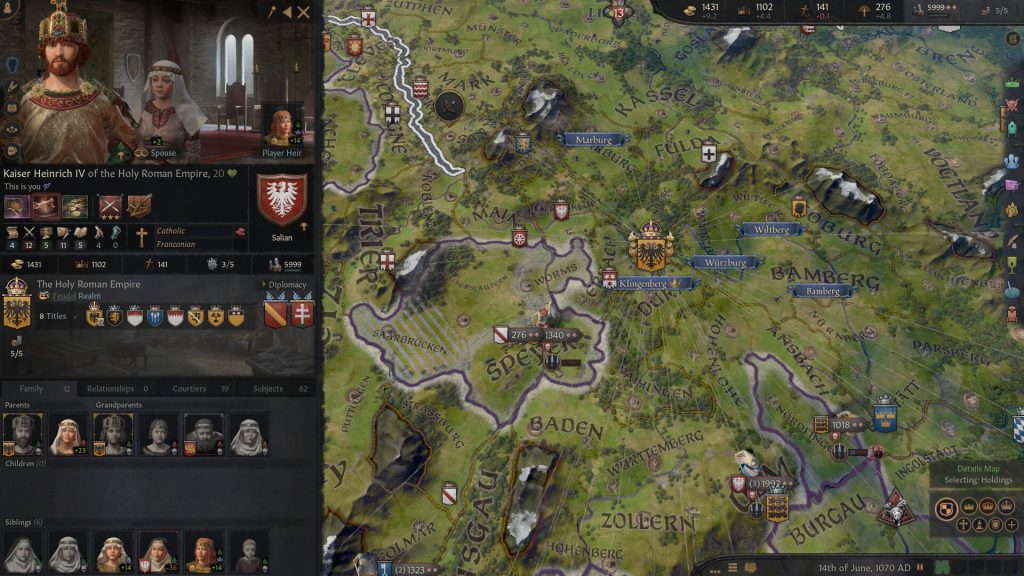
TL;DR: Start this Crusader Kings 3 beginner guide by pausing and checking your ruler, player heir, personal holdings, council, and strongest vassals. Secure a succession you can continue, preserve a cash reserve, and fight a small war only after confirming its target and beneficiary. Your first success is a stable next ruler, not the largest possible realm under the current one.
Crusader Kings 3 follows characters and dynasties across generations. The land you rule, the holdings you personally own, and the titles your heir will inherit are different things. Understanding those differences makes the first campaign easier to plan.

This guide uses ordinary landed feudal play as its starting point. Other governments, landless play, and expansion systems can change the available decisions. The principles below give you a workable first reign without requiring a specific character build or a fixed sequence of events.
On this page
Crusader Kings 3 beginner guide: choose one manageable objective
Choose a ruler whose first problem you can explain in a sentence. You might want to unite a small region, preserve a family kingdom, or learn to serve a liege before becoming independent. Avoid combining every ambition in the opening session.
The game’s tutorial is a useful place to learn the interface. For a fresh campaign, inspect the ruler and surroundings before deciding that an attractive historical name makes an easy start. A famous king can have more difficult internal politics than a lesser ruler with fewer immediate obligations.
Your first objective should include a stopping point. For example, aim to secure the heir, improve the personal domain, and complete one affordable county war. Then reassess. That is a hypothetical learning plan, not a promise that a particular start will offer the same target or marriage.
The published Hearts of Iron 4 versus Crusader Kings 3 comparison explains the broader difference between military-state planning and CK3’s character-led campaign. Here, begin by treating the ruler’s death as something to prepare for throughout the reign.
Pause and inspect the ruler before spending anything
Read the ruler’s age, family, traits, skills, and current situation. Identify strengths you can use and pressures you should avoid. A capable military ruler and a capable administrator can pursue the same broad objective through different priorities.
Personality matters because choices can create stress. Do not assume the action with the largest immediate reward is best for every character. A recurring sequence that conflicts with your ruler’s traits can create trouble even when it looks profitable in isolation.
Choose a lifestyle that supports the problem you are solving. For a small realm needing stable income, administrative development can be useful; for an impending war, relevant military skills deserve attention. You do not need an internet build that presumes a completely different ruler, government, and starting position.
Also inspect relationships that can end the reign unexpectedly. A weak or hostile person in a sensitive position deserves attention before optional projects. The archived Gamepressure first-steps guide illustrates this with a ruler whose existing council is politically convenient but not well matched to its jobs.
Know who continues the campaign
Find the player heir and inspect succession. The person who inherits one prestigious title is not always the person who receives every holding you care about. Check the expected distribution of titles and identify what supports your continuing dynasty.
For a beginner, ask three questions: Who will I play next? What personal land will that character hold? Will important siblings inherit titles that change the realm’s structure? Answering them early is easier than trying to rebuild a power base immediately after death.
Marriage and children can alter the succession picture. Revisit it after a birth, death, new title, or important marriage. Do not assume that the result you saw at the start remains valid throughout a long reign.
Keep this separate from optimizing inherited traits. A strong future ruler needs a viable dynastic path and useful holdings before fine-tuning genetic possibilities. No marriage guarantees a particular child, trait combination, or lifespan.
Separate your personal domain from the realm
Your realm includes territory controlled through vassals. Your domain consists of the holdings you personally control. A large realm can still leave the ruler with a weak personal income base.
Open your holdings and identify the ones you intend to keep. A compact, useful core is easier to defend and develop than scattered acquisitions. Keep within the capacity the current ruler can manage, while preparing for the heir’s different skills and limits.
Higher titles organize political relationships; they do not turn every vassal’s county into personal land. The archived titles guide explains the hierarchy and the importance of retaining a personal economic base.
When granting titles, pay attention to rank. A recipient holding a title equal in rank to your own cannot simply remain your ordinary vassal under that same arrangement. Read the grant’s consequences before using a prestigious title as a quick opinion gift.

Build a council that can do its jobs
Inspect council skills and relationships together. The most skilled candidate is attractive, but replacing a powerful vassal can have a political cost. Conversely, giving a sensitive role to an unsuitable character solely to keep that person happy can create another risk.
Start with the job that addresses your immediate weakness. A marshal restoring control helps a damaged county. A steward improving the domain supports future income. A reliable spymaster matters when hostile schemes threaten the ruler or court.
Assign tasks deliberately rather than leaving every councillor on the initial setting. However, avoid changing tasks constantly without allowing them to accomplish anything. A development plan needs time; an urgent county-control problem may deserve priority over it.
For a hypothetical opening, imagine a recently conquered personal county with poor control and a treasury too small for a long war. Recover control and improve recurring income before buying optional projects. The council should support that sequence, not several unrelated ambitions at once.
Read the strongest vassal’s complaint
A negative opinion is a symptom. Inspect its causes before sending gifts or granting land. A vassal who wants a particular de jure relationship has a different complaint from one angered by a recent arbitrary action.
Begin with powerful vassals and active factions. The vassal guide describes opinion, obligations, and faction membership as connected parts of internal politics. A realm’s stability depends on more than making one character like you.
Use a targeted response. A suitable council appointment, a lawful title arrangement, a personal scheme, or a gift can each help in a different situation. They also have different costs. Giving away the personal county that funds your army may solve one grievance while making the next crisis harder.
Do not grant a troublesome vassal every nearby title by default. Consider the power of that character’s successor too. A temporary opinion improvement can create a permanently larger rival if you give away too much land.
Preserve a war chest before improving the realm
Construction and military investment compete for the same resources in ordinary feudal play. Recurring income helps you maintain a force; a cash reserve helps you survive the time between starting a war and ending it.
Read the cost of raising the army you intend to use. The peacetime balance is not the budget for a campaigning force. A war that appears easy can last longer if an ally joins the defender, a siege takes longer than expected, or your army needs recovery.
Choose investments that support holdings you expect to retain. An income building in the core domain can serve later rulers, while developing land about to leave your direct control has a different value. The official 1.9 release announcement describes major changes to buildings and regiment stationing, so old blanket advice about bonuses across every regiment should not be treated as timeless.
Avoid emptying the treasury merely because construction is available. You need enough flexibility to respond to a raid, an unexpected war, or an internal crisis. There is no single reserve amount appropriate to every start.
Build an army around a job
Levies provide numbers, men-at-arms provide specialized military roles, and knights contribute individual fighting strength. Your composition should support the war you intend to fight rather than collect one of every available regiment.
For a small first war, identify the likely opposing troops, the terrain, and the fortifications you must occupy. A combat core needs enough support to fight effectively; suitable siege engines can help end the occupation phase. Buying more combat troops does not necessarily shorten a difficult siege.
Stationing and buildings also affect how useful a regiment becomes. The documented 1.9 change moved many building bonuses toward the regiment stationed at a holding. Build a relationship between the troop type and its supporting domain, rather than assuming an improvement benefits the entire army equally.
Protect the army’s condition. Do not keep all troops stacked in a low-supply location simply because a larger number looks safer. Spread for recovery where practical, then concentrate deliberately for battle.
Confirm the war’s result before declaring it
A casus belli is the reason for the war, and its result determines what victory gives you. A claim pressed for someone else can give the title to that claimant. A war over de jure land, a personal claim, and a holy war are different political transactions.
Before declaration, identify the target title, beneficiary, costs, enemy allies, and intended occupation route. Ask whether victory improves your position enough to justify the military and political cost. You are not automatically buying personal land every time you win.
During the war, use the objective to decide where the army goes. Chasing a retreating force far from the contested land can waste supplies and delay the result. Protect your own important holdings too, especially the capital and people located there.
After victory, pause again. Inspect control, new vassals, the domain limit, and succession. Conquest should produce a governable result before you begin another declaration. Disband forces that no longer have a job, restore damaged regiments, and check whether the newly acquired title changes what the heir receives.
FAQ
What should a beginner do before unpausing?
Inspect the ruler, heir, succession, personal holdings, council, powerful vassals, and treasury. Choose one immediate problem to solve and one modest objective for the reign.
Should I expand as quickly as possible?
No. A conquest is useful when you can fund it, keep or govern the result, and pass on a viable position. A larger realm with an exhausted treasury and weak heir can be harder to play than a stable smaller one.
Is there one army or lifestyle build for every ruler?
No. Government, culture, skills, terrain, opponents, and resources change the best choices. Start with the role your army or character must perform.
What is a good first milestone?
Reach a stable succession with a useful personal domain and enough income to respond to trouble. One affordable, well-understood war can teach more than several declarations whose political results you have not checked.
Sources and further reading
- https://www.gamepressure.com/crusader-kings-3/first-steps/z4f0f8
- https://www.gamepressure.com/crusader-kings-3/titles/zff0fc
- https://www.gamepressure.com/crusader-kings-3/vassals/z0f0fd
- https://store.steampowered.com/news/app/1158310/view/6557848386941142486
- https://steamcommunity.com/sharedfiles/filedetails/?id=2222736076
Keep exploring

Crusader Kings 3 faith reformation: holy sites, rites and the realm afterward
Reform an unreformed rite with holy-site access and Piety, then check doctrine choices, divergence and which rulers will follow the change.
Crusader Kings 3 cultural innovations: choose the unlock your realm needs
Prioritize the innovation that removes a current realm obstacle; check the head, matching skill, cultural Development, spread and era restrictions.

Manor Lords vs Crusader Kings 3: build a town or guide a dynasty?
Pick Manor Lords for a medieval settlement and its household economy; pick Crusader Kings III for rulers, relationships and a realm passed between generations.