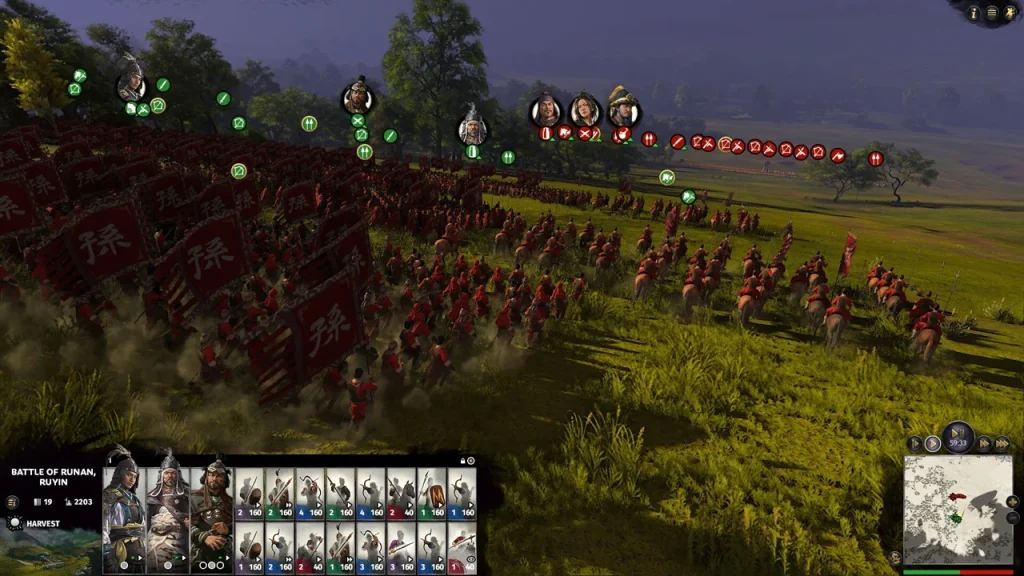
TL;DR: The Total War Three Kingdoms Sun Jian campaign opening for 190 CE combines a home base in Changsha with an initial fight against Han commander Quan Rou and an objective in Nan. Win efficiently to build Heroism, use immediate-strength mercenaries for a real military need and reserve money to hold the new territory. Treat the Imperial Jade Seal dispute with Liu Biao as a frontier decision before committing the army to distant southern conquests.

Sun Jian’s opening rewards momentum supported by an economy. The faction reference identifies Changsha, Quan Rou, Nan and the potential Liu Biao conflict for Rise of the Warlords. Sun Ce’s 194 and 200 campaigns have different starts and resource mechanics. This guide follows Sun Jian in 190 CE rather than borrowing the later Reckless Luck race.
On this page
Total War Three Kingdoms Sun Jian campaign opening: a useful sequence
- Defeat Quan Rou while keeping the army capable of its next engagement.
- Take the relevant Nan objective and assess the northern approach before marching away.
- Preserve productive territory and give the home commandery a clear development role.
- Hire mercenaries only when their immediate strength solves an urgent battle or defense.
- Choose your response to the Jade Seal dispute with the army and treasury in mind.
- Expand along a frontier you can sustain rather than taking every reachable settlement.
The map offers room to grow, but distance becomes a cost when the same army must defend several directions. Finishing an easy assault does not prove the next county will be equally safe or that the Han Empire has no forces able to respond.
1. Connect the Quan Rou battle to a position in Nan
Fight the named initial enemy before turning the opening into an unrelated tour of the south. The faction source directs Sun Jian against Quan Rou and toward Nan. The Nan reference identifies Jiangling as the Han-owned capital in 190, with Huarong’s livestock farm under Cai Mao. Taking the Han objective is therefore different from owning the whole commandery.
Arrange your army so the infantry can hold contact, ranged troops can fire safely and a mobile force can attack an exposed flank. Use Sun Jian where his contribution changes the fight. His character reference identifies him as a Sentinel with useful combat abilities, but that does not make an unsupported charge through the entire enemy formation a good opening.
In Romance, consider a duel only when the matchup and the surrounding battle justify it. In Records, protect his bodyguard’s position and numbers. Do not use an exact skill or ability sequence unless it is actually unlocked in your campaign. The same named character can have a different development state from the one shown in a general reference.
After the battle, preserve the roles the next engagement requires. If infantry losses leave your ranged troops unprotected, replenish or add a suitable unit before another attack. If the force remains healthy, move against the objective while retaining enough strength to hold it. A short recovery is better than a conquest whose garrison and exhausted army cannot resist a counterattack.
2. Earn Heroism through useful, efficient victories
Heroism is Sun Jian’s faction resource. The faction reference describes gains from victories in which you lose fewer soldiers than the enemy and from duel victories by the faction leader. Higher tiers support character satisfaction and, at stronger levels, recruitment and retinue upkeep. The resource also decays, so its benefits should fit an active campaign rather than a plan to wait indefinitely.
This encourages efficient aggression. Keep troops out of avoidable missile fire, avoid unsupported frontal charges and exploit an exposed flank when the enemy is committed. Finishing a battle with many survivors improves both the military position and the chance that the victory fulfills the favorable-loss condition.
Do not start an unnecessary war simply to pursue the resource. A battle that adds another dangerous frontier can create more expense than its reward offsets. Seek engagements that protect your holdings or advance a planned acquisition. Heroism should reinforce a good campaign route, rather than dictate targets regardless of their position.
Temporary upkeep benefits also need a reserve. If your treasury only balances at a strong Heroism tier, a quiet period can expose the army’s continuing cost. Keep enough income or cash to cover the force when the current discount changes. The same caution applies to relying on satisfaction bonuses while ignoring an individual character’s growing demands.

3. Use immediate-strength mercenaries for a specific gap
Sun Jian’s unique Mercenary Infantry, Mercenary Archers and Mercenary Cavalry deploy at full strength according to the faction reference. That lets an available mercenary unit answer an immediate shortage without the ordinary mustering wait. It does not make every non-mercenary unit recruit at full strength.
Choose the role before the purchase. If a damaged line cannot protect the existing archers, infantry is the relevant reinforcement. If the force holds contact but lacks the means to punish enemy missiles or an exposed rear, a suitable mobile addition may help. More ranged troops have value only when you can protect them and obtain useful firing positions.
Immediate strength buys time; it does not erase recruitment and upkeep costs. For a hypothetical example, suppose a recruitment would leave 800 cash and the army costs 700 more each turn than the economy earns. You have little room for repairs or another unexpected commitment. Those numbers are illustrative, but the consequence is clear: a fast reinforcement needs either an immediate military payoff or an affordable continuing role.
Do not assume a full-strength new unit restores existing casualties. Recruitment and recovery are different tasks. If the army’s older units remain badly damaged, one new mercenary can improve its options without making it ready for every siege. Reassess the whole force before treating the purchase as permission to continue attacking.
Sun Jian also has a Mercenary Outpost chain. Consider its displayed recruitment and support benefits where they solve the local army’s needs. Do not fill all available construction space with military infrastructure while the recurring economy still lacks a foundation.
4. Develop Changsha according to its actual resources
The Changsha reference lists Linxiang as Sun Jian’s 190 CE town. Chaling’s tea, Lingxian’s armor craftsmen and Chibi’s trade port are separate Han-owned counties in that setup. Starting in Changsha does not mean starting with all of those resources.
This creates a practical home-base choice. Nearby resource consolidation can improve the region behind the army, but each acquisition still needs travel, a battle or another valid means of transfer. Compare that task with the need to protect the new Nan position. A valuable resource is not immediately profitable if acquiring it leaves your army unable to answer Liu Biao.
Sun Jian’s faction has a distinctive harbor benefit: the reference describes its commerce percentage effects as applying across commanderies. That makes existing commerce elsewhere relevant when evaluating a harbor upgrade. Compare the wider eligible income with the upgrade cost; a percentage effect remains less useful when there is little base commerce to multiply.
Protect food as well as money. Tea, armor production and a trade port are not interchangeable with a food-producing farm or fishing settlement. Urban development can raise consumption, so obtain a workable food margin before growing towns simply for another building slot.
Nan’s Huarong farm belongs to Cai Mao in the cited start. Do not count its food as yours after taking Jiangling. The reference also contains a dated fertility-bug claim, which is not a reliable substitute for your campaign’s actual production. Plan using the food you control rather than relying on that old claim or assuming the whole commandery is already unified.
5. Decide what the Imperial Jade Seal is worth to the opening
The faction reference links the Imperial Jade Seal’s ownership to potential hostility with Liu Biao. Make that choice before sending your main force far from the relevant frontier. The important question is whether retaining the Seal is worth the confrontation your current position can support.
Consolidate if the army needs recovery
Assume the first battles left the army depleted and Jiangling needs repairs. Favor a response to the dilemma that reduces immediate confrontation if the displayed choice offers it and the tradeoff is acceptable. Losing or giving up an ancillary can be preferable to paying for a war the army cannot presently win.
This is a cautious branch, not a guarantee of permanent peace. A different diplomatic issue can still cause conflict later. Use the quieter period to recover, restore useful production and organize a defensible route between the northern objective and the home region. Reconsider expansion when those tasks are complete.
Retain the Seal with a funded defensive plan
Assume the army is healthy, the treasury can cover reinforcement and Liu Biao’s approach is manageable. Retaining the Seal becomes more reasonable if you accept the potential war and keep the army positioned to fight it. A strong ancillary is less helpful if the field force is several marches away when the conflict begins.
Give the war a defined objective: defeat a threatening army, secure an approach or take a settlement that makes the frontier easier to hold. Avoid turning the dispute into a simultaneous campaign against every nearby owner. Cai Mao’s Huarong and other targets need their own diplomatic assessment rather than being treated as automatically included in a single Han conquest.
6. Expand south when the northern position can survive
Southern expansion works best when each new acquisition fits a supported route. Prioritize a settlement that improves income, food or the frontier, then give its conquest enough time and money to become useful. A string of damaged towns can consume the treasury faster than it expands your military capacity.
Long travel also changes the recruitment choice. A second force can reduce response time, but it adds continuing costs before earning anything itself. Build it for a specific defense or campaign when the economy supports both armies. If one force still does the necessary jobs, strengthen production before adding another expensive commitment.
Your next action should follow the bottleneck. Recover if the army is damaged, secure the exposed approach if Liu Biao threatens it, or improve a productive home holding if money prevents movement. Once that obstacle is resolved, resume expansion with an objective that the improved position can sustain.
Frequently asked questions
Where does Sun Jian start in 190 CE?
His home base is Changsha; the commandery reference lists Linxiang as his town. His initial military objective involves Quan Rou and Nan.
Do all Sun Jian units recruit at full strength?
No. The cited immediate-strength rule applies to his unique mercenary units. Ordinary units still require mustering.
Does taking Jiangling give me Huarong’s farm?
No. The cited 190 CE setup places Jiangling under the Han Empire and Huarong under Cai Mao. They are separate acquisitions.
Does Sun Jian use Reckless Luck?
This 190 CE opening uses Heroism. Reckless Luck and Legacy of Wu belong to the later Sun Ce campaign mechanics described in the faction reference.
Sources and further reading
Keep exploring
Total War Three Kingdoms vs Total War Shogun 2: heroes or clans?
THREE KINGDOMS emphasizes heroic characters and Guanxi; SHOGUN 2 puts generals and agents inside a Japanese clan-unification campaign.
Total War Three Kingdoms vs Crusader Kings 3: battles or heirs?
THREE KINGDOMS fits direct tactical battle command; Crusader Kings III fits a ruling house whose playable heirs carry its story forward.

Total War Warhammer 3 vs Total War Three Kingdoms: who should lead?
Pick WARHAMMER III for fantasy race and lord identity; pick THREE KINGDOMS for Chinese empire strategy shaped by heroic characters and relationships.