TL;DR: Total War Three Kingdoms vassal management starts with choosing a subject you can afford to support. Compare its income contribution, location, enemies and leader’s personality before negotiating. Read any autonomy guarantee carefully, plan how you would answer a protection request, and assess the economic and diplomatic consequences before annexing. A profitable subject can still become a costly commitment when its frontier is beyond your military reach.

For a conventional warlord campaign, a vassal offers an overlord relationship while retaining its own faction. That differs from directly conquering its settlements or cooperating with equal coalition members. The objective is to gain useful income and strategic support without accepting obligations that undermine your campaign.
On this page
Total War Three Kingdoms vassal management: choose the relationship first
The Gamepressure diplomacy guide, updated May 30, 2019, describes the Vassals diplomacy category, requesting subject status, asking a subject for help and receiving part of its income. It also distinguishes that arrangement from absorbing another faction’s settlements and armies.
Use vassalization when leaving the faction separate has a practical advantage. A nearby subject may contribute income while holding a frontier you do not want to administer directly. Direct conquest is a different solution when you need the settlement itself, a complete commandery or dependable control of a route.
A coalition suits cooperation among peers. It is not a substitute for the overlord relationship, and joining one does not transfer another member’s land to you. Decide which relationship solves the problem before selecting a diplomatic option.
Check the available option in your own campaign. Rank, faction rules, the other faction’s position and modifications can affect the diplomatic choices presented. This guide does not give a universal unlocking rank or claim that a friendly relationship makes every faction eligible.
1. Screen the candidate’s land, enemies and personality
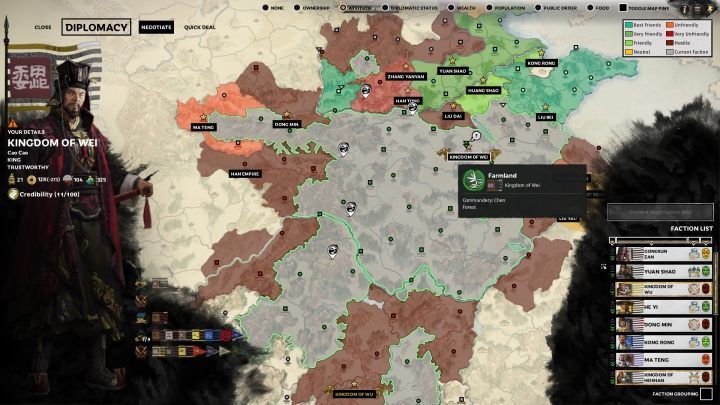
Open diplomacy and examine the candidate on the map. Identify the subject’s settlements, nearest enemies and routes connecting its territory to your armies. The important question is whether you could support it while preserving your main front.
Compare a nearby subject with a distant one. A faction across a manageable border might fit your existing deployment. A remote faction surrounded by enemies may require an additional army, access negotiations and several turns of movement before you can respond to trouble.
Hover over the leader’s personality information and read the displayed description. Geroiko’s Advanced Legendary Speed-Running Guide, updated December 28, 2021, recommends this check when selecting vassals. Treat the personality as useful context rather than a certainty that a particular leader always behaves identically.
Review the candidate’s current wars and relationships, not just its attitude toward you. A subject with attractive income can still bring exposure to factions you wanted to keep neutral. Write down that exposure before bargaining, while declining the agreement is still straightforward.

2. Read the complete proposal and autonomy terms
The official manual confirms detailed diplomatic bargaining and Quick Deal for finding workable exchanges. Use those tools to identify possibilities, then inspect the selected vassal proposal and every additional term.
Athrek’s Advanced Tips and Tricks community guide describes using Quick Deal to look for Create Vassal opportunities. This is an efficient screening method; it does not remove the need to examine the proposed subject’s military situation or your promised concessions.
Check which faction becomes the overlord. Asking to become someone else’s vassal and asking another faction to become yours are different diplomatic actions. Read the direction of the proposal before confirming a deal that changes your role.
If an autonomy guarantee appears, treat it as a commitment rather than a harmless acceptance aid. Geroiko specifically warns that annexing a vassal after guaranteeing autonomy carries a serious diplomatic penalty. Do not offer that guarantee while assuming you can immediately absorb the subject without consequences.
Review payments, food or other items added to secure the agreement. The price includes those concessions as well as future defense costs. A proposal that looks acceptable numerically can still be strategically expensive.
3. Make a protection plan before accepting
Geroiko’s trustworthiness section describes a protection decision when a vassal is attacked: honoring the defense request improves trustworthiness, while refusing and allowing independence damages it. This is dated community evidence, not an official list of every possible war interaction.
The practical response is to plan for that decision in advance. Identify which army could defend the subject, which border it would leave behind and whether your treasury could support reinforcements. Do this before the diplomatic agreement, not after a protection request creates immediate pressure.
When the request arrives, read the actual popup. Confirm the attacker, the relationship that will change and the consequences shown for each choice. Distinguish defending an attacked subject from voluntarily ordering it to support your own offensive war.
Do not extrapolate a rule that every vassal automatically joins every conflict under all circumstances. The sources describe assistance and protection choices, but do not establish one universal trigger for every campaign type. Inspect the active war and treaty state after accepting a request.
If refusal is necessary, consider the diplomatic loss alongside the military cost of acceptance. Losing reliability can affect later bargaining; preserving a subject at the cost of your undefended capital is also a serious consequence. The best prevention is selecting a defendable subject.
4. Measure income against the cost of support
Both the Gamepressure guide and Geroiko describe a vassal income contribution. Geroiko frames it as a share of gross income, so a wealthier subject can contribute more. This guide does not assume one fixed tribute percentage for every faction, patch or mod.
After the deal, inspect your actual financial breakdown and the subject’s situation. Compare the contribution with any recurring payment you promised and the military spending needed to protect the relationship. A contribution is not the same as the agreement’s net benefit.
Suppose, purely as a calculation example, a subject contributes 400 each turn, you promised 100 each turn and its protection requires 250 of additional upkeep. The immediate balance is 50 before other costs. These invented figures illustrate budgeting; they are not Three Kingdoms tribute or upkeep values.
Repeat the review after the subject loses land or you change your deployment. A faction that once contributed useful income may become vulnerable and expensive to protect. Its previous performance does not guarantee the same result after a major defeat.

5. Request useful support without assuming direct control
Gamepressure describes asking a vassal for assistance. Geroiko also recommends the coordinate-attack control for assigning a target and notes that a subject may wait until it has an adequate army. A request is therefore different from directly issuing orders to your own units.
Select a target that fits the subject’s position and capacity. A reachable settlement near its border is a more understandable objective than an enemy army far across the map. Check the active wars and available coordination controls before assuming the request can be carried out.
Maintain your own plan for critical battles. The subject may lack resources, be occupied defending its territory or fail to arrive when you need it. Military assistance is valuable when it complements your deployment; it is a weak foundation for an offensive requiring exact synchronized movement.
Review outcomes after a request. If the subject is not advancing, inspect its wars, territory and visible forces before repeating the command. The issue may be its capacity rather than a need for a different diplomatic payment.

6. Compare annexation with preserving or ending the relationship
The Gamepressure guide describes absorption as acquiring settlements, armies and characters, together with the resulting financial burden. Annexation should therefore begin with a budget and administration review. More territory can also mean more upkeep and additional settlements requiring attention.
Inspect the annexation option and its displayed consequences in the Vassals category. Geroiko warns about treachery penalties, especially following an autonomy guarantee. Check existing promises and the diplomatic position you need for later deals before confirming.
Prepare to manage the acquired army costs, food requirements and local conditions. Absorbing a faction that is already operating at a deficit can weaken your treasury even when its land looks attractive. Decide which assets support your campaign and which obligations you must cover.
For ending the subject relationship, inspect the available diplomatic action and confirmation text. The evidence checked here establishes refusal of a defense request as a route to independence with a trustworthiness cost. It does not verify every voluntary-release button, cooldown or penalty, so do not assume a universal consequence-free release procedure.
A hypothetical buffer subject and a risky distant subject
Assume Candidate A borders your northeastern territory and faces one nearby rival. Candidate B is farther away, offers more apparent income and is already threatened on two fronts. These are invented conditions for comparing choices.
For A, check whether your current reserve can support its frontier without abandoning another important settlement. Review its personality, wars and proposal. If the contribution and defense plan are useful, keeping it separate can support the campaign without immediate annexation.
For B, calculate the cost of reaching its territory and sustaining another force. If you cannot respond to a protection request, the larger contribution may not justify the obligation. Decline or postpone that agreement rather than relying on a future refusal to repair an avoidable commitment.
Vassal management questions
Should I annex every useful vassal?
No. Compare direct control with continued income and support. Annexation also creates administration, upkeep and diplomatic consequences, including risks tied to autonomy promises.
Is refusing protection harmless?
Geroiko describes independence and reduced trustworthiness after refusal. Read your campaign’s request and consequences before choosing; avoid promising protection you cannot realistically provide.
Does a vassal replace my defensive army?
No dependable defense follows from the treaty alone. Inspect the subject’s position and forces, then preserve a practical response plan for your own important settlements.
Continue through the Three Kingdoms game hub and strategy game guides.
Sources and further reading
Keep exploring

Total War Rome 2 vs Total War Three Kingdoms: territory or characters?
Choose ROME II for classical civilizations and empire development; choose THREE KINGDOMS for Chinese warlords and relationships that connect statecraft with battle.
Total War Three Kingdoms vs Crusader Kings 3: battles or heirs?
THREE KINGDOMS fits direct tactical battle command; Crusader Kings III fits a ruling house whose playable heirs carry its story forward.
Total War Three Kingdoms vs Total War Shogun 2: heroes or clans?
THREE KINGDOMS emphasizes heroic characters and Guanxi; SHOGUN 2 puts generals and agents inside a Japanese clan-unification campaign.