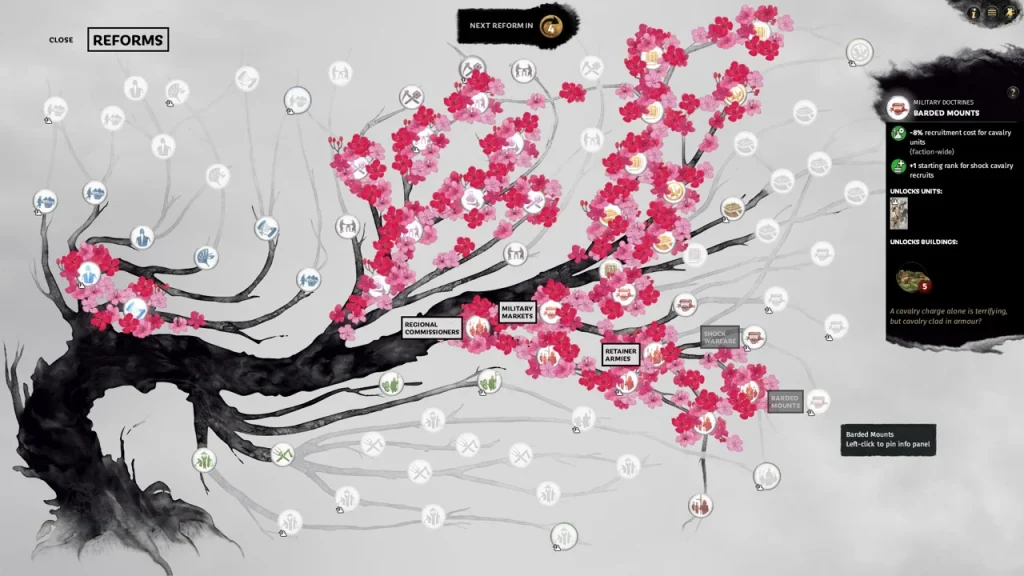
TL;DR: Total War Three Kingdoms reforms research works best when you start with a specific campaign need, find the reform that addresses it and trace the prerequisites before choosing. Compare how soon the benefit becomes usable with what you postpone on another branch. A building unlock needs a construction budget; a military unlock needs a retinue that can recruit and support it. Research should remove a real constraint rather than simply complete a colored branch.

For a conventional Han or warlord campaign, examine the reform tree when the next choice becomes available. The Gamepressure starting guide describes a five-turn selection interval for its base-game context. Check your campaign’s availability indicator rather than extending that interval to every faction or assuming all downloadable content uses the same research system.
On this page
Total War Three Kingdoms reforms research: identify the next constraint
List the problem that is actually slowing your campaign. Your army may take too long to recover casualties, a planned building may be locked, food production may not support a city upgrade, or an intended military unit may remain unavailable. Each calls for a different research decision.
Separate research problems from problems research cannot immediately solve. An unlocked building still needs money and an available construction slot. A damaged army may also need time in an appropriate recovery situation. Choosing a related reform does not automatically finish construction or restore every casualty.
Use the tooltips associated with the blocked action. If a building or unit lists a reform requirement, record that requirement before searching the tree. This is more precise than picking a branch because its color seems generally associated with your intended playstyle.
Choose one main objective for the next selection. For example, make the next food-producing development possible, or improve the recovery of the armies already fighting. You can keep a longer plan, but the immediate objective gives the current choice a measurable purpose.
1. Trace prerequisites from the desired result
Open the reform tree, inspect the desired reform and follow its connecting prerequisites back to the choices you have already completed. Count the remaining selections along that route. The relevant commitment is the whole path, not just the appealing final tooltip.
Read each intervening reform. Some prerequisites may already help your army or economy; others may contribute little until you reach the final result. A route with useful intermediate effects can be easier to justify than one whose benefits arrive only after several delayed opportunities.
Check additional requirements shown for the chosen reform or its associated unlock. Your campaign’s actual tree and tooltips determine what is available. A screenshot from another faction or starting date is useful for orientation but does not establish that your route begins in the same state.
Record the path in a short note: desired result, remaining prerequisites and the action you will take after unlocking it. If you cannot identify that final action, the path may be an interesting research project rather than a solution to the current campaign problem.
Recheck the route after a major territorial or military change. Losing the settlement intended for construction, recruiting a different general or ending the war can change the value of the final unlock before the path is complete.
2. Match the actual effect to your economy or army
The official manual’s Wu Xing section connects the five elements with the game’s units, buildings and technologies. It gives wood, peasantry and farming as an example, while fire buildings are associated with warfare. This provides a useful organizing framework, but the individual reform description remains the evidence for its effect.
For an economic reform, identify the income or production source it changes. A bonus that affects a source you scarcely use may contribute less than a modest improvement to your main production. Compare the effect with the buildings and resources in the commanderies you already possess.
For a military reform, identify the army action it enables. Is the problem recruiting a particular unit, supporting an existing force or moving that force through the campaign? Those are separate objectives. Do not treat all red-branch benefits as interchangeable military power.
Confirm that a unit unlock fits your available generals and retinues. The official manual describes armies as character-led retinues, so research is only part of fielding a force. Check the recruitment options presented to the relevant general before planning an army around an unfamiliar unit.
Keep the benefit’s scope explicit. A faction-wide effect, a new construction option and a unit unlock operate differently. Read whether the tooltip changes current output, permits a future purchase or helps only a particular source or activity.

3. Compare an immediate improvement with a long route
Compare what happens after the next choice, not only after the entire branch is complete. An immediately useful reform can strengthen your current position while a distant unlock may arrive after the war or development project that motivated it.
Timing does not mean always taking the quickest option. A longer route can be worthwhile when several prerequisites support the same plan and the final benefit addresses a lasting constraint. The comparison should include the campaign time you expect to use the result.
State what you are postponing. Choosing a military prerequisite may delay a food improvement or an economic construction option. This is the opportunity cost even when selecting the reform itself does not require a direct treasury payment.
Consider your construction and recruitment budget over the same period. If you cannot afford the unlocked action when it becomes available, an immediate production or support benefit may be more useful. Conversely, money saved specifically for that action can make the longer route practical.
Avoid completing a branch solely because earlier choices went into it. The previous selections remain part of the campaign, but they do not oblige you to ignore a new food shortage or a changed military objective.
4. Use a researched route as an example, not a universal build
Geroiko’s Advanced Legendary Speed-Running Guide, updated December 28, 2021, emphasizes red reforms for rapid expansion. Its reform section identifies Regional Levy with replenishment and names Swiftness Is the Key and Green Dragon Supply Ships as movement-related choices.
That route answers the guide’s stated problems: getting armies to the next settlement and recovering casualties while expanding aggressively. It illustrates matching research to a campaign constraint. It does not establish the best opening for every faction, difficulty, date or slower development strategy.
Before copying it, inspect the corresponding reform names and effects in your own tree. The same community guide notes that some starting factions or dates already have choices unlocked and that faction mechanics can change the priority. Count your remaining path rather than copying someone else’s total.
Do not adopt the guide’s exact percentages as current universal balance values. Its date and speedrun context matter. Use the named reforms to locate a relevant route, then read your campaign’s values and prerequisites before making the commitment.
5. Work a food-development versus military-unlock decision
Assume you have enough food for the present settlement levels but not for a planned city upgrade. Also assume a military reform you want requires two more prerequisite selections, and your current army can continue operating without its final unlock. These are hypothetical conditions, not a fixed Three Kingdoms opening.
First, inspect the development project. Determine whether the relevant food reform improves existing production or merely unlocks a building you must construct. If it is an unlock, include construction time, cost and the required settlement in the plan.
Next, compare the military path. Read both prerequisites and decide whether their immediate effects help the ongoing war. If they do, the route may still be worthwhile even before its final result. If they do little for your current force, its benefit is mostly deferred.
Then choose according to the next actionable project. If the city upgrade supports an important commandery and the food improvement can be used soon, prioritizing it is reasonable. If the upgrade is optional while the army faces repeated losses, the military route may deserve the next selections.
Finally, write the consequence of the decision. Choosing food delays the military path; choosing military delays the city project or requires another food solution. This makes the tradeoff explicit instead of presenting either branch as inherently correct.
After selection, verify that the plan became usable
Reopen the affected building, recruitment option or campaign statistic after the reform takes effect. Confirm what changed and whether another requirement remains. This catches the common mistake of researching an unlock while overlooking the money, settlement level or character needed to use it.
Update the next research objective based on that result. Once food supports the planned development, the limiting factor may become money. Once a military unit is available, the problem may become upkeep or getting an appropriate retinue into position.
Reform research questions
Should I always finish one color before choosing another?
No. Follow a route while its effects support your campaign. Change priorities when a concrete constraint makes another selection more useful.
Does an unlock give me the building or unit immediately?
An unlock permits an action; it does not replace its construction or recruitment requirements. Inspect the relevant option after research.
Can I use the same schedule for every faction?
Do not assume that. The five-turn description comes from a base-game guide. Check your faction’s research system and current availability display.
Find related lessons in the Three Kingdoms game hub and strategy game guides.
Sources and further reading
Keep exploring
Total War Rome 2 vs Total War Three Kingdoms: territory or characters?
Choose ROME II for classical civilizations and empire development; choose THREE KINGDOMS for Chinese warlords and relationships that connect statecraft with battle.
Total War Three Kingdoms vs Crusader Kings 3: battles or heirs?
THREE KINGDOMS fits direct tactical battle command; Crusader Kings III fits a ruling house whose playable heirs carry its story forward.
Total War Three Kingdoms vs Total War Shogun 2: heroes or clans?
THREE KINGDOMS emphasizes heroic characters and Guanxi; SHOGUN 2 puts generals and agents inside a Japanese clan-unification campaign.