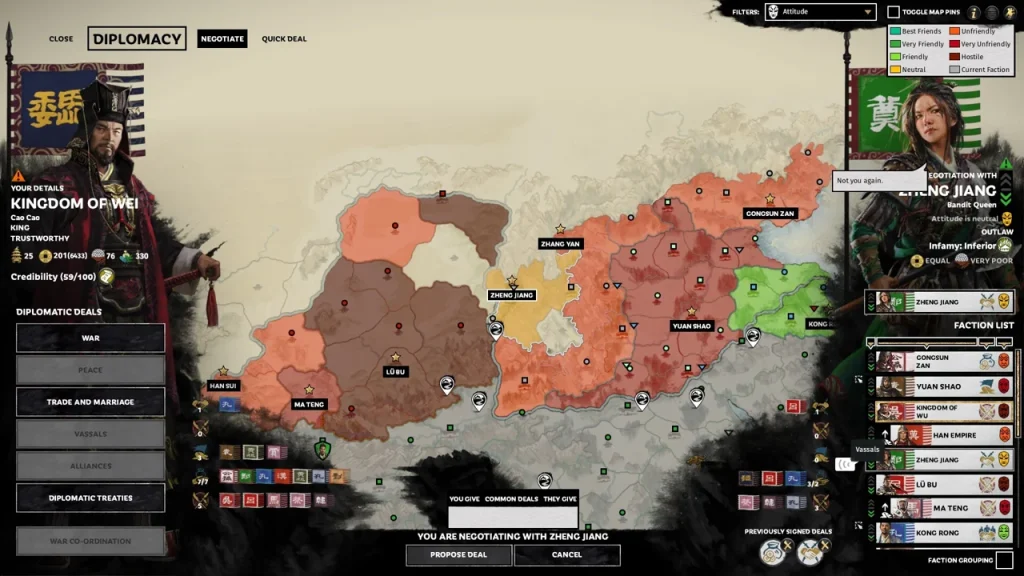
TL;DR: Use Total War Three Kingdoms food trading after checking what your own settlements and active deals need. Sell only the surplus you can maintain for the proposed duration, buy food when it bridges a specific shortfall, and compare the return with the risk of losing production or the partner. Read the quantity, payment and remaining turns before confirming. A favorable-looking food deal can become expensive when a city upgrade or captured farm changes your balance.

Food trading is a diplomatic agreement built around a resource your campaign also consumes. Treat the food you promise as committed production, not spare stock that can be sold repeatedly. The useful question is how much you can offer without making your development or defense plan fragile.
On this page
Total War Three Kingdoms food trading: identify usable surplus
Inspect your current food balance, existing imports and exports, and the settlement developments you intend to complete. A positive balance is the starting point, but it does not show how much remains after a planned upgrade increases consumption or another agreement changes.
The Gamepressure food guide identifies livestock farms, farmlands and fishing ports as important production sources tied to particular resource settlements. Locate the settlements supplying your food before offering a large recurring export.
Separate reliable production from vulnerable production. Food supplied by a resource settlement near an active enemy may be interrupted by a territorial loss. A large current surplus resting on that settlement deserves a different buffer from production safely inside your territory.
Review upcoming city upgrades. The commandery development guide warns that developing the main settlement increases food demand. If the upgrade is already part of your plan, reserve its requirement before bargaining away the balance.
Use a conservative amount rather than the largest possible offer. The buffer should reflect your actual exposure and planned development; this guide does not give a universal safe number of food for every faction.
1. Decide whether to sell, buy or withhold
Sell when production exceeds present and foreseeable needs and the return supports a useful objective. Food can help negotiate money or another diplomatic benefit, but the best return is one your campaign can use without creating an avoidable shortfall.
Buy when you can identify the problem the import solves. Perhaps a city upgrade outpaces local development, a food-producing settlement has been lost, or a temporary gap remains while construction finishes. State that problem before selecting a quantity and duration.
Compare buying with improving your own production. The food guide describes production bonuses from buildings, administrative effects and reforms, alongside the resource settlements producing the base food. An import may be quicker, while local development may be more dependable over a longer period.
Include the cost and timing of that alternative. A production improvement that needs research and construction will not necessarily solve an immediate shortage. Conversely, recurring imports from an exposed partner can be a weak long-term foundation for an expanding city.
Withhold food when the surplus is already assigned to development or military recovery needs. Declining a profitable offer can be sensible if it would consume the margin required to preserve the rest of your plan.
2. Read quantity, duration and the full return
The Gamepressure diplomacy guide describes trading food for a specified number of turns, with money available as either a one-time or recurring payment. These different terms require different comparisons.
Open negotiations with the selected faction and inspect the food option. Check who sends the food, the amount involved and the displayed duration. Then read the compensation and other terms added to the same proposal.
A one-time payment should be compared with the full export commitment. A recurring payment should be compared over the number of turns it will actually run. Do not compare one turn of food against a total payment without accounting for the duration.
For example, a hypothetical agreement offering 200 each turn for five turns has a nominal total of 1,000 if it runs throughout. A one-time offer of 800 is a different cash-flow choice. These invented terms illustrate comparison; they are not default Three Kingdoms trade settings or recommended prices.
Read counteroffers carefully. A higher return accompanied by more food, a longer duration or another concession is not automatically an improvement. Compare the revised commitment with the surplus and buffer calculated earlier.
Also check whether another active agreement already imports food that supports this export. Suppose, hypothetically, you import 4 and export 6: the two food flows have a net difference of 2, but their payments and expiration dates remain separate commitments. If the import ends first, your exported amount can become harder to support. Compare both agreements together before accepting a new sale, especially when you are using purchased food to maintain a city upgrade. The net food balance does not reveal that timing mismatch.
Check availability through diplomacy or Quick Deal, but decide the strategic value yourself. The official manual describes Quick Deal as a way to find workable exchanges. It does not establish a universal fair food price.

3. Choose a partner whose agreement fits your plan
Inspect the partner’s territory, relationships and current wars. A faction threatened with losing its settlements presents a different continuity risk from a stable neighbor. A faction you intend to attack shortly is a poor foundation for a recurring deal you plan to honor.
Review the partner’s apparent need without treating it as a fixed pricing rule. A shortage can make food relevant to negotiations, but its value is still represented by the actual offer and the whole diplomatic situation. Avoid promising that a particular deficit always produces a specific payment.
For imports, consider what happens if that partner cannot remain a dependable supplier. Your alternatives may include another purchase, local production or delaying a city upgrade. Have one viable fallback when the imported quantity is essential to the campaign.
For exports, keep the promised production geographically secure. Check whether defending a threatened farm would require resources that exceed the deal’s return. A food agreement should support the campaign rather than dictate an expensive deployment to preserve a marginal profit.
Before deliberately ending an agreement or starting a war involving the partner, read the treaty and confirmation consequences. Geroiko’s dated trustworthiness guide discusses penalties for breaking ongoing diplomatic commitments. This guide does not assume one universal cancellation rule for every possible war interaction.
4. Monitor commitments, reserves and expiration
After acceptance, inspect the active agreement and your food balance. Confirm the quantity and direction rather than assuming the negotiation changed the resource exactly as intended. Record the remaining duration beside any development project relying on it.
Do not count the same surplus twice. Once an export is committed, another buyer must be evaluated against what remains. Similarly, an imported amount already needed to support existing settlement consumption should not be treated as freely available for new development.
The food guide distinguishes ordinary food production, reserves and army military supplies. Keep those separate when diagnosing trouble. A diplomatic food agreement is not a universal instant refill for every army’s supplies.
If the food balance worsens, check the actual production, consumption and active treaty entries. A territorial loss, city development or agreement expiration points to a different response. Identify what changed before buying more of the resource.
Approaching expiration is a new negotiation decision. Recheck the amount you still need and the partner’s situation instead of assuming automatic renewal. The same quantity that bridged an earlier construction gap may be unnecessary after your own production improves.
For a replacement import, confirm the new agreement before depending on it for another upgrade. A previous partner and quantity do not guarantee the same terms in a later negotiation.
5. Work a hypothetical surplus-and-buffer example
Assume your campaign currently has a hypothetical surplus of 18 food. A planned city upgrade will consume another 5, an existing export already accounted for in that balance will expire later, and a threatened farm contributes 6. These are invented values for a planning exercise.
First, reserve the 5 needed for the planned upgrade, leaving 13. Next, decide whether the farm’s 6 should be protected by a buffer while the frontier is uncertain. If you reserve that amount as well, only 7 remains for a new export under these assumptions.
Now inspect a proposal asking for 10 food over its displayed duration. The offer exceeds that conservative allowance even if the current top-line balance appears adequate. Reduce the quantity, postpone the deal or change the development plan before acceptance.
If the same campaign instead needs an import, define when local production can replace it. Buy enough to bridge that specific gap and note the expiration. A longer agreement may be useful, but its payment commitment should match the time you expect to need the food.
Finally, revisit the calculation after the frontier becomes secure or the upgrade finishes. A buffer is a response to identified uncertainty, not a permanent arbitrary subtraction. Updating it can reveal a new surplus without sacrificing reliability.
Food trading questions
Should I sell every point above zero?
No. Reserve foreseeable consumption and a buffer appropriate to threatened production. The current balance alone does not capture your next development step.
Is a food agreement permanent?
The diplomacy guide describes food traded for a specified duration. Read the actual agreement and monitor its remaining turns; do not assume permanent supply or automatic renewal.
Does imported food replace military-supply management?
No. Food production, reserves and army supplies are distinct parts of the campaign. Inspect the army’s own supply situation when diagnosing field attrition.
Find related campaign lessons in the Three Kingdoms game hub and strategy game guides.
Sources and further reading
- https://www.feralinteractive.com/en/manuals/threekingdomstw/latest/linux/
- https://www.gamepressure.com/total-war-three-kingdoms/diplomacy-and-trade/z0c44e
- https://www.gamepressure.com/total-war-three-kingdoms/food/z0c454
- https://www.gamepressure.com/total-war-three-kingdoms/developing-commanderies-districts/zcc450
- https://steamcommunity.com/sharedfiles/filedetails/?id=2414275203
Keep exploring

Total War Rome 2 vs Total War Three Kingdoms: territory or characters?
Choose ROME II for classical civilizations and empire development; choose THREE KINGDOMS for Chinese warlords and relationships that connect statecraft with battle.
Total War Three Kingdoms vs Crusader Kings 3: battles or heirs?
THREE KINGDOMS fits direct tactical battle command; Crusader Kings III fits a ruling house whose playable heirs carry its story forward.
Total War Three Kingdoms vs Total War Shogun 2: heroes or clans?
THREE KINGDOMS emphasizes heroic characters and Guanxi; SHOGUN 2 puts generals and agents inside a Japanese clan-unification campaign.