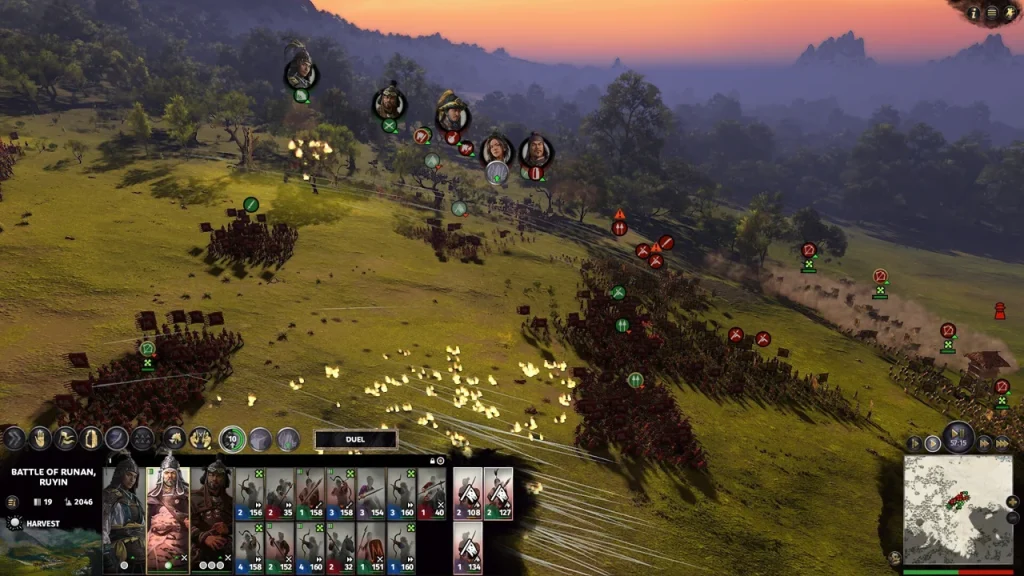
TL;DR: Total War Three Kingdoms duel mechanics belong to Romance’s individual-general combat model. Inspect both participants and the wider battle before offering or accepting a challenge. A duel can occupy a dangerous enemy general, but it also commits yours while the armies continue fighting. Watch health and the duel state, and remember that withdrawing or interfering can carry morale consequences. Declining an offer is a separate decision from abandoning an accepted duel.

The useful question is whether this particular duel helps this particular battle. A famous character, a favorable estimate or the chance to remove an opponent is not a guarantee of victory. Your army may need the general elsewhere even when the individual matchup looks attractive.
On this page
Total War Three Kingdoms duel mechanics: confirm the mode and participants
The Gamepressure duel guide, updated June 5, 2019, describes a one-on-one fight between generals in Romance. Its mode comparison distinguishes that from Records, where generals fight with bodyguards and the manual duel challenge is unavailable.
In Romance, select the general and inspect the duel control and potential opponent. The official glossary’s Duels entry explicitly says that Strategists cannot engage in duels. Check eligible participants, their current condition and the displayed relative-strength meter before challenging.
Check the opponent indicated by the challenge. A duel with an enemy specialist is a different decision from engaging the general you initially noticed on the battlefield. Read the participant information before confirming rather than using the enemy’s faction name as a substitute for the individual matchup.
Keep ordinary combat separate. A general attacking another character outside the challenge procedure is not necessarily an organized duel with the same rules and consequences. Likewise, cavalry fighting a Records bodyguard unit is ordinary unit combat.
1. Compare the matchup and what your army needs
The duel guide describes a challenge screen showing the participants and their estimated strength. Use that estimate as an aid, then examine current health and the abilities, equipment or traits visible to you. A relative estimate does not make the outcome certain.
Check whether your general is already injured or exhausted by other fighting. A matchup that would interest you with a fresh character may be unsuitable after it has spent much of the battle under attack. Compare current condition, not only campaign reputation.
Identify the role each general is playing in the larger battle. Occupying an enemy who is threatening your infantry can be useful. Removing your own general from a flank that needs support may create a new problem larger than the duel’s benefit.
Consider what happens if the duel lasts while the rest of the battle changes. Your ranged troops may need protection, another enemy may bypass the line or your infantry may begin routing. The duel does not pause those events.
Make the intended benefit explicit: eliminate a favorable opponent, keep a dangerous general occupied or preserve a particular battlefield position. If the only reason to accept is that a challenge appeared, reconsider before committing.
2. Offer, accept or decline deliberately
Gamepressure describes initiating a duel with the control above the general’s portrait. An enemy challenge produces a corresponding request window. In both cases, review the named participants and matchup before accepting the confrontation.
When offering the duel, do not build the rest of your battle plan around guaranteed enemy acceptance. Maintain your general’s useful position and continue controlling the army while the challenge is resolved.
When responding to an enemy offer, compare it with the same criteria you would use for your own challenge. A request from a stronger opponent is not a reason to gamble a general needed by your main line. A favorable duel can also be unnecessary if the battle is already moving toward your objective.
If the matchup or timing is poor, decline the offer through the response shown. Declining before acceptance is different from withdrawing during an active duel. Do not infer that the two actions always carry identical penalties.
The sources checked for this guide do not establish a universal exact consequence or morale value for declining. Read any consequence displayed by your current challenge rather than relying on an invented refusal penalty. The withdrawal and interference rules below are separately described by the dated guide.

3. Monitor the duel while managing the battle
After the duel begins, track the participants’ health and the duel’s progress. At the same time, continue issuing orders to the rest of the army. The duel guide explicitly notes that other generals and troops continue fighting during the confrontation.
Do not watch only the animation. Look for the battlefield condition that motivated the duel: has your threatened infantry gained room to recover, has the opponent’s general stopped influencing the relevant fight, and is your own line still holding?
If the matchup becomes unfavorable, evaluate the cost of continuing against the consequences of ending it. A valuable general and a fragile army can make that choice serious. Do not delay every decision until the character is almost defeated.
Check available abilities and their conditions rather than assuming every skill can be activated at any moment. This article does not give an unverified cooldown, fixed damage formula or guaranteed combination for winning duels.
Protect other vulnerable units while the duel occupies your attention. A cavalry attack on your missiles or a collapsing infantry flank can decide the battle independently of which general is ahead. A useful duel should support your control of the wider engagement.
4. Understand withdrawal, interference and ending outcomes
A duel can end through defeat, withdrawal or outside intervention. Its countdown also changes the withdrawal option for a weaker participant. These circumstances should not be treated as interchangeable, and timer expiry is not simply a guaranteed automatic end to every duel.
The official glossary says outside troops interrupting a duel inflict a major morale penalty on their entire army and allied armies in the battle. Ordinary shameful withdrawal sends the character fleeing and carries an alliance-wide morale penalty. The weaker-character timer exception below is a separate case.
Before withdrawing, inspect the control and the battlefield route available to the general. Preserving the character may be worth a morale consequence, but plan how your remaining army would cope. If the troops are already near collapse, even a temporary loss of morale support can matter.
Before intervening, compare the character’s danger with the effect on the rest of your force. Outside intervention can change the organized confrontation. Consider it as a deliberate battlefield choice rather than a free way to improve an unfavorable one-on-one matchup.
If your character is weaker than the opponent and survives until the countdown expires, the official rule allows withdrawal without penalty. Surviving the stronger adversary cheers the character’s retinue, temporarily improving its fighting speed and morale. Watch the timer and health: waiting only helps if the weaker general can survive until this honorable withdrawal becomes available.
After a general falls or the duel ends, inspect its battle and post-battle status. Do not translate every battlefield defeat into guaranteed permanent campaign death. The checked source’s broad wording about death is insufficient for a universal persistence rule.
5. Work a hypothetical challenge decision
Assume an enemy combat general is threatening your infantry, your healthier general appears competitive in the challenge estimate, and your ranged line has a separate protector. These are invented conditions for comparing a useful duel with an avoidable one.
First, inspect the matchup and identify the benefit as occupying the enemy threat. Accepting may be useful because your general has a defined task while the remaining army can still defend its vulnerable units.
During the duel, continue controlling the infantry and watching the ranged protector. If the duel remains competitive while your line stabilizes, it is serving the intended purpose even before a winner emerges.
Now change one assumption: your general is already heavily injured, and accepting would remove the only nearby support for a failing flank. Declining is a more defensible choice. Keep the general available for the army’s needs rather than chasing a speculative individual victory.
Finally, suppose an accepted duel turns unfavorable while your army’s morale is fragile. Read withdrawal or intervention consequences and compare them with losing the general in battle. This is a difficult recovery decision, which is why the initial matchup and wider deployment deserve attention before acceptance.
Assess what the duel actually changed
When the confrontation ends, review the affected general, active bonuses or penalties and the units closest to collapse. If the enemy is routing, decide whether pursuing the battlefield objective or restoring your formation is more useful than focusing on the former duel location.
Check the actual enemy units after their general falls. A morale change can create an opportunity, but it does not justify assuming an entire retinue has automatically disappeared. Continue fighting the units that remain, protect against fresh threats and use the opening while it exists. Judge the battlefield result rather than assigning a fixed fraction of the enemy army to the duel’s outcome.
After the battle, check the character’s actual campaign status before planning the next turn. The useful lesson is not simply whether the duel was won; it is whether committing that general improved the battle enough to justify the risk.
Duel questions
Can I manually challenge generals in Records?
The checked mode guide says no. Records uses general bodyguard units rather than Romance’s organized one-on-one challenge model.
Does the stronger estimate guarantee victory?
No. Inspect current health, available abilities and the ongoing fight. An estimate informs the decision rather than settling it.
Can I rescue the general without consequences?
A weaker character who survives until the countdown expires can withdraw without penalty and encourage the retinue. Early withdrawal or outside interference follows different morale rules affecting the army and allies.
Find related topics in the Three Kingdoms game hub and strategy game guides.
Sources and further reading
Keep exploring
Total War Rome 2 vs Total War Three Kingdoms: territory or characters?
Choose ROME II for classical civilizations and empire development; choose THREE KINGDOMS for Chinese warlords and relationships that connect statecraft with battle.
Total War Three Kingdoms vs Crusader Kings 3: battles or heirs?
THREE KINGDOMS fits direct tactical battle command; Crusader Kings III fits a ruling house whose playable heirs carry its story forward.
Total War Three Kingdoms vs Total War Shogun 2: heroes or clans?
THREE KINGDOMS emphasizes heroic characters and Guanxi; SHOGUN 2 puts generals and agents inside a Japanese clan-unification campaign.