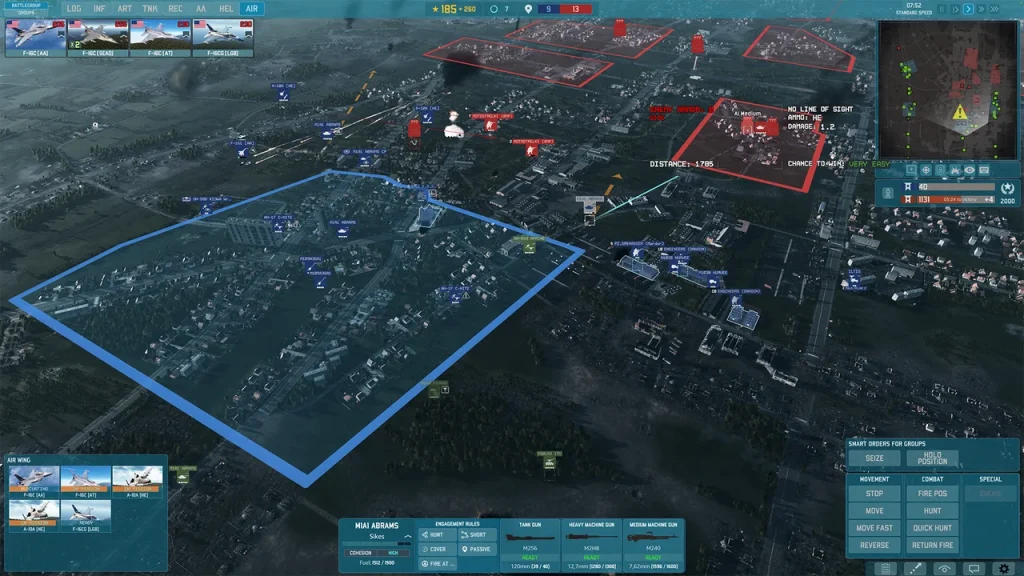
Build a WARNO deck around the jobs your force must perform: observe, occupy terrain, defeat armor, resist air threats, capture objectives and keep fighting. Good WARNO division deck building connects the chosen cards to an opening and a reinforcement plan. A collection of individually attractive units can still leave a battlegroup unable to solve the first problem it meets.
A division is the parent pool for your battlegroup, as the official game description explains. Work within that pool. The advice here is an editorial method for constructing a practical deck, not a current patch tier list or a tested optimal card allocation.

On this page
Write a battlefield plan in one sentence
Begin with an intended task, such as holding a village and covering the open approach beside it. That sentence gives you a way to judge cards. Infantry needs to secure the close terrain, reconnaissance needs to observe the approach, and anti-armor weapons need to threaten vehicles using it. Each purchase should contribute to the same plan.
For a different lane, the roles can stay familiar while their implementation changes. An exposed approach creates different movement and protection needs from dense urban fighting. Pick the division because its roster can support the intended job, rather than choosing a favorite expensive unit and hoping the rest of the deck will fit around it.
Eugen’s Deck Creation Rework says the division Gameplay summary describes strengths, drawbacks and playstyle tips. Use that information to identify a constraint you must accommodate. Signature units are described as distinctive, not necessarily strongest. Their presence should not settle every card choice.
Cover six jobs before adding luxuries
| Job | Question the deck must answer | A warning sign |
|---|---|---|
| Observation | Who sees the lane and watches a flank? | Combat units enter exposed ground before recon has a useful position |
| Terrain control | Who occupies the close terrain you plan to hold? | The opening depends on vehicles doing every task |
| Anti-armor | How do you threaten armor on that approach? | More infantry is the only planned reply to a protected tank |
| Air defense | How is the main group protected from relevant air threats? | Important units have no planned protection |
| Command | Who captures, and how is its route protected? | Objective control depends on a unit sent ahead alone |
| Sustainment | How do useful units get supply and recover? | The whole plan assumes the first ammunition and fuel are enough |
These are responsibilities, not instructions to select exactly one card from each category. A division can offer several ways to solve a job. Consider the unit’s actual weapons, movement, protection, availability and cost together. A role is covered only when the unit can do it in the terrain and force you expect to use.

Price the opening as a group
Draft an affordable opening from the deck before filling every remaining slot. Include the units that let the group work: reconnaissance, terrain holders, supporting weapons, command and appropriate protection. If buying the centerpiece prevents buying the support, change the centerpiece or the plan.
Use a hypothetical village-and-road exercise. Suppose your intended opening includes infantry for the village and an anti-armor weapon covering the road. A recon option must be able to find an observation point, and the command unit must have a route into the objective after the area is protected. Each card now has a job to justify.
Leave yourself a realistic response to first contact. You do not know the opponent’s exact opening. Spending every available resource on a force that only handles one imagined enemy can make the next purchase too late. Think through which support or replacement unit you would call if the initial assumption proves wrong.
Make the second purchase plan as deliberate as the first
The deck needs reinforcements, not only an opening roster. Ask what you will buy if infantry loses the close fight, armor controls the approach, an aircraft threatens the position or reconnaissance is destroyed. Your answer should name a function available in the deck, rather than an unavailable unit you wish the division had.
Where the deck editor offers tradeoffs between experience and available numbers, judge them against that reinforcement plan. Do not maximize one setting automatically. An experienced but limited option and a more numerous option solve different problems if you expect to replace losses or maintain several positions.
A specialist should earn its place by answering a recurring need. Artillery, aircraft and other supporting assets can contribute to the plan, but they should not silently displace the basic jobs needed to see, hold and capture terrain. Add them when you can explain what they help accomplish and how the rest of the deck supports their use.
Test what a card does, rather than how impressive it looks
Recon is a useful example. The official LOS article distinguishes field of view from detection affected by stealth. Pick a recon option for the position and target it must observe. Its presence in a list is not proof that the main force will receive useful information.
Command is another example. The command overhaul allows leaving a zone after capture. That gives the unit a continuing role, but the deck still needs the force that makes its approach safe. A capture asset cannot replace infantry, observation and combat protection.
Revise from a specific battlefield failure
After a match, record one concrete gap: insufficient observation, no suitable reinforcement against armor, weak protection for an important position or supply arriving too late. Change the card or opening that addresses that gap. Avoid replacing half the deck after one loss; you would lose track of which change helped.
Keep useful cards whose jobs were performed successfully, even if they did not produce dramatic kills. A scout that made the engagement possible or a command unit that completed the capture contributed to the plan. Continue with the WARNO beginner guide to connect the finished deck to its first movements. A playable deck is one you can explain in battlefield actions, including what happens after the opening.
Sources and further reading
- https://store.steampowered.com/app/1611600/
- https://steamstore-a.akamaihd.net/news/externalpost/steam_community_announcements/1822556746168512
- https://steamstore-a.akamaihd.net/news/externalpost/steam_community_announcements/5036749277232271511
- https://steamstore-a.akamaihd.net/news/externalpost/steam_community_announcements/5035621474415086677
Keep exploring
WARNO Recon Positioning: observe the fight before you join it
Put recon where it answers the force’s next movement question; preserve a useful view, cover the flank and move it when the front changes.
WARNO Command Unit Placement: capture safely, then use the leader
Bring command behind protection, complete the capture, then relocate or support nearby troops; WARNO does not require permanent parking after capture.
WARNO Beginner Guide: build a front before you chase kills
Begin with one lane, a combined-arms opening, recon ahead of the force and a command unit behind protection; reinforce the threat you actually see.