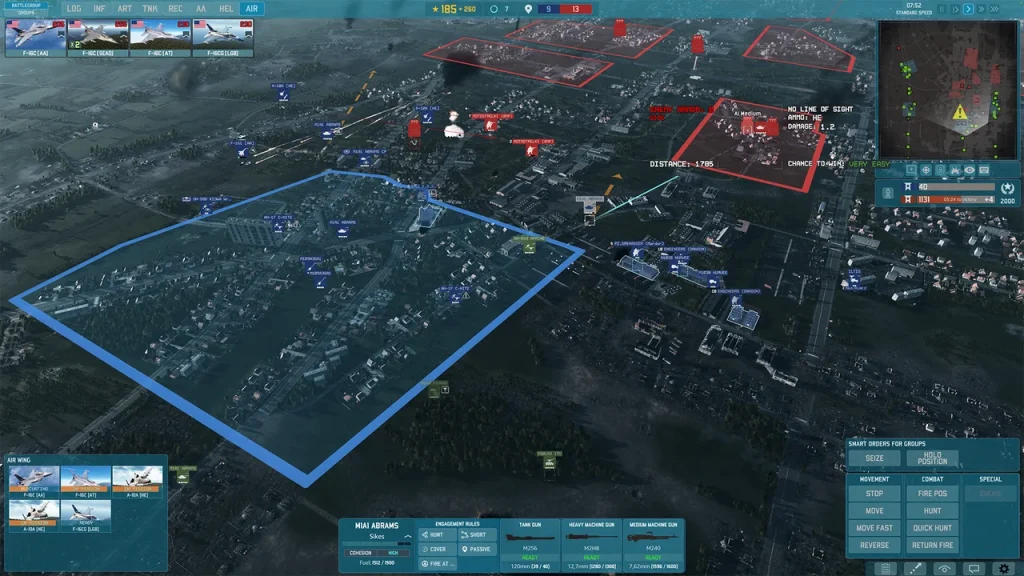
Place recon to observe the route your force is about to use, then add observation of the flank that could make that route unsafe. Good WARNO recon positioning gives the main force actionable information before it commits. A scout at the front of a column is not automatically useful if terrain prevents it seeing the approach you need covered.
The official description warns about ambushes and outflanking on maps with hills, villages, forests and industrial terrain. The following positioning method is editorial tactical advice built around those terrain problems and Eugen’s documented LOS system. It is not a tested opening for a named map or a guaranteed detection distance.

On this page
Give each scout an observation question
Before moving recon, name what it must observe. A useful question is whether an enemy is using the road beside the village you intend to occupy. Another is whether troops are moving through the side approach behind your anti-armor position. A scout’s placement is good when it helps answer that question while remaining useful to your force.
Do not begin with the rule that recon must always be as far forward as possible. Distance from your main group matters less than seeing a relevant approach without taking an unnecessary engagement. A position behind the first crest can be safe yet blind; a position with a useful view can be valuable even if it is not the most advanced point you could reach.
For a practice scenario, suppose your force plans to hold a village with a road on one side and a wooded flank on the other. Assign one observation task to the road and another to the flank exit. This is an example of dividing responsibilities, not a demand to buy exactly two scouts in every opening.
Separate field of view from detecting a hidden target
Eugen’s LOS explanation describes a field of view cut by buildings, forests and other obstacles or limited by distance. It also describes detection depending on an enemy’s stealth. Open-looking ground does not prove that every target on that ground will be found by the selected unit.
The documented C-key display can be used at a cursor position or centered on a unit. Use it before the main force commits, with a specific route or terrain edge in mind. Test the proposed scout position against that route, then consider the type of enemy you need detected. The tool’s detection simulation is relevant to that second question.
The official example distinguishes a white true-LOS boundary from blue areas in which the selected unit cannot detect potential enemies itself, even though allied detection can reveal them. Do not treat the whole overlay as one guaranteed detection area. Also keep weapon range separate: seeing or sharing a target is not a reason to assume a weapon can fire through a physical obstruction.

Deploy for useful information before the first fight
Pick a route toward the observation point that does not require the main force to discover the enemy for the scout. Recon should help determine whether the next commitment is safe. If armor reaches an exposed approach first and is already under fire, the information task arrived too late for that movement.
For recon infantry delivered by transport, make the observation position and the transport’s destination separate decisions. Use the unit in the terrain appropriate to its role rather than assuming the vehicle’s roadside stopping point is the ideal place to observe from. For a reconnaissance vehicle, consider both the view and the route through which it can leave a bad encounter.
Advance deployment, where the selected unit actually offers it, can help establish an earlier position. Judge that opportunity against the observation task and survival plan. Reaching the furthest possible point is not valuable if the scout cannot see the intended approach or cannot be supported when contact occurs. Check the selected unit’s real allowance rather than borrowing one from another division.
Make the firing force use the information
Once a threat is detected, give the combat units a plan that benefits from it. An anti-armor weapon needs an engagement position suitable for the approach you have observed. Infantry needs protection while moving toward close terrain. Recon’s contribution is incomplete if the rest of the group still drives blindly into a different route.
A useful response to a newly spotted armored threat is to stop an unnecessary exposed advance and arrange the available anti-armor coverage. It is not automatically to order the reconnaissance unit into the fight. Preserve the scout if its observation is what lets the force choose a better engagement.
If the scout meets an opponent it cannot sensibly handle, consider moving away while the supporting force addresses the threat. Recon that survives can establish another view. A needless duel can remove both a unit and the information on which the lane was relying. This is a tactical recommendation, not a claim that every recon unit has the same weapons or protection.
Move the observation task when the front moves
After securing the village, the old road view may no longer answer your next question. If the force is preparing to move beyond it, establish a new observation point for the next approach before shifting every combat unit forward. Keep the flank observation useful during that transition instead of assuming the captured position makes all rear routes safe.
When withdrawing, recon can help observe the route you need to use and the enemy’s likely approach. Decide which view matters now. A scout that remains in a dramatic forward position while the whole force retreats elsewhere may be providing information you can no longer act upon.
Diagnose the failure by the missing information
If units took unexpected fire, ask whether recon was absent, badly placed, late, unable to detect that target, or watching the wrong approach. Those are different problems. Adding another scout without changing an obstructed observation point does not automatically solve the geometry; moving the existing scout does not create better detection against every stealthy enemy.
Change one observation decision and repeat a familiar lane exercise. The deck-building guide helps select recon as part of a complete force, while the beginner guide connects its timing to the opening. Place recon where the next decision needs information, not wherever an isolated scout can travel.
Sources and further reading
Keep exploring
WARNO Command Unit Placement: capture safely, then use the leader
Bring command behind protection, complete the capture, then relocate or support nearby troops; WARNO does not require permanent parking after capture.
WARNO Division Deck Building: give every card a battlefield job
Build a division deck around an opening and reinforcement plan; cover battlefield jobs before spending cards on optional specialists.
WARNO Beginner Guide: build a front before you chase kills
Begin with one lane, a combined-arms opening, recon ahead of the force and a command unit behind protection; reinforce the threat you actually see.