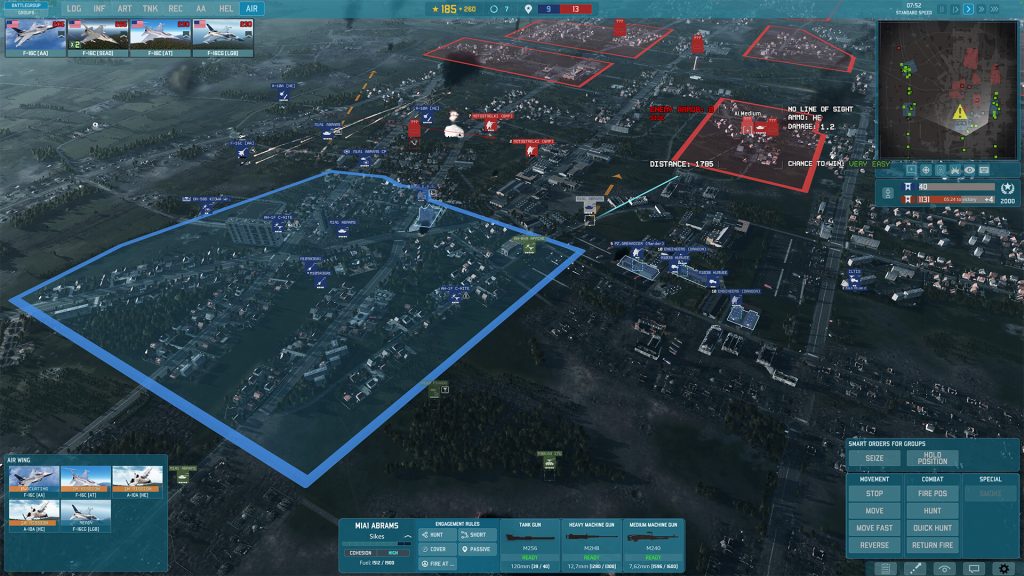
For WARNO urban combat, begin with the objective and what your units can actually observe, then assign a specific task. Check the intended position’s line of sight, inspect whether the selected weapon can engage the target and reassess as the game state changes. Sending additional units into a town without identifying the problem can repeat the same failed decision.
WARNO’s official description includes villages and industrial areas among its tactical terrain. A developer map explanation also discusses towns surrounded by fields and woodland, showing why the urban area and its approaches belong to the same decision. This guide uses game information and tools, without prescribing real-world tactics or fixed building bonuses.

On this page
Inspect the objective and the actual view into the town
Confirm what the town contributes to the current match before committing to it. Identify the objective location on the selected map, your observed units and the places where information is missing. A dense group of buildings can draw your attention even when your immediate objective requires a different task.
Use the game’s line-of-sight information from the position you intend to use. The developer describes a tool that accounts for spotting across different unit types, and later patch notes mention detection-range feedback. Read the actual feedback rather than assuming that an attractive position sees every street or approach.
Keep the last known enemy location separate from a current observation. If the enemy is no longer visible, treat that as a change in the information available. Do not base the next order on the certainty that a previously observed unit remains in the same place.
Match the selected unit to one game task
Give the unit a task you can assess: observe an approach, engage a currently visible target or support an objective-related position. Then inspect its current weapons and state. The official product description says the Armory allows detailed unit inspection and comparison, so use the unit you actually have instead of an assumed role attached to its name.
The Smart Target developer explanation describes feedback for incompatible weapons, broken line of sight and insufficient penetration. If an intended attack cannot happen, identify the reported reason. A different position can address a sight-line problem, while a different unit role may be needed for a weapon-target mismatch.
These are separate corrections. Buying another copy of the same unit does not by itself resolve a weapon that cannot engage the intended target. Likewise, changing weapons will not automatically restore a blocked view. Fix the condition indicated by the game before enlarging the commitment.

Decide whether to contest, support or preserve
Consider a hypothetical situation in which your unit reaches a town-side position but the intended target is no longer visible. First recheck observation and the objective. If your task was to engage that target, the missing information changes the decision; it is not a reason to issue the same attack repeatedly.
If the unit can still serve a useful objective-related role, keep that role explicit. If another unit can provide the missing information or a suitable weapon response, request that specific help. If the selected unit no longer has a useful supported task, consider preserving it for a different position instead of committing more units on the same assumption.
This is an editorial practice scenario, not a tested opening or a promise that withdrawal is always possible. Its purpose is to make the decision depend on observed information and available unit roles, rather than on a general rule to attack or defend every town.
Reassess when the local state changes
Recheck after the unit moves, the observed target changes or the relevant objective state changes. Look again at visibility, the selected weapon’s feedback and the unit’s condition. A decision made from one position can become unsuitable after even a small change in the engagement.
In a practice game, compare two town-side positions with one unit and one intended task. Observe which firing or spotting relationships the game supports from each. Change one part at a time so the lesson is specific enough to use in the next match.
Use this sequence whenever an urban engagement becomes unclear: objective, current observation, supported weapon task and the next reassessment. Choose the unit and order that solve the actual game problem. Check current game feedback for ranges, controls and terrain effects instead of treating an archived screenshot as a current build recommendation.
Sources and version scope
Sources read on November 10, 2026: WARNO official Steam description; WARNO developer introduction: Smart Target and line-of-sight tools (2021); TWIN CITIES available: line-of-sight improvements (2023); WARNO developer map and transport update. Official product modes and dated developer tool explanations support the game context. Communication examples and practice decisions are editorial advice. No universal team formation, shared-resource rule, fixed cover bonus, current key binding or tested winning tactic is asserted.
Sources and further reading
- https://store.steampowered.com/app/1611600/
- https://steamstore-a.akamaihd.net/news/externalpost/steam_community_announcements/4224938027302509533
- https://steamstore-a.akamaihd.net/news/externalpost/steam_community_announcements/5036749277244319217
- https://steamstore-a.akamaihd.net/news/externalpost/steam_community_announcements/4247462367448914600
Keep exploring
WARNO Recon Positioning: observe the fight before you join it
Put recon where it answers the force’s next movement question; preserve a useful view, cover the flank and move it when the front changes.
WARNO Command Unit Placement: capture safely, then use the leader
Bring command behind protection, complete the capture, then relocate or support nearby troops; WARNO does not require permanent parking after capture.
WARNO Division Deck Building: give every card a battlefield job
Build a division deck around an opening and reinforcement plan; cover battlefield jobs before spending cards on optional specialists.