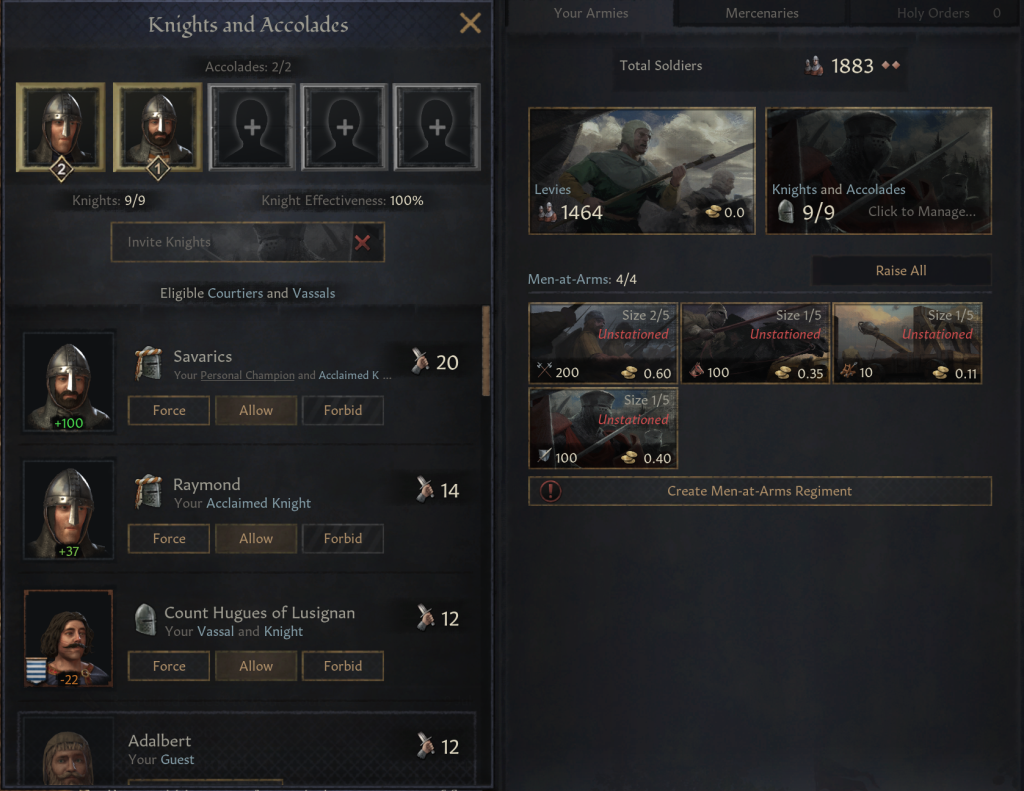
TL;DR: Improve Crusader Kings 3 knight effectiveness by combining strong serving knights with useful effectiveness bonuses, rather than stacking a percentage onto an empty or weak roster. Prowess affects an individual knight’s fighting strength; effectiveness increases the value of the knights you actually field. Recruit suitable replacements, fill available positions, and protect characters whose loss would damage your succession.
Knight management has several parts: who serves, how well each character fights, what bonuses support them, and whether the roster survives long enough to remain useful. A high-looking modifier is only one part of that system.

This guide distinguishes ordinary knights from acclaimed knights and their accolades. Those additional features have availability and succession conditions of their own. It does not assume every culture, government, or expansion setup offers the same roster or modifiers.
On this page
Crusader Kings 3 knight effectiveness: start with the serving roster
Open the knight list and identify who is actually serving. Available capacity, eligible characters, and permission to serve are different things. An unused position contributes nothing, and a high-prowess character cannot help the battle as a knight if that character is not in the fighting roster.
Sort candidates by prowess, then look beyond the top number. Consider health, age, eligibility, and the character’s other importance to the realm. A useful fighter who is likely to remain available can be a better long-term recruit than a celebrated character you cannot realistically retain.
The JamesTheSpot combat guide describes knights as a separate contributor to army quality and connects their individual strength with prowess. Its historical numerical formulas and capture probabilities are not used here.
Your first decision should be whether you have a roster problem or a modifier problem. If several positions are empty, recruit. If the roster is full but weak, improve the candidates. If the roster is already strong, an appropriate effectiveness bonus becomes a more valuable next investment.
Prowess and effectiveness solve different problems
Prowess belongs to the character. Knight effectiveness is a supporting modifier applied to knight performance. Increasing one does not remove the need to manage the other.
Think of two hypothetical armies with the same effectiveness bonus. One fields capable fighters; the other has missing positions and several weak candidates. The modifier does not turn them into the same roster. Improving the second army’s actual serving knights can be more useful than chasing another percentage increase.
Conversely, a strong roster can make an effectiveness bonus attractive because more useful fighting strength is being supported. The community military guide describes the relationship between individual prowess and knight efficiency; this guide uses that distinction without quoting its old numerical values.
Avoid comparing rulers by the effectiveness number alone. Compare serving capacity, candidate quality, and relevant supporting conditions. You want a roster that performs a military job, not a character screen that looks impressive while the army remains fragile.
Recruit candidates through the court you actually have
Consider available recruitment routes before planning an expensive cultural or lifestyle change. Suitable guests, invitations where available, and marriages that bring useful characters to court can improve the roster.
The marriage strategy guide discusses recruiting fighters and commanders through court marriages. The crucial decision is where the couple will live: an attractive match is not a successful knight recruitment if the relevant character leaves for another court.
Read the proposal’s court and marriage arrangement before accepting. Do not assume that selecting a strong candidate guarantees you can use that person. Rank, eligibility, acceptance, and the destination of the couple can change the practical result.
For a hypothetical example, an unmarried courtier can provide an opportunity to bring in a high-prowess partner under an appropriate arrangement. Compare that with the needs of the dynasty. A marriage used for recruitment is a different asset from the ruler’s heir marrying for an essential alliance, so do not consume the same family opportunity without considering both purposes.
Use serving permissions deliberately
Force, allow, and forbid controls determine whether eligible characters can be used as knights. They are useful management tools, but forcing service is a decision about risk as well as battlefield contribution.
Forbid an irreplaceable heir when preserving that person matters more than the fighting benefit. A talented family member can still be a poor choice for an unnecessary battle if the loss would make succession unstable.
Allowing ordinary candidates can preserve flexibility, while forcing a particular capable fighter ensures that the roster does not overlook that character when slots are limited. Review these decisions after deaths, recruitment, marriages, and succession.
Do not treat the controls as a guaranteed way to produce or prevent a particular event. Battle outcomes and character risks are uncertain. The purpose of the roster is to support a viable military campaign while preserving the people the dynasty needs afterward.
Choose bonus sources that fit the wider realm
Knight-related benefits can come from character development and other available military or cultural systems. Compare them with what you give up to obtain them. A modifier is more attractive when it complements the army and ruler you already have.
Read the complete effect of a cultural or lifestyle choice. Some options may support knight performance while imposing restrictions or costs elsewhere. Do not reduce the choice to the single number that improves the roster.
If your realm needs a functioning economy and siege capacity, spending every available resource on knight optimization can leave the army unable to complete the war. Knights contribute quality, but they do not replace every other military job.
A useful decision is to choose a supporting benefit when the roster is already strong and the rest of the military plan is funded. If the army cannot sustain a campaign, fix that constraint first rather than assuming better knights will remove upkeep, supply, or occupation requirements.

Separate knight management from commander selection
The knight role and commander role are different jobs. Prowess matters to individual fighting, while a commander contributes leadership and applicable army effects. A strong knight is not automatically the best commander for a long march or siege operation.
Select the commander according to the immediate task. A relevant terrain or siege trait can matter in a specific phase even when another candidate looks more impressive in a different statistic. Reassess when the army changes from movement to occupation or a field engagement.
For a hypothetical war, your best individual fighter can remain part of the roster while a different character commands the force. The point is to combine suitable roles rather than make every appointment a contest for the single strongest-looking character.
This distinction also matters for accolades. The official accolade diary states that a knight army modifier can support an army through the acclaimed knight’s presence without requiring that knight to command it.
Accolades add attributes, not just another effectiveness number
Where available, an accolade gives an acclaimed knight an additional role built around attributes and glory. The official diary explicitly distinguishes the feature from simply adding more knight effectiveness.
Read the attributes and decide how their benefits fit your army. Some support military roles, some provide other advantages, and the progression affects what you receive. An accolade suited to a particular regiment plan can be more useful than one chosen only for a prestigious name.
Compare eligibility with the desired attribute. Not every knight qualifies for every accolade, and not every existing fighter can become the acclaimed candidate you want. Avoid spending on an accolade before checking the candidate and intended benefits.
Keep ordinary roster maintenance active alongside the feature. An acclaimed knight does not make empty ordinary positions irrelevant, and a strong accolade cannot compensate for an army arriving depleted or fighting in an unsuitable situation.
Plan accolade succession before losing the holder
Accolades can continue through successors, but succession is not a promise that every previous benefit remains identical. The official diary describes the primary and secondary attribute distinction, glory loss, and changes that can occur when a successor does not share the same secondary qualification.
Identify a suitable successor while the current acclaimed knight is still available. If the court lacks a candidate, consider recruitment or the available successor-seeking interaction. Its availability and conditions should be part of the plan rather than assumed to be unlimited.
An inactive accolade does not provide its effects. Check whether the feature is active before crediting a modifier to the army. If a holder died and no suitable successor replaced them, your military plan may have lost more support than the ordinary knight list suggests.
For a hypothetical cavalry-focused army, an accolade helping that role may be a meaningful investment. If the succession changes its supporting attributes, compare the new arrangement before expanding the cavalry again. The name of the accolade alone does not prove that the old effect continues.
Keep the roster alive through sensible army operations
Good knights still need a usable army. Avoid fighting before gathering is complete, with badly depleted regiments, or under a supply problem that undermines the entire force. A roster built over several years can suffer losses in an unnecessary engagement.
Read the route and opponent before committing. If the enemy is stronger and the war objective does not require an immediate battle, consider a different timing or concentration plan. Knight quality is a reason to use the army well, not a reason to ignore the rest of the battle conditions.
After a battle, review casualties and replacements. Do not assume the roster automatically returns to the previous level of quality. An empty position or newly available weak fighter can change the next engagement even when the effectiveness modifier remains unchanged.
Recruit before the next war where practical. Replacing a lost veteran in the middle of a crisis gives you fewer choices than maintaining a usable pool of candidates during peace.
Diagnose disappointing results in the right order
Start with the army and battle conditions, then the roster, then the bonuses. Check that the knights were actually present and allowed to serve. Confirm whether important positions or accolades had become inactive.
Next, compare the individual candidates. A roster that lost several capable fighters can be weaker even if the total number of knights looks unchanged. Check replacements rather than assuming every occupied slot represents the same value.
Only then decide whether another effectiveness investment is the right answer. If the army lost because it was depleted, attacked a poor location, or could not recover supplies, the largest problem may lie outside knight optimization.
For broader context on military choices inside a dynasty campaign, see the published Hearts of Iron 4 versus Crusader Kings 3 comparison. Your next action should be a roster audit: fill the useful positions, protect the essential people, and match any new bonus to the army you intend to field.
FAQ
Is knight effectiveness the same as prowess?
No. Prowess describes an individual character’s fighting strength. Effectiveness supports the performance of the knights you actually use. Manage both rather than comparing only one number.
Should I force my heir to serve if they have high prowess?
Not automatically. Compare the military benefit with the succession risk. A capable replacement fighter can be easier to find than a replacement for an essential dynastic heir.
Do acclaimed knights have to command the army?
Not for the knight army modifier described in the official accolade diary. Their presence can provide that effect; commander selection remains a separate decision.
Why did an accolade stop helping?
Check whether it is active and has a valid holder, then inspect its current attributes and glory. Succession or an inactive state can change the support available to the army.
Sources and further reading
- https://steamcommunity.com/sharedfiles/filedetails/?id=2222736076
- https://store.steampowered.com/news/app/1158310/view/5133583099813563352
- https://store.steampowered.com/news/app/1158310/view/6557848386941142486
- https://steamcommunity.com/sharedfiles/filedetails/?id=2388342923&l=english
- https://steamcommunity.com/sharedfiles/filedetails/?id=2846475771
Keep exploring

Crusader Kings 3 faith reformation: holy sites, rites and the realm afterward
Reform an unreformed rite with holy-site access and Piety, then check doctrine choices, divergence and which rulers will follow the change.
Crusader Kings 3 cultural innovations: choose the unlock your realm needs
Prioritize the innovation that removes a current realm obstacle; check the head, matching skill, cultural Development, spread and era restrictions.

Manor Lords vs Crusader Kings 3: build a town or guide a dynasty?
Pick Manor Lords for a medieval settlement and its household economy; pick Crusader Kings III for rulers, relationships and a realm passed between generations.