TL;DR: Choose a Crusader Kings 3 casus belli by what victory gives you, who receives the title, and which enemies can join the war. A personal claim, someone else’s claim, a de jure war, conquest, and a holy war are different routes with different conditions. Confirm the beneficiary and objective before spending resources on the declaration.
A casus belli is a reason to wage a particular war. It is not a general permission to take every county occupied along the way. The chosen reason defines the political result you are trying to achieve.

This guide focuses on ordinary landed campaigns and explains how to compare available options. Government, faith, culture, rank, innovations, and special campaign systems affect which reasons a ruler can use. There is no single expansion route available to every character.
On this page
Crusader Kings 3 casus belli: start with the intended result
Identify the title or relationship you want to change. Do you want personal land, a new vassal, a larger realm, or a claim pressed for a family member? Those goals can point to different declarations against the same ruler.
Next, inspect the result of enforcing demands. Confirm which character receives the title and whether that character becomes or remains your vassal. A title gained by someone else can benefit the dynasty without becoming part of your personal domain.
The archived Gamepressure titles guide distinguishes personal claims from wars pressed on another character’s behalf. It also explains the importance of title rank. Read the beneficiary and relationship together rather than assuming every victorious claimant joins your realm.
For a hypothetical example, pressing a courtier’s claim to a high-ranking title may be useful if the political result serves your plan. It is a poor substitute for a personal county claim if your immediate goal is stronger direct income. Choose the transaction you actually need.
Use a personal claim when the title itself is the goal
A personal claim provides a legal basis for pursuing a title held by another ruler. Claims can come from inheritance, fabrication, and other available interactions. Having a claim does not by itself transfer ownership or make the war affordable.
Inspect the holder of the claimed title and the ruler you must fight. A county holder inside a larger realm can lead you into a war against a stronger liege rather than an isolated local opponent.
Also distinguish the claim from the war’s outcome. Occupying nearby holdings may help warscore, but it does not expand the declaration into a right to keep every occupied county. The intended target remains the title selected by the casus belli.
Before using the claim, compare its value with the military cost and the role of the land afterward. If it is useful personal territory, plan control recovery and domain capacity. If you intend to grant it away, identify a suitable recipient and the political arrangement in advance.
Press another person’s claim deliberately
Someone else’s claim can provide an expansion route, but the claimant receives the contested title rather than you taking it directly. Whether the resulting ruler belongs under your authority depends on the actual war result and rank relationship.
This can be useful when you want a particular family member established or a suitable claimant brought into the realm. It can also create a stronger ruler outside your control if you misunderstand the result.
Inspect the claimant’s current position, relevant title, and expected relationship after victory. Do not spend a long campaign installing a character whose new status defeats your original objective.
A practical comparison is between two available wars: one gives you a useful county, while another installs a relative over a larger area. Neither is automatically better. The first strengthens the personal domain; the second may serve a wider dynasty or realm plan. Choose according to the problem you are solving.
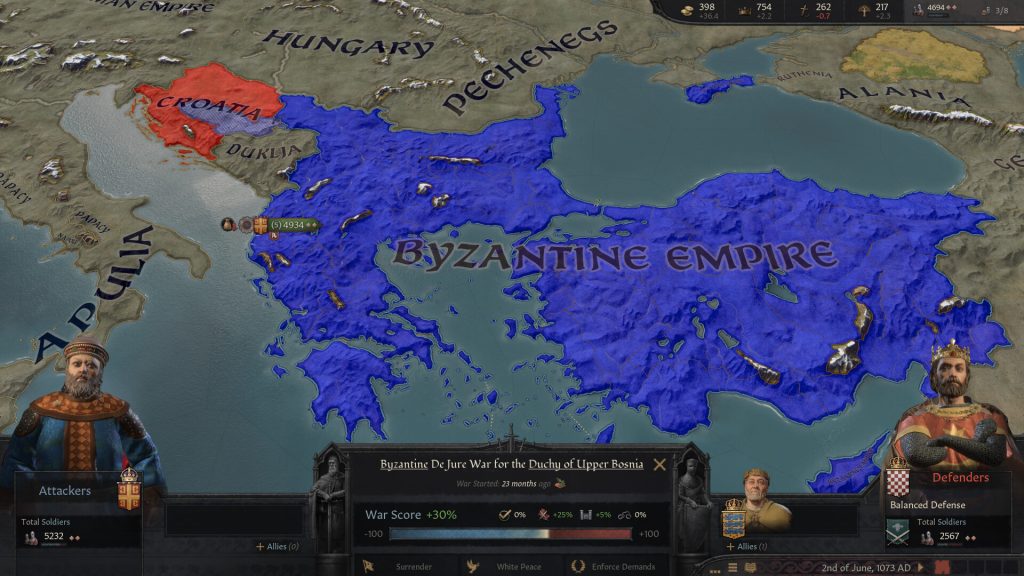
De jure wars follow a title’s legal structure
De jure territory refers to the lands associated with a title’s legal structure. A de jure war can help bring those lands under the appropriate higher title where the ruler has access to that war reason.
Owning a prestigious title does not make every related war immediately available. Relevant innovations and other conditions matter. If the declaration is unavailable, identify the missing condition instead of repeatedly acquiring more unrelated claims.
Use the de jure view to understand the intended political arrangement. A county currently belongs to a ruler, but it also sits inside a legal hierarchy of larger titles. Those are separate facts, and a war changes actual control rather than merely the map’s historical association.
Do not assume a de jure objective produces the same personal ownership result as a personal claim. Read the enforcement result. The reason can be useful for organizing a realm even when its purpose is not to fill the ruler’s personal domain.

Conquest depends on the ruler’s available rules
Conquest and subjugation options can provide different routes from claim fabrication. Their availability depends on the ruler and campaign systems, including government, faith, and other conditions.
The archived government guide describes how military expansion differs between traditional government types. Its old numerical clan rules are not used here. The practical lesson is to plan around the options your actual ruler has.
Read the scope and usage conditions. A broader war reason can be more efficient for expansion, but the larger military and political result still needs to be governable. Limited-use opportunities should serve a valuable objective rather than the first target that happens to be available.
After conquest, account for control, new vassals, succession, and the economy. Winning a larger area can increase the work needed to stabilize the realm. The best casus belli is not always the one that colors the most territory at once.
Holy wars require a wider enemy assessment
A holy war uses the religious relationship between attacker and defender. It should be planned with attention to nearby rulers who may support the defender, rather than only the army number beside the selected target.
The official AI diary discusses changes to religious defense and the importance of nearby rulers joining a holy war. It is evidence for considering broader opposition, not a current promise about exactly which personality will join in every save.
Before declaring, compare the local religious landscape, possible allies, army condition, and available funds. A weak-looking target can become a larger conflict if other defenders participate.
Also consider the aftermath. New territory with different local religious conditions can need political and administrative attention. The declaration’s religious basis does not automatically make the captured land easy to govern.
Compare costs against the entire campaign
Declaration costs are only the beginning. Estimate raised army expenses, siege time, travel, and likely recovery. Keep resources for complications rather than using the last available funds to unlock a war you cannot finish.
Check enemy alliances and current wars. A ruler already under pressure can offer an opportunity, but do not assume those conditions remain unchanged throughout your campaign. Plan for the plausible response rather than a guaranteed sequence of distractions.
Your own internal situation matters too. A dangerous faction or an unstable succession can make an otherwise useful external war badly timed. The casus belli can be valid while the declaration remains a poor decision.
For broader context on CK3’s character and realm focus, see the published Hearts of Iron 4 versus Crusader Kings 3 comparison. A legal reason should support a viable ruler and dynasty plan, not operate separately from it.
Fight for the chosen objective
During the war, use the objective to decide where the army goes. Occupations, battles, and prisoners can affect warscore, but a needless chase far from the contested territory can consume supplies and delay victory.
Protect your important holdings while occupying the relevant targets. A war fought for one county should not expose the capital and dynasty to an unnecessary siege elsewhere.
Before enforcing demands, read the result again. Then pause after victory to inspect ownership, vassals, control, domain capacity, and succession. Finish the political transaction before opening another one.
FAQ
Does occupying land mean I keep it after the war?
Not automatically. Occupation helps prosecute the war; the selected casus belli determines the enforced political result. Read the targeted title and beneficiary.
Why did the new title go to someone else?
You may have pressed another character’s claim. The claimant receives that title, and the resulting relationship depends on the actual enforcement outcome and rank.
Why can another ruler declare a conquest that I cannot?
Government, faith, culture, innovations, rank, and special campaign conditions can change available war reasons. Build the plan around your ruler’s options.
Which war should I choose first?
Choose an affordable war with a clear beneficiary, useful objective, and governable aftermath. A small result that strengthens the ruler can be more useful than a larger declaration you cannot sustain.
Sources and further reading
Keep exploring

Crusader Kings 3 faith reformation: holy sites, rites and the realm afterward
Reform an unreformed rite with holy-site access and Piety, then check doctrine choices, divergence and which rulers will follow the change.
Crusader Kings 3 cultural innovations: choose the unlock your realm needs
Prioritize the innovation that removes a current realm obstacle; check the head, matching skill, cultural Development, spread and era restrictions.

Manor Lords vs Crusader Kings 3: build a town or guide a dynasty?
Pick Manor Lords for a medieval settlement and its household economy; pick Crusader Kings III for rulers, relationships and a realm passed between generations.