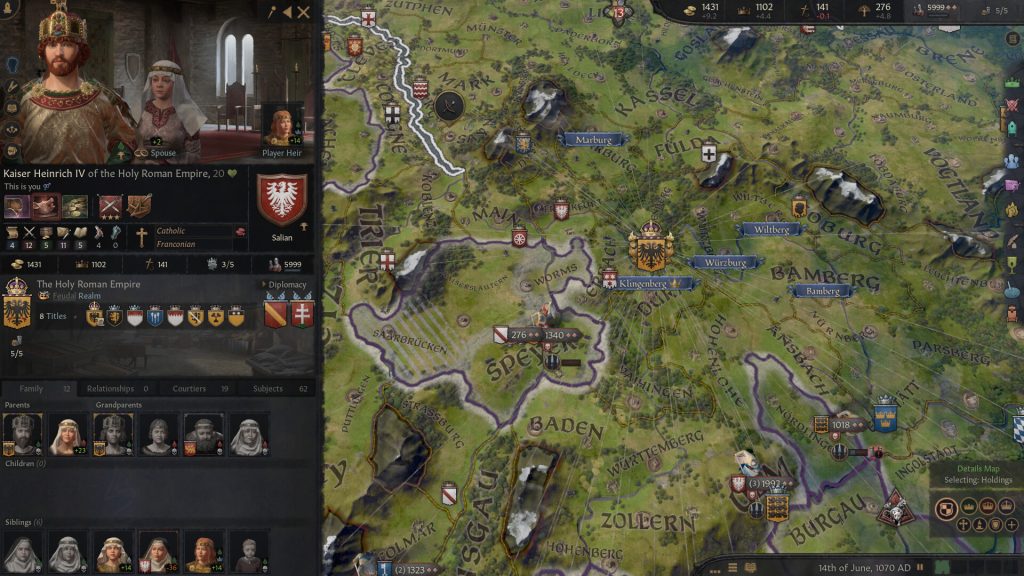
TL;DR: Choose Crusader Kings 3 marriage alliances by the help you can actually use, while protecting dynasty succession and the intended court arrangement. Compare an ally’s location, current wars, military condition, and likely obligations. The largest army on a marriage list is not automatically the best partner for your next conflict.
A marriage can serve several purposes: an alliance, spouse skills, dynasty continuation, claims, or court recruitment. Decide which purpose matters most before choosing the candidate, because those benefits can compete.

This guide focuses on ordinary landed dynasty planning. Marriage rules, eligibility, faith, government, and special campaign systems affect the available arrangements. No match guarantees a particular child, inherited trait, or military victory.
On this page
Crusader Kings 3 marriage alliances: name the war or threat
Begin with the reason you need an ally. You may want protection from a dangerous neighbor, support for a planned conquest, or a political relationship that stabilizes the realm.
Then identify a partner who can help that objective. A distant ruler with a large army may take too long to contribute, while a nearby partner with a more modest force can be relevant to the actual front.
The marriage strategy guide discusses the competing purposes of court marriages and the obligations of alliance partners. Its numerical examples and exploit recommendations are not used here.
For a hypothetical coastal war, compare a distant ally requiring a long transfer with a nearby ruler able to approach the front more directly. Location does not guarantee participation, but it helps distinguish visible strength from usable support.
Inspect the partner beyond the army number
Open the potential ally’s situation. Check current wars, the state of the realm, and existing commitments. A ruler already fighting several conflicts may be a less dependable addition to your own plan.
Look at the intended enemy’s relationships too. A candidate connected to the opposing side can produce restrictions or political complications that the marriage list alone does not explain.
Consider the durability of the arrangement. An aging ruler or an unstable realm can change the alliance sooner than you expect. Do not base an entire long campaign on a relationship you have not checked beyond its present military total.
Use these facts to form a shortlist, then compare acceptance and marriage consequences. Avoid committing first and discovering afterward that the partner cannot serve the purpose you had in mind.
Preserve the dynasty before accepting the proposal
Inspect the couple’s arrangement, the children’s dynasty, and the expected court destination. A marriage that gives useful military support can still endanger the dynastic path if the resulting heirs belong elsewhere.
This matters particularly when the marriage involves the player heir or a character expected to continue the main line. Read succession alongside the proposal rather than treating the alliance as a separate transaction.
The archived first-steps guide shows why the spouse, current heir, and succession deserve an opening inspection. The titles guide explains how claims and title inheritance can add another consequence.
Do not assume that choosing a matrilineal or ordinary arrangement has the same effect in every proposed match. Confirm who belongs to which dynasty and where the relevant people will live.

Separate an alliance marriage from a spouse-skills marriage
The ruler’s spouse can support the character’s practical role, while another eligible close-family marriage may provide the desired alliance. Consider whether those jobs need to be combined in the same proposal.
For a ruler trying to manage a strained personal domain, useful spouse skills can matter throughout the reign. Choosing solely for a distant army can sacrifice that benefit for support you rarely use.
Conversely, a serious immediate threat can justify prioritizing military support. The decision should reflect the campaign situation, not an automatic rule that one purpose always wins.
A hypothetical plan uses the ruler’s marriage for useful long-term support and a sibling’s available marriage for a nearby alliance, where the arrangements are eligible. It is a comparison to consider, not a promise that every starting family has those options.
Account for the wars the ally may ask you to fight
An alliance creates obligations in both directions. The partner can call on you while your own army is recovering, your treasury is low, or an internal faction demands attention.
Read requests and the consequences of the available response. Do not assume you can accept every call, contribute nothing indefinitely, and keep the relationship unchanged.
Before arranging the alliance, inspect whether the partner regularly faces conflicts that would interfere with your own objectives. A powerful ally can be useful while still imposing expensive commitments.
For a small realm planning one affordable war, several unnecessary alliances can create more obligations than military benefits. Choose a purposeful relationship rather than filling every available family marriage with the largest candidate.
Betrothals need the same political review
When using a betrothal, distinguish the arrangement promised for the future from the relationships it currently establishes. Read the actual proposal and alliance information rather than assuming every pending marriage works identically.
Revisit the plan as characters age and circumstances change. Deaths, succession, war, and new family members can alter the value or viability of a long-term match.
Keep the heir’s development in mind. A useful future marriage should support the character who will actually take power, not merely solve an old ruler’s temporary problem at the cost of the next reign.
Do not reserve every family option so tightly that the new ruler has no flexibility. Available close-family marriages can help rebuild relationships when the political situation changes.
Review alliances after succession and before declaration
The old ruler’s alliances should not be treated as permanent properties of a title. After succession, inspect which relationships remain and which need to be negotiated or rebuilt.
Sputnik’s succession guide emphasizes preparing the incoming ruler’s ability to form alliances. Its specific opinion and budget values are not used here.
Before a new declaration, confirm the ally’s present availability and obligations. A relationship that helped the previous war may be less useful while the partner fights elsewhere or faces a changed political situation.
For wider context on CK3’s dynasty focus, see the published Hearts of Iron 4 versus Crusader Kings 3 comparison. Your next action is to shortlist a partner for a named need, then check the dynasty and court consequences before proposing.
FAQ
Should I choose the marriage offering the largest allied army?
Not automatically. Compare location, current commitments, military condition, and the marriage’s effect on dynasty and succession.
Can an alliance marriage hurt the succession plan?
Yes. The couple’s arrangement, children’s dynasty, and court destination can matter more than the immediate military benefit. Inspect them before accepting.
Do I keep every alliance when the ruler dies?
Do not assume so. Inspect the new ruler’s actual relationships and rebuild the important ones after succession.
What makes a useful first alliance?
A partner who can help a real nearby threat or objective, without sacrificing the heir’s viable dynastic path or creating obligations the realm cannot sustain.
Sources and further reading
- https://www.gamepressure.com/crusader-kings-3/first-steps/z4f0f8
- https://www.gamepressure.com/crusader-kings-3/titles/zff0fc
- https://www.gamepressure.com/crusader-kings-3/vassals/z0f0fd
- https://store.steampowered.com/app/1158310/
- https://steamcommunity.com/sharedfiles/filedetails/?id=2388342923&l=english
- https://steamcommunity.com/sharedfiles/filedetails/?id=2776845816&l=english
Keep exploring

Crusader Kings 3 faith reformation: holy sites, rites and the realm afterward
Reform an unreformed rite with holy-site access and Piety, then check doctrine choices, divergence and which rulers will follow the change.
Crusader Kings 3 cultural innovations: choose the unlock your realm needs
Prioritize the innovation that removes a current realm obstacle; check the head, matching skill, cultural Development, spread and era restrictions.

Manor Lords vs Crusader Kings 3: build a town or guide a dynasty?
Pick Manor Lords for a medieval settlement and its household economy; pick Crusader Kings III for rulers, relationships and a realm passed between generations.