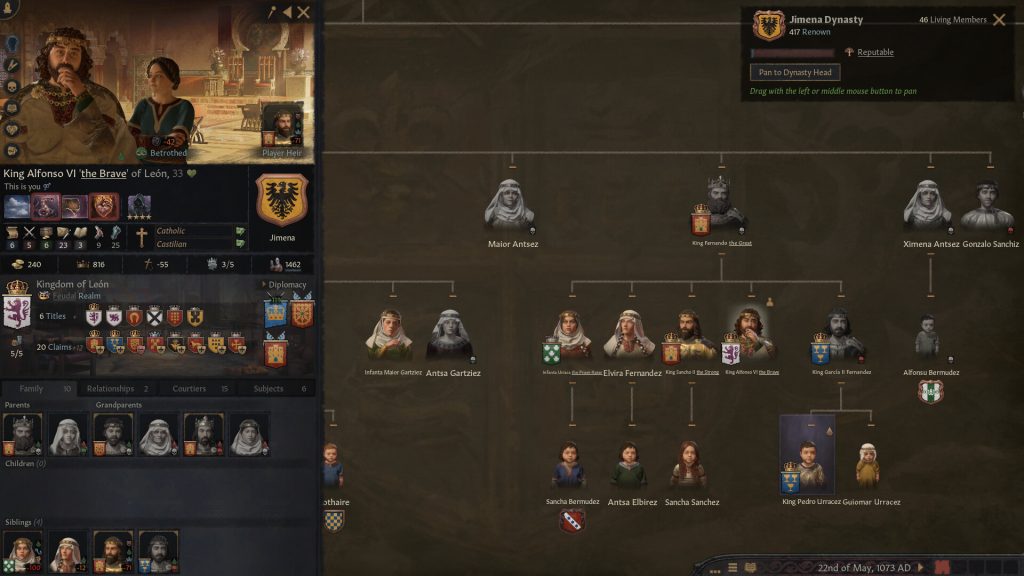
TL;DR: Crusader Kings 3 claim fabrication creates a legal claim to pursue; it does not transfer land or pay for the war. Choose a county worth taking, assign the available religious councillor’s fabrication task, reserve funds for the outcome, and inspect the claim before declaring. Plan the war and the new holding’s role while the task runs.
A fabricated claim is useful when it opens an affordable, meaningful expansion route. It is less useful when you buy access to land you cannot reach, cannot win, or do not have a plan to govern.

This guide focuses on the ordinary religious-councillor route in landed play. Government, faith, councillor roles, and other campaign systems can affect the available action. It gives no guaranteed completion date or fixed claim price.
On this page
Crusader Kings 3 claim fabrication: choose the county first
Identify what the target adds to your position. It might strengthen the personal domain, connect existing territory, help complete a useful title, or provide a holding you intend to grant to a suitable vassal.
Then inspect who currently controls it. A weak count inside a powerful kingdom is not necessarily an isolated opponent. Your declaration may involve the wider realm and its alliances.
The archived Gamepressure titles guide describes claims as a legal route to titles and names the religious councillor’s fabrication task. Use that legal route to support a campaign goal rather than simply selecting the nearest county.
For a hypothetical small duke, a reachable county inside the intended personal core can be a better target than an isolated rich-looking holding across a hostile region. Access, defense, and the war’s political result all matter.
Assign the task and read its actual conditions
Open the council, select the available religious councillor, and choose the claim-fabrication task. Select the intended target location and confirm that the task has been assigned there.
- Inspect the councillor and task conditions.
- Confirm the target county and current title holder.
- Reserve resources for the potential claim outcome.
- Prepare an affordable war while the task proceeds.
- Read the resulting event or claim before accepting a new obligation.
Councillor skill and the task’s stated effects deserve attention, but they do not justify a promised universal deadline. Do not describe the progress estimate as a guarantee that every campaign finishes on the same day.
Avoid changing the target repeatedly without a reason. A new attractive county is not enough if the original target still serves the plan and the process is already underway.
Keep payment funds separate from the war chest
The claim’s cost and the campaign’s cost are different. You may need resources to accept the fabrication outcome, then more to maintain a raised army, travel, and complete sieges.
Before starting, estimate the army you intend to use and the likely occupation phase. A purchased claim is a poor investment if the treasury cannot support the war it enables.
The archived gold guide explains why military costs and long-term income compete for resources. Do not spend the same reserve on construction while counting it as money available for the claim and declaration.
For a hypothetical opening, delay an optional building upgrade if it would leave no flexibility for the claim outcome and campaigning costs. If the target is not urgent, the opposite decision can also make sense: strengthen recurring income first, then fund expansion.

Verify the claim after the task succeeds
Inspect the claim on the ruler or relevant title. Confirm the claimant, target, and claim type. A claim belongs to a character; it is not a permanent property of the realm under every succession rule.
Do not assume an event always provides the exact scope you initially imagined. Read the available outcome and what you would receive before paying or changing the war plan.
The titles guide distinguishes fabricated unpressed claims from other claim relationships. Review the actual inheritance implications if the ruler is unlikely to use the claim during the current reign.
If you intend to press someone else’s claim, keep the beneficiary clear. That is a different transaction from fabricating a personal claim and taking the title for the ruler.
Confirm the declaration before raising the army
Open the available war options and check the target title, beneficiary, costs, and enforcement result. A valid claim does not mean every occupied county becomes yours after victory.
Inspect the enemy’s allies, current conflicts, and the route to the objective. Consider whether your own realm can tolerate an external war while the army is away.
Also read any legal restriction on the declaration. A truce, liege-related condition, or other limitation can make an immediately available claim unusable for the intended timing. Buying the claim and being able to prosecute it are separate steps.
Choose a useful moment rather than declaring merely because the task finished. A recovering army or dangerous faction may justify waiting, provided the claim remains usable for your plan.
Compare fabrication with other available routes
Before repeating the task for another county, inspect the claims and war reasons you already have. Inheritance, relevant religious interactions, de jure options, or other available rules can sometimes provide a different route.
The archived government guide describes claim fabrication as particularly relevant to feudal expansion among same-faith neighbors. It does not mean every government should fabricate claims before every war.
Avoid manufacturing a claim that duplicates an existing useful option. Compare the scope, beneficiary, cost, and political aftermath of each route.
For a hypothetical ruler already holding an applicable claim, funding the military may be more useful than assigning another fabrication task. Conversely, when no suitable alternative exists, a carefully chosen personal claim can provide a clear first objective.
Prepare the county’s role before victory
Decide whether the new land belongs in the personal domain or under a vassal. Check current capacity, the core territory you want to retain, and the succession plan.
After victory, inspect control and the new holding’s condition. A county added to the realm is not automatically a fully productive part of the ruler’s economy.
If you grant it away, read the recipient and title relationship carefully. A political gift should support a stable realm rather than create an unnecessarily powerful rival.
For broader context on claims and characters in CK3, see the published Hearts of Iron 4 versus Crusader Kings 3 comparison. The next step is to choose one useful target and fund the complete claim-to-war plan.
FAQ
Does fabrication give me the county immediately?
No. It provides a claim. You still need an available route to press it and a military plan for the resulting war.
How long does fabrication take?
Use the task’s actual information for your councillor and campaign. There is no universal guaranteed completion date in this guide.
Why can I not declare war after gaining the claim?
Inspect the stated declaration restriction. The claim, costs, truces, liege conditions, and other rules are separate parts of availability.
Which county should I fabricate on first?
Choose a useful, reachable target you can afford to take and govern. An attractive-looking county is not necessarily a sensible first war.
Sources and further reading
Keep exploring

Crusader Kings 3 faith reformation: holy sites, rites and the realm afterward
Reform an unreformed rite with holy-site access and Piety, then check doctrine choices, divergence and which rulers will follow the change.
Crusader Kings 3 cultural innovations: choose the unlock your realm needs
Prioritize the innovation that removes a current realm obstacle; check the head, matching skill, cultural Development, spread and era restrictions.

Manor Lords vs Crusader Kings 3: build a town or guide a dynasty?
Pick Manor Lords for a medieval settlement and its household economy; pick Crusader Kings III for rulers, relationships and a realm passed between generations.