On this page
Total War Warhammer 3 Kislev Supporters: TL;DR
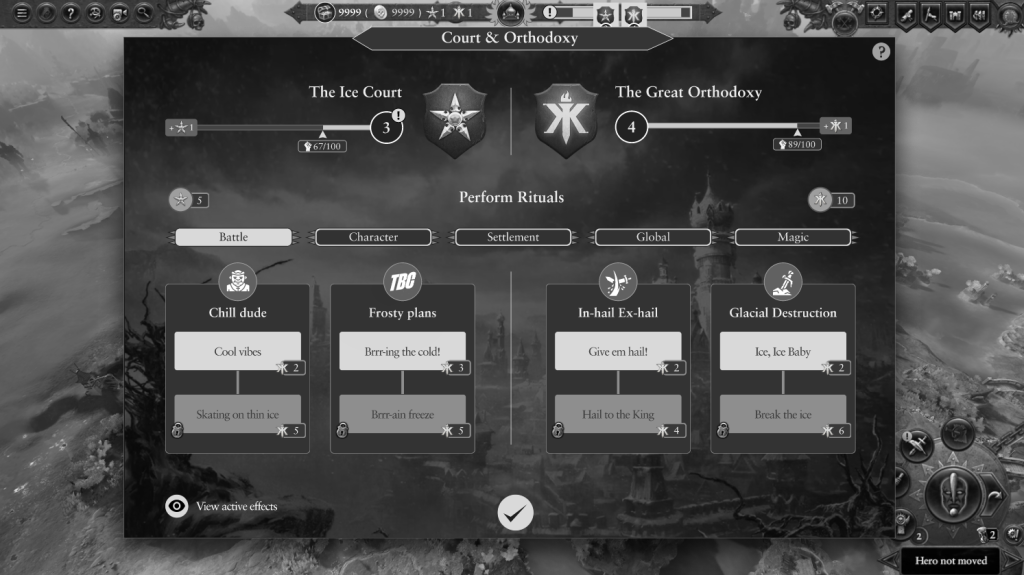
Total War Warhammer 3 Kislev supporters now belong to Court and Orthodoxy, rather than the old race to confederate your rival. Build support for both institutions, earn their Boon tokens, and watch the imbalance warning before committing another aligned building or Ataman. Devotion is a separate provincial resource used for local and army invocations.
The practical goal is to earn permanent benefits without letting one institution’s lead create escalating penalties. Every 100 support earned with an institution raises its support tier and grants a token under the published 6.1 rules. Choose the next reward around your actual army and economy, then deliberately develop the other institution when the balance becomes uncomfortable.

If an older guide tells you to reach the end of a supporter race to absorb Katarin or Kostaltyn, it describes the earlier system. The official 6.1 release notes replaced that competition and restored standard Kislev confederation. This guide explains the replacement and the decisions it creates. For other faction systems, use the WARHAMMER III guide hub.
Open Court and Orthodoxy before choosing new buildings
Read each institution’s support tier, current progress and balance warning together. A higher tier is useful because it unlocks rewards, but the difference between the two institutions also matters. Maximizing a single bar without checking the other can create a problem that a seemingly profitable building choice then makes worse.
The released system is available to all Kislevite factions, including Mother Ostankya. It is not exclusive to Katarin’s Ice Court or Kostaltyn’s Great Orthodoxy. You are building relationships with both institutions even when the lord you selected has another personal campaign feature.
The patch lists aligned construction, fighting an institution’s enemies and dedicating Atamans among the support sources. Read the current effects of each candidate building rather than assuming that every religious building produces the same support or that every trained character benefits the same institution. Record which side needs help before spending treasury on several provinces at once.
For example, suppose your main army already uses common line troops and the next Orthodoxy reward fits it well. You can work toward that reward while preparing an Ice Court building elsewhere. The second investment has a purpose: it keeps future support flowing to the side you would otherwise neglect. It is better than discovering the imbalance only after several completed upgrades.
Spend Boon tokens on a current need
Pick rewards that your existing forces and provinces can use. The developer preview describes Orthodoxy benefits around common troops, the economy and invocations, while Ice Court support favors elite infantry, spellcasting and heroes. The installed panel supplies the actual rewards and their recipients.
An elite infantry bonus has limited immediate value when you cannot recruit that infantry or cannot afford a second expensive army. A common troop reward can help several modest forces, while an economic reward can support another front. Neither choice is automatically best. Check the army roster, recruitment access and upcoming wars before choosing.
Treat permanent rewards differently from temporary army effects. A Boon is a progression choice; an invocation is a local Devotion purchase. Do not spend a token expecting an immediate province ritual, or burn provincial Devotion because you think it advances the old supporter competition.
Inspect restrictions carefully. Hotfix 6.1.2 adjusted the Common Steel Orthodoxy Boon and corrected several Kislev effects. Its existence is a useful reason to trust the current reward description over a launch screenshot. This article does not supply a fixed reward ranking or assume those historical values remain unchanged.
Use Atamans to support a planned balance
Dedicate an Ataman to the institution you want that province to support. Make the choice alongside its defensive and governing role. An Ataman in a threatened province still needs skills that let its garrison perform its job; support generation is one part of that assignment.
After 6.1, Atamans have their own skill trees and gain experience through administration. They are defensive governors rather than lords you recruit permanently to lead a normal field army. They also enable garrison sally attacks within their controlled province, so an appointment can connect provincial defense and institution progression.
Before replacing a dedication, check what your other provinces already contribute. Several governors pointed toward the same institution can create a steady imbalance that a single new building will not quickly undo. Plan the portfolio across your territory instead of evaluating each governor in isolation.
Character traits can be another source. Hotfix 6.1.2 specifically states that Court Agent on Ice Witches and Frost Maidens gives Ice Court support per turn. That is a named trait effect, not a promise that all such characters automatically generate support. Read the trained character’s actual trait before counting it in your plan.

Keep support and provincial Devotion separate
Devotion replaced Control for Kislev in the rework. It belongs to provinces, with effects and spending rules distinct from Court and Orthodoxy. A province with enough Devotion can support local or force invocations, but that expenditure does not make it the same currency as a Boon token.
Check the provincial trend before using an invocation. The released notes explain that high Devotion can negate climate penalties and that spending Devotion can remove that benefit. A border province might be more valuable as a stable recruitment base than as a source of one immediate army boost.
The initial 6.1 invocation requirement was later adjusted. Hotfix 6.1.2 lowered the eligibility requirement to 25 or more Devotion while retaining a 50 Devotion cost. Therefore, do not copy the original release threshold without checking the live tooltip. Eligibility and the amount spent are separate facts, and the post-spend province may be much less comfortable.
Use the same caution with wars against another Kislev faction. Standard confederation is now available, and the rework removed the old restrictions on declaring war between Kislev factions. War can still create provincial Devotion consequences. Being allowed to declare war does not make it a cheap way to manage support or domestic stability.
Manage the imbalance before it becomes your next crisis
Favor one institution for a useful reward, but monitor the margin you are allowed. The release notes say that undue favoritism produces escalating penalties and that some sources, including control of relevant faction leaders, can stretch the permitted imbalance. The interface should determine your exact safe margin.
When the warning rises, identify the recurring sources behind the lead. Are multiple building chains aligned to one institution? Did several Atamans receive the same dedication? Is a character trait contributing every turn? Correcting a recurring source is more useful than waiting for an incidental battle to rescue the balance.
You do not need identical building layouts in every province. One province can host recruitment and another can concentrate income, provided that their combined support direction remains manageable. The objective is a stable progression path with benefits you use, not visual symmetry in every settlement.
Confederation deserves another check immediately after completion. New provinces, characters and buildings can change your support pattern. Review the whole faction before scheduling the next construction round, especially if you just absorbed one of the institution leaders. Do not assume the balance behaves exactly as it did before the acquisition.
Troubleshoot a support bar that will not advance
First distinguish a historical bug from a current mechanical restriction. Hotfix 6.1.3 fixed Ice Court and Great Orthodoxy progress becoming stuck at 100/100 after quest battles without raising the tier. The published fix does not prove the same fault affects your installed version.
Check your patch and mods, then confirm the support source actually names the institution you are watching. Read the value before and after the relevant turn or action. If the bar reaches its threshold, inspect both the tier and available token count rather than only the graphic.
For a repeatable problem on a current unmodded save, keep the save and describe the exact trigger when reporting it. Avoid rebuilding several expensive chains as a first response to a display problem. A screenshot, patch number and reproducible action are more useful than guessing which unrelated building caused it.
Frequently asked questions
Does winning the supporter race still confederate Kostaltyn or Katarin?
The old race was removed in 6.1. Current support earns institution tiers and Boon tokens; standard Kislev confederation is available separately.
Can Mother Ostankya use Court and Orthodoxy?
Yes. The released 6.1 notes explicitly include her among the Kislev factions with access to the shared feature.
Should I support only one side?
Only within the imbalance your current faction can tolerate. Strong favoritism creates escalating penalties, so use the other institution’s support sources before the warning becomes costly.
Are Devotion and support the same resource?
No. Devotion belongs to provinces and can be spent on invocations. Support advances the Ice Court or Orthodoxy toward permanent Boon rewards.
Your next turn
Open Court and Orthodoxy, choose one useful next Boon, and identify the next support source for the weaker institution. Then inspect provincial Devotion separately before using an invocation. That sequence keeps permanent progression, domestic balance and temporary army power connected without confusing their currencies.
Sources and scope
This guide uses the official released 6.1 notes, its developer preview, and Hotfixes 6.1.2 and 6.1.3. The preview images are historical work in progress; the text follows release notes and later corrections. No hands-on campaign test or current universal reward values are claimed.
Sources and further reading
Keep exploring

Total War Warhammer 3 vs Stellaris: battles or a galaxy to discover?
Choose WARHAMMER III for commanding fantasy armies; choose Stellaris for exploring a galaxy and shaping the society, technology and fleets of an empire.
Total War Warhammer 3 vs Total War Rome 2: fantasy or empire?
Choose WARHAMMER III for fantasy races and Legendary Lords; choose ROME II for classical empire building, politics and historical battles.
Total War Warhammer 3 vs Total War Attila: fantasy or survival?
Choose WARHAMMER III for fantasy races and Legendary Lords; choose ATTILA for late-antique survival, vulnerable territory and destructive warfare.