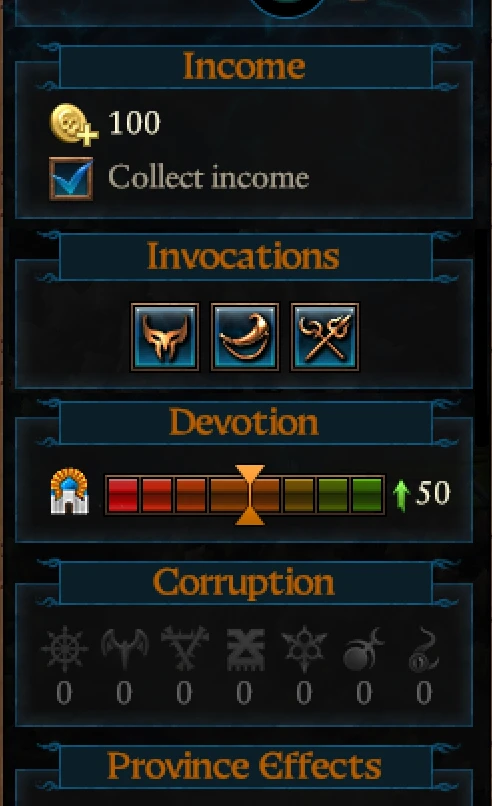
Total War Warhammer 3 corruption control starts with the province tooltip. Identify which corruption type is rising, what produces it, and what your faction gains or loses from it. Then remove a continuing source or add a suitable reduction effect. A temporary army visit is a poor substitute for fixing a source that returns every turn.
The same colored province can mean a defensive problem for one faction and useful territory for another. Do not aim to clear every corruption type automatically. Read the effects for your faction and the army you intend to move through the area. The WARHAMMER III guide hub covers the related campaign systems.

On this page
Total War Warhammer 3 Corruption Control: Diagnose the province before buying a building
Open the province panel, hover the corruption icons, and read the contributing effects. Separate the amount already present from the forces pushing it upward or downward. A high current value with a falling trend needs a different response from a low value that is rapidly increasing.
Check the source labels rather than guessing from the nearest enemy settlement. Buildings, characters, faction effects and special mechanics can produce different contributions. Inspect neighboring territory when the tooltip identifies an adjacent source. Destroying the wrong settlement spends an army turn without solving the actual problem.
Record a small diagnosis: the unwanted type, its largest ongoing source, and the effect you can afford to apply. Reopen the tooltip after making the change. If the expected modifier is absent, check its recipient and location before constructing another copy elsewhere.
Stabilize Control while corruption changes
Treat corruption and Control as related checks, not interchangeable numbers. Read the province’s actual Control modifiers and rebellion risk. A province recovering from conquest can need a garrison or another stabilizing measure while its corruption improves.
Avoid promising that one reduction building will immediately make the province safe. Construction takes time, and the remaining modifiers still matter. If an army must leave, check whether the province will remain manageable without its local contribution. Losing the stabilizing army can expose a problem that a favorable corruption trend has not yet solved.
Choose an affordable response to the immediate risk, then continue the longer cleanup. The goal is to keep the province usable while the underlying balance changes, rather than repeatedly returning an expensive field army to the same settlement.

Remove recurring pressure before adding more reduction
Compare eliminating a hostile source with paying for permanent countermeasures. Capturing or destroying the source can be the stronger long-term move when it also advances your campaign. It can be a distraction when the source is distant, defended, or unrelated to your next objective.
Use reduction effects with a clear scope. A provincial commandment requires its own conditions; a character effect applies where its tooltip says; a factionwide effect reaches a different area again. Two bonuses with similar names do not necessarily protect the same province.
Creative Assembly’s Immortal Empires introduction described active army tools for spreading and reducing corruption, alongside natural reduction for uncorrupted factions. That supports using armies as part of a plan, but not assuming an identical cleansing stance exists for every race.
Check the army’s route separately
Before moving, inspect the route and stance for attrition and replenishment consequences. Provincial cleanup and immediate army protection are separate decisions. A province can be strategically worth taking even when your army should avoid spending an exposed end turn there.
Read the selected stance’s movement requirement, protections and restrictions. Do not assume that protection against one attrition type covers every environmental or enemy effect. An army suffering a special ability’s attrition needs the relevant countermeasure, even if the province’s corruption is falling.
For example, Tamurkhan’s Chieftains interface includes an enemy-army attrition ability. That is a named character mechanic; it should not be diagnosed solely from the corruption icons. Checking the active effect prevents you from spending several turns clearing a province while the real cause remains active.
Use your faction’s special answer when available
Some mechanics change the problem directly. Patch 7.2 clarified that the Tomb Kings’ Scholarly Purity edict clears all corruption in its province and blocks increases. This is a specific edict effect, not a rule for every commandment with a purity theme.
Kislev’s provincial interface displays Devotion separately from its corruption values. Check both systems when managing a frontier province; spending or restoring Devotion does not replace reading the corruption breakdown. Likewise, a Chaos faction should judge which corruption supports its own mechanics before removing it.
Finish each diagnosis by confirming the trend next turn. Keep the measure that addresses the continuing source, remove emergency spending when it is no longer needed, and revisit the plan after a new enemy character, capture or campaign event changes the balance.
Sources and scope
Official sources provide the corruption rework, the released Scholarly Purity clarification and the displayed Kislev and Tamurkhan interfaces. Exact thresholds, stance protections and modifier values must be read in the installed campaign. This guide presents a diagnostic method and does not claim a hands-on test.
Sources and further reading
Keep exploring

Total War Warhammer 3 vs Stellaris: battles or a galaxy to discover?
Choose WARHAMMER III for commanding fantasy armies; choose Stellaris for exploring a galaxy and shaping the society, technology and fleets of an empire.
Total War Warhammer 3 vs Total War Rome 2: fantasy or empire?
Choose WARHAMMER III for fantasy races and Legendary Lords; choose ROME II for classical empire building, politics and historical battles.
Total War Warhammer 3 vs Total War Attila: fantasy or survival?
Choose WARHAMMER III for fantasy races and Legendary Lords; choose ATTILA for late-antique survival, vulnerable territory and destructive warfare.