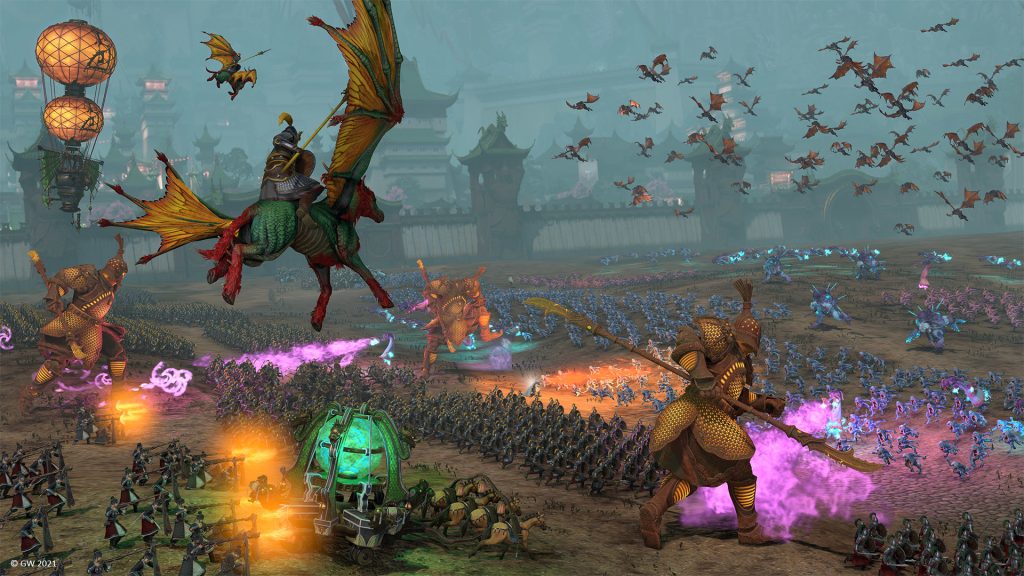
TLDR: Total War: Warhammer III is a strong fit if you want to build a fantasy empire and then command its armies in real-time battles. Its documented strengths are contrasting playable races, Legendary Lords, a narrative journey into the Realm of Chaos, and a customizable Daemon Prince. Choose it for the combination of military planning and fantasy spectacle; choose a historical Total War game if grounded armies and a historical setting matter more to you.
This Total War Warhammer 3 review evaluates the design described in Creative Assembly’s official Steam material. It is a source-based assessment, without a claimed playtest or performance benchmark. Its recommendation concerns the documented base-game experience; the available source does not support an assessment of the latest Immortal Empires build, faction balance, or every expansion.

On this page
Total War Warhammer 3 review verdict: the two-layer strategy is the attraction
The main reason to choose Warhammer III is that army building and battlefield command belong to the same experience. The official description pairs an empire-building strategy sandbox with real-time battles. That pairing gives your decisions two different tests: whether the campaign puts a useful army in the right conflict, and whether your command of that army can turn the confrontation into a victory.
This structure should appeal to players who enjoy preparing for a battle as much as fighting it. A fantasy army is more interesting when it represents a deliberate choice about your faction and your goals. Conversely, an empire map becomes more compelling when the forces you raise can be commanded directly. The attraction is the connection between those layers, rather than the promise that either layer reproduces a dedicated city builder or a small-scale tactical simulator.
There is a real commitment attached to that combination. You need to enjoy changing your attention between long-term planning and immediate combat decisions. Someone who wants only a sequence of battles might prefer a battle-focused experience. Someone who wants to manage a realm while combat remains abstract might find a grand strategy game a better match. Warhammer III’s central proposition is strongest when both halves interest you.
Fantasy armies change the appeal of real-time battles
Warhammer III’s documented battle offering includes hundreds of units across its advertised base-game races. The important buying question is what you want that variety to do for your experience. If choosing a fantastical army is part of the pleasure, the game’s setting gives military command a different identity from a campaign built around historical civilizations.
The official material names the four Chaos powers, Kislev, Grand Cathay, and the Daemon Prince. Those identities establish the breadth of the fantasy premise without proving a specific unit’s damage, armor, or battlefield efficiency. The appeal is being able to take sides in that world and command the associated army, not an unsupported claim that every roster is equally effective on the latest patch.
For a prospective player, think about the battle you would actually want to arrange. Do you want an army led by an ancient transforming dragon? Would you rather defend Kislev with the Ice Queen? Does commanding a daemonic champion sound more appealing than leading a historical general? These are examples supported by the official description, and they offer a better guide to personal fit than an arbitrary overall score.
The tradeoff is that fantasy spectacle can be the wrong attraction for a historically minded player. If your interest comes from recognizable military institutions, geography, or a particular historical conflict, the Warhammer setting cannot supply that foundation. Choosing a historical Total War title preserves the broad campaign-and-battle proposition while changing the reason you care about its armies.
The Realm of Chaos gives the campaign a narrative direction
The official base-game premise begins with a dying god opening a path to the Realm of Chaos. Kislev and Cathay stand against the spreading threat while the Daemon Prince pursues revenge. This establishes a campaign with an explicit fantasy conflict, rather than asking the player to supply every reason for conquest from scratch.
A narrative framework is useful if you want your first campaign choice to have a recognizable motive. Defending a homeland, pursuing revenge, or commanding one of the Chaos powers gives a faction a role before you have learned its entire strategic vocabulary. That is a meaningful design strength for a player attracted to the setting but still deciding which perspective to inhabit.
The same feature creates a preference question for sandbox players. A directed fantasy conflict and an open-ended empire fantasy are related attractions, but they are not interchangeable. If your ideal campaign is chiefly about selecting your own political and territorial goals, identify which campaign experience you intend to play before using a narrative-focused description as evidence for that purchase.
The source describes both a narrative journey into the Realm of Chaos and a strategy sandbox. It does not establish every campaign rule or how a later patch changes pacing. For this review, the defensible conclusion is that the base game offers a story premise alongside empire building. It would be misleading to turn that statement into a claim that its current campaign pacing has been tested or that all players will prefer the same mode.
Legendary Lords make faction choice more personal
The archived official description advertises ten Legendary Lords for its base-game presentation. That number describes the source’s advertised roster, not a complete count of the game’s expanded content. More useful than the number itself is the range of roles the description offers: daemonic champions, Cathay’s transforming dragons, Kislev’s Ice Queen, and the Daemon Prince.
This gives the campaign selection a character dimension. You are choosing an army and also choosing the figure who represents it. For someone already interested in Warhammer’s personalities, that can provide a reason to start a different campaign even before considering map position or strategic systems. For a newcomer, a clear character fantasy can make a complicated selection feel less abstract.
However, a compelling lord concept is not evidence of a forgiving campaign. A dragon-led faction can sound attractive while still requiring systems the player has not learned. Treat character appeal as the first part of your choice, then separate it from questions about starting conditions, faction economy, or difficulty. This review does not rank lords by ease because the available official material does not establish those comparisons.
That distinction also matters when considering additional content. A desired character is a concrete reason to investigate a particular pack; a larger roster by itself is a less useful buying objective. Start by deciding which campaign identity you want. Expansion ownership and current access rules require their own verified documentation, rather than assumptions based on a base-game lord count.

The customizable Daemon Prince is a specific reason to care
The Daemon Prince stands out because the official description explicitly offers customization through body parts and powers. This is more specific than a general promise of replayability. It gives players interested in building a personal fantasy leader a recognizable feature to evaluate.
The attraction is the relationship between appearance, character concept, and playstyle. A player who enjoys designing a leader can see a reason to choose this campaign beyond its place in the story. That preference differs from choosing a named Legendary Lord because you want to inhabit an established character. Neither approach is inherently better; they serve different reasons for playing.
Customization should not be confused with unrestricted tactical freedom. The source confirms body-part and power customization, but it does not prove that every combination is equally practical or that any desired build is available immediately. A purchase recommendation can acknowledge the system’s existence without promising a particular endgame configuration.
If this feature is your main attraction, make it your first focused research question. You need documentation about the progression and choices that matter to your intended character. A giant advertised combination count is less useful than knowing whether the system supports the kind of daemon you want to create. This review deliberately avoids presenting that promotional number as a measured count of meaningfully different playstyles.
Multiplayer offers more than one kind of shared session
The archived Steam material describes an eight-player Realm of Chaos multiplayer campaign, story-driven multiplayer campaigns built around Kislev and Cathay, ranked and custom battles, and one-versus-one Domination. Those are distinct advertised formats. A campaign group and a pair of players interested in a competitive battle are choosing different experiences, even though both are described as multiplayer.
For a group, the campaign offering is attractive because the larger strategic conflict can become a shared project. Its practical drawback is scheduling: an empire-building session asks people to agree on a campaign commitment. A group that meets irregularly should decide whether it actually wants that commitment before treating the maximum advertised player count as a benefit.
For two players who primarily enjoy tactical competition, a named one-versus-one mode is a more direct proposition. Custom and ranked battles also identify battle-oriented options in the source. This review does not claim particular lobby controls, cross-platform compatibility, or ownership requirements, because those details need a multiplayer FAQ or manual.
The sensible recommendation is to choose a format based on what the group wants to do together. Discuss whether the evening should advance an ongoing campaign or revolve around individual confrontations. That decision is more useful than buying the game on the assumption that all multiplayer modes share the same structure or the same player limit.
Value depends on the experience you will actually use
Warhammer III’s value is strongest for a player who wants fantasy faction choice, campaign planning, and direct battle command in one game. The official feature set supplies several concrete reasons to return: another faction perspective, a different Legendary Lord, a customized Daemon Prince, or a different multiplayer format. Those are reasons to investigate the game, not a guarantee of a particular number of enjoyable hours.
Avoid evaluating value by counting every available expansion. A large catalog can obscure the simpler question of whether you like the core design. If the combination of fantasy armies and empire building already matches your preferences, you have a reason to consider the base experience. If it does not, adding more factions is unlikely to resolve the underlying mismatch.
There is no current US price quoted here. The available source is an archived product description, and its store context does not justify a live pricing claim. Likewise, this review supplies no frame rate, hardware ranking, active-player count, or stability verdict. Those are different forms of evidence from a developer’s description of game features.
For a buying decision, keep three questions separate: does the design interest you, does the selected edition provide the campaign you want, and does your hardware meet its documented requirements? Answering the first does not settle the other two. That separation keeps an appealing feature list from becoming an unsupported promise about access or performance.
Which player should choose Warhammer III?
Choose it if you want the campaign decisions to culminate in battles you command and you are drawn to the Warhammer factions. It is particularly easy to see the appeal for someone interested in named fantasy leaders, daemonic armies, or a customizable central character. The official description directly supports those attractions.
Consider another game if historical context is your main motivation, if you want character politics without direct battle command, or if you only want quick tactical engagements. The right alternative depends on which part of Warhammer III you are trying to replace. Our games like Total War Warhammer 3 guide separates those preferences into concrete choices.
Your next step should be selecting the campaign concept that interests you most, then verifying its specific access and rules in official documentation. That makes the decision about an experience you intend to use, rather than the size of a franchise catalog.
FAQ
Is Total War: Warhammer III a real-time strategy game?
It includes real-time battles within a broader empire-building strategy experience. Its appeal comes from combining campaign planning with direct command of armies, rather than offering only standalone real-time combat.
Does this review include hands-on performance testing?
No. This is an editorial assessment of the documented design. It does not claim a playtest, measured frame rates, load times, benchmark results, or verification of the latest patch’s balance.
Can you customize the Daemon Prince?
Yes. The official base-game description confirms customization using body parts and powers. It does not establish every unlock requirement or prove that all possible combinations are equally useful.
Does Warhammer III support multiplayer campaigns?
The archived official description advertises an eight-player Realm of Chaos campaign and story-driven multiplayer campaigns associated with Kislev and Cathay. Those statements should not be generalized into a universal player limit for every campaign or mode.
Should a newcomer buy every DLC immediately?
The documented base-game proposition already includes multiple faction identities and campaign approaches. Decide whether that design fits you first, then investigate additional content for a specific lord or campaign you want. This review makes no unsupported claim about the current ownership rules for expanded campaigns.
Sources and scope
The official Steam description for Total War: Warhammer III supports the base-game campaign premise, advertised roster, Daemon Prince customization, and named multiplayer formats discussed above. The local source was read on November 9, 2026; its original retrieval timestamp and applicable patch version were not verified. This article is not a current-build Immortal Empires review.
Sources and further reading
Keep exploring

Total War Warhammer 3 vs Stellaris: battles or a galaxy to discover?
Choose WARHAMMER III for commanding fantasy armies; choose Stellaris for exploring a galaxy and shaping the society, technology and fleets of an empire.
Total War Warhammer 3 vs Total War Rome 2: fantasy or empire?
Choose WARHAMMER III for fantasy races and Legendary Lords; choose ROME II for classical empire building, politics and historical battles.
Total War Warhammer 3 vs Total War Attila: fantasy or survival?
Choose WARHAMMER III for fantasy races and Legendary Lords; choose ATTILA for late-antique survival, vulnerable territory and destructive warfare.