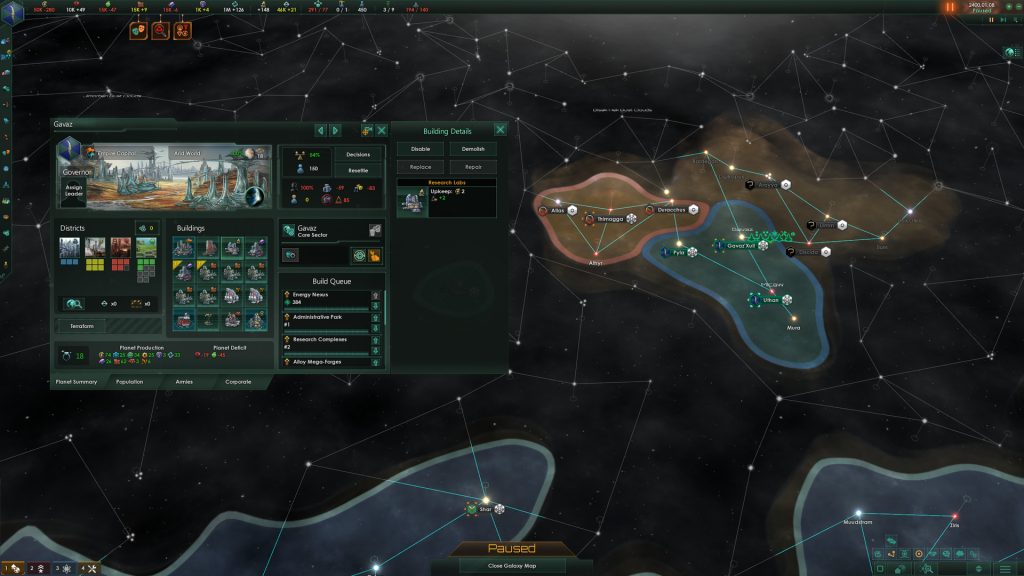
TL;DR: Stellaris federation management starts with a type that fits the members, positive cohesion and laws the group can use. Read fleet contribution, war voting and succession before raising centralization. In PC 4.5, also review the new economic laws for free Research Agreements and Commercial or Wayline Pacts.
A larger federation is useful when its members can cooperate and its rules support a clear task. Adding incompatible members or raising centralization can create a cohesion problem before the desired law becomes useful. Inspect the current federation screen, then change the particular membership, assignment or law causing the constraint.

The official Federations expansion description distinguishes advanced federation types and diplomatic features. This guide combines that identity with the historical federation rework and released 4.5 changes. Requirements and numerical bonuses must be checked in your installed version.
On this page
Stellaris federation management: pick a shared purpose
Choose what cooperation should accomplish. A research partnership, an economic league and a military coalition ask different questions about membership and fleet commitment. Inspect the type’s current passive benefits and unlocked perks before treating every federation as equivalent.
The historical rework describes Galactic Union as a broad cooperation type, Martial Alliance around fleet strength, Research Cooperative around technology, Trade League around trade and Hegemony around a stronger central member. These identities help organize the choice; they do not establish the exact current formation requirements or perk values.
Compare the group’s actual economies and known threats with that purpose. If members need a shared defense, inspect who can contribute and who controls the fleet. If they seek research benefits, inspect the agreements already available and the laws that might duplicate them.
Inspect cohesion before recruiting another member
Read both current cohesion and its monthly change. A favorable current value can decline when the recurring change is negative. The official rework connects cohesion with federation experience and level progression, so a continuing loss can threaten perks you already rely on.
Open the breakdown and identify membership or ethical friction. Consider whether another member’s benefit justifies the additional management cost. A new friendly empire can be strategically useful while making the group’s internal cooperation more difficult.
Check the personnel assignment offered by your build. An old guide may say to assign Envoys, while the released 4.0.11 notes correct the federation tooltip to Officials. Use the current screen and requirements rather than searching for an obsolete control.
After changing an assignment or membership, inspect the monthly result again. A positive direction matters more than expecting the meter to reach its maximum immediately. Keep the assignment long enough to see whether it addresses the identified cause.
Raise centralization for a particular law
Read which law you want and the level or centralization it requires. Raising centralization is useful when it unlocks a change the members can actually pass and use. It is a poor default purchase when the group’s cohesion already needs repair.
The historical rework explicitly connects higher centralization with a cohesion cost and different law access. Do not copy its preview thresholds blindly. Read the current requirements, proposed effect and vote conditions before making the change.
For a hypothetical military coalition, suppose a desired fleet contribution needs more centralization. First check whether the members can sustain cohesion and whether they support that contribution. Unlocking the law without enough support can leave the group paying a management cost without the intended fleet.

Check fleet contribution and control together
Open the fleet contribution law and identify how it affects member capacity and the shared fleet. Read who constructs ships, who controls the fleet and which designs it uses. Contribution is not the same decision as readiness to deploy.
Keep national defense in the budget. A member still needs forces for the routes it must protect, while the federation fleet may be elsewhere or controlled by another president. Consider what happens if a border attack arrives before the shared force can return.
Inspect the actual fleet and its upgrade state before counting it in an operation. A high theoretical contribution does not supply finished ships, a coherent design or a travel route. Coordinate the objective and arrival with the member controlling the force.
Read war voting and presidency rules before a conflict
Check the law governing war declarations and other collective decisions. Identify whose approval is required, whether votes have equal or different influence, and what the president can decide. The current federation rules determine the options your group has.
Review succession as well. Rotation, strength-based selection and challenges can create different expectations for the next president. The official federation Q&A describes the historical variety and later additions. Use your current law for the actual selection method.
Do not assume an ally’s preferred war is your own objective. Before agreeing, inspect the targets, participating enemies and the claims or political outcome. A collective victory can still provide benefits unevenly across members.
Use the 4.5 economic laws without duplicating benefits
The released 4.5 Cygnus announcement adds federation economic laws granting free Research Agreements and Commercial or Wayline Pacts. It says the laws are blocked for types that already provide those benefits, such as Trade League.
Inspect which agreements the federation already supplies before pursuing another law. Read the type’s perks and the proposed law’s requirements. A missing option can be an intentional duplication restriction, rather than a problem with your federation level.
Wayline features depend on the relevant nomadic content. Do not count a DLC-dependent agreement as available to every base-game empire. Check the installed content and the member’s actual diplomatic options before planning around it.
Reassess after membership or borders change
Review the federation after a subject joins, a member leaves or a shared war changes the map. The historical Q&A says subject participation follows federation law and their overlord’s membership. Check current law and subject diplomacy before assuming the group remains unchanged.
Return to the purpose of the alliance. Is the federation still supporting research, a trade network or a defensible coalition? Change one rule that improves that task, then check cohesion and the actual benefit before making another large commitment.
Use the Stellaris guides hub for related vassal, fleet and Trade decisions. Before the next federation vote, know the law’s effect, the support it needs and the member resources required to use it.
FAQ
Is more membership always better?
Compare the new member’s strategic contribution with cohesion, access and voting effects. A larger group can need more support and coordination.
Why is an economic law unavailable in 4.5?
Read its requirements and your federation perks. The released announcement blocks laws when the federation type already supplies the same agreement benefit.
Should I raise centralization immediately?
Choose the law it will enable first, then check cohesion and member support. Centralization has a purpose when the new rule can produce a useful result.
Sources and further reading
- https://store.steampowered.com/app/1140001/
- https://steamstore-a.akamaihd.net/news/externalpost/steam_community_announcements/2451574645858102197
- https://steamstore-a.akamaihd.net/news/externalpost/steam_community_announcements/2597949245047144249
- https://steamstore-a.akamaihd.net/news/externalpost/steam_community_announcements/1799817379631646
- https://steamstore-a.akamaihd.net/news/externalpost/steam_community_announcements/1844115010503624
Keep exploring
Stellaris vs Hearts of Iron 4: discovery or industrial war planning?
Choose Stellaris for discovering a galaxy and shaping a space society; choose Hearts of Iron IV for coordinating industry, army design and politics around a WWII nation.

Total War Warhammer 3 vs Stellaris: battles or a galaxy to discover?
Choose WARHAMMER III for commanding fantasy armies; choose Stellaris for exploring a galaxy and shaping the society, technology and fleets of an empire.
Stellaris vs Crusader Kings 3: build a society or guide a dynasty?
Pick Stellaris when your campaign idea starts with a civilization and unknown stars; pick Crusader Kings III when rulers, relationships and the next heir are the central attraction.