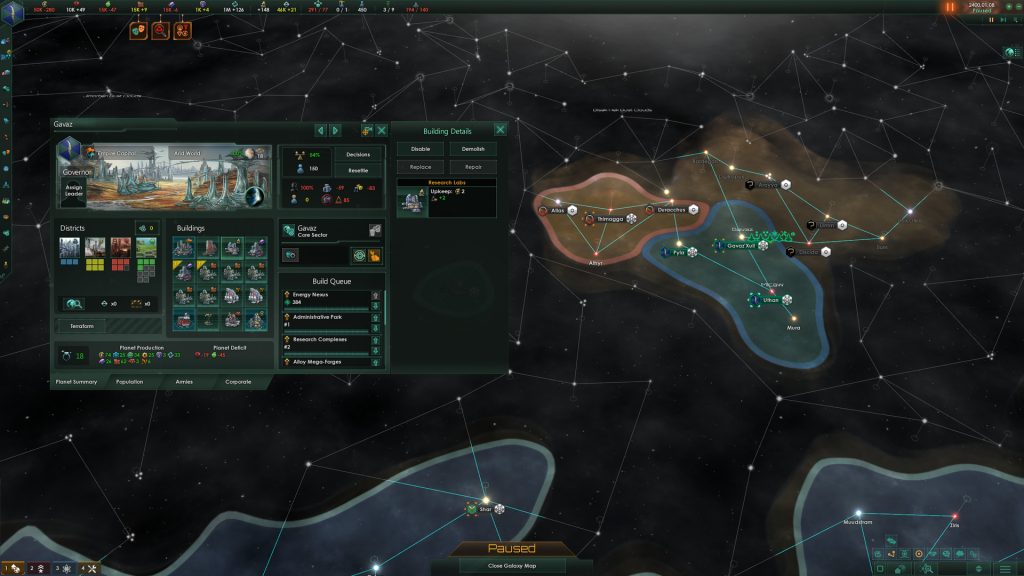
Choose Stellaris if you want your campaign to revolve around a space civilization; choose Crusader Kings III if you want it to revolve around rulers and their heirs. In Stellaris vs Crusader Kings 3, the decisive difference is what you want to follow over time: an expanding society discovering the galaxy, or a medieval noble house whose playable leader changes across generations.
Both games offer diplomacy and warfare, so liking maps or empire expansion leaves the choice unresolved. A more useful test is to complete this sentence: “I want to know what happens next to…” If your answer is a species, its neighbors and its discoveries, begin with Stellaris. If your answer is a ruler, their family and the successor they are preparing, begin with Crusader Kings III.

On this page
What gives your Stellaris empire its identity?
The official Stellaris description introduces a civilization beginning its journey between the stars. Science ships survey and explore, while construction ships build stations around newly discovered planets. This gives your campaign a practical outward direction: learning about the galaxy accompanies the work of building an empire within it.
The same description includes species traits, ideologies and other choices shaping society. For a buyer, those systems support a campaign idea built around the civilization itself. You might be drawn to discovery, to the society you want to create, or to how that society interacts with others. Those interests can remain connected as you decide where to expand and how to approach alien neighbors.
Watch an example of science-ship exploration together with empire customization before choosing. Ask whether an unfamiliar discovery would make you curious about your civilization’s next decision. The relevant question is whether the society remains interesting beyond its appearance or the first impressive space battle.
Who will carry the dynasty forward?
Crusader Kings III’s official description begins with a noble house and a dynasty spanning generations. It explicitly says that the lineage continues with new playable heirs after a ruler’s death. That makes the current ruler part of a longer family campaign, rather than the sole identity you follow.
Character traits and lifestyles determine actions and schemes, and heirs can be educated through guardians or by the player ruler. These are concrete reasons to choose CK III if individual people make strategy more engaging for you. Preparing an heir becomes a decision about the person who may carry the campaign forward, alongside the realm you are developing.
A useful preview should show a ruler’s traits, relationships and heir, then explain why those people affect the player’s next choice. A large medieval map alone cannot demonstrate this attraction. The official character-selection screenshot illustrates the focus on named rulers; it does not prove which starting character or date suits your current version.

Read diplomacy through societies or people
Stellaris describes relations with other species through diplomacy, negotiation, alliances and war. The buyer appeal is deciding how one society responds to another within an expanding galaxy. If learning who your neighbors are and choosing an approach to them interests you, that is a reason to favor Stellaris.
CK III’s official description gives diplomacy a character context. Its cast can be influenced or betrayed; intrigue includes recruiting agents to undermine opponents. War remains one of several tools for establishing a reign. If the identity, motives and relationships of the people involved make a political decision more interesting, CK III is the stronger match.
This does not make Stellaris a game without characters or CK III a game without realm management. The recommendation follows the emphasis of the documented systems: species and empire identity in one, and rulers, traits, relationships and succession in the other. Choose the emphasis that will make you care about the outcome.
Which uncertainty makes you want to continue?
Consider two hypothetical campaign questions. In Stellaris, you might ask what an exploration discovery means for your expansion plans and future dealings with another society. In CK III, you might ask whether the heir you are educating is the person you want to inherit the realm. These are editorial examples based on documented features, not accounts of a campaign we played.
They also help clarify your reaction to setbacks. Would an obstacle to your society’s plans motivate you to reconsider its direction? Or would a difficult ruler or family situation make you want to continue the dynasty’s story? You do not need to prefer every possible outcome. Look for the uncertainty that makes planning the next move appealing.
Choose the campaign subject you will keep following
Start with Stellaris when exploration, a civilization’s identity and relations across a galaxy are your strongest reasons to play. Start with CK III when character traits, heir preparation and personal political relationships are the systems you most want to learn. Both official descriptions include warfare, so choosing the family story does not remove military decisions, and choosing exploration does not guarantee peaceful neighbors.
Before purchasing, compare current footage of those specific systems and check the official listing for included content. Archived descriptions and screenshots may show dates, expansions or interface details that do not match the purchase you are considering. The best fit is the campaign subject you want to follow through ordinary decisions: the development of a society, or the continuing fortunes of a dynasty.
Sources and scope
Researched on November 10, 2026 from archived official descriptions: Stellaris official Steam description; Crusader Kings III official Steam description. This is a comparison of documented systems and buyer preferences, without claiming hands-on testing. Purchase contents and screenshot interface details can change; check current official listings for your intended edition.
Sources and further reading
Keep exploring

Crusader Kings 3 cultural innovations: choose the unlock your realm needs
Prioritize the innovation that removes a current realm obstacle; check the head, matching skill, cultural Development, spread and era restrictions.
Crusader Kings 3 faith reformation: holy sites, rites and the realm afterward
Reform an unreformed rite with holy-site access and Piety, then check doctrine choices, divergence and which rulers will follow the change.

Manor Lords vs Crusader Kings 3: build a town or guide a dynasty?
Pick Manor Lords for a medieval settlement and its household economy; pick Crusader Kings III for rulers, relationships and a realm passed between generations.