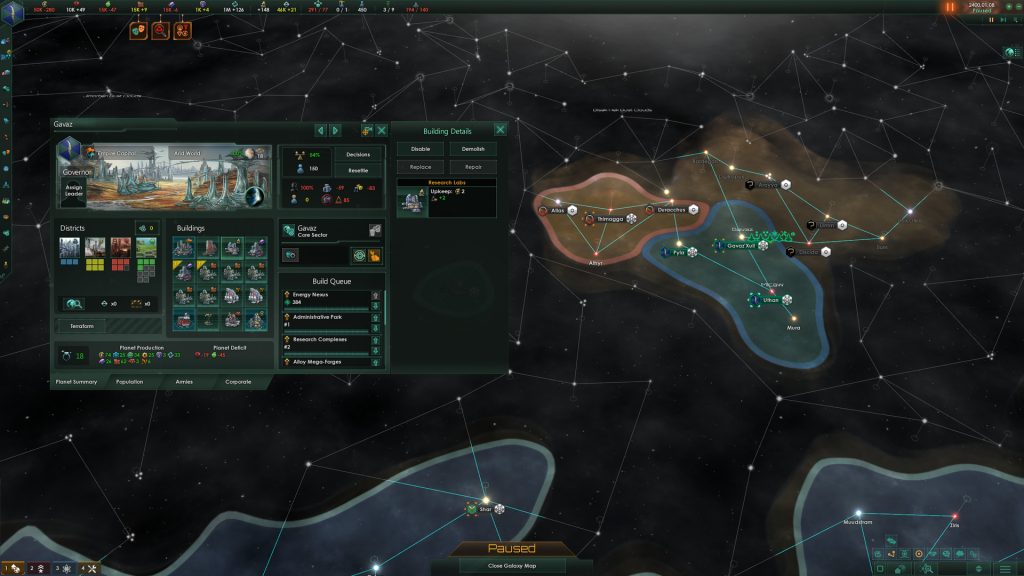
TL;DR: Stellaris is a strong fit if you want to invent a space civilization, explore a changing galaxy and manage the economic and political consequences of your choices. Its main costs are time, a substantial learning curve and the need to understand version and expansion boundaries. Start with a specific empire concept and the content included in your chosen purchase.
This Stellaris review recommends the game for players who enjoy designing societies as much as winning wars. Exploration, colony development, diplomacy and customizable fleets support that goal. Players seeking direct tactical control of every ship or a campaign that asks for little economic management should consider a different kind of space strategy game.

This is a research-based buying review using official product descriptions and developer explanations. It does not claim a personal playthrough, measured performance or a numerical score. The discussion concerns PC Stellaris; older branches, modifications and Console Edition can differ substantially.
On this page
Stellaris review: who will enjoy its campaign?
The best match is a player who wants to make several linked decisions over a long campaign. Choosing your civilization is only the beginning. You then decide what to explore, where to settle, which industries to support and how to respond to neighboring empires.
A practical example is an empire designed around welcoming other species. Its immigration and political identity create work for colony development and species rights. A machine civilization or a hostile empire asks different questions about growth, government and diplomacy. Those identities matter because they change what you are trying to support with the economy.
The tradeoff is that the game does not isolate these decisions into tidy independent activities. A war can alter income and population; an economic transition can delay a fleet; a diplomatic commitment can affect where you can project power. Choose Stellaris if tracing those consequences sounds satisfying. If you mainly want to admire a fleet and fight the next battle, much of its management will sit between you and that objective.
Exploration gives the opening a clear purpose
The official game description places science ships, surveys and anomalies at the center of the opening. Exploration reveals opportunities and risks before the galaxy becomes familiar. Construction and colonization then turn those discoveries into an empire you can operate.
That makes exploration more useful than simply uncovering a fogged map. You are identifying places worth developing, meeting other civilizations and deciding which opportunities justify your attention. The game’s procedural galaxy and event framework support different starting situations rather than one fixed campaign route.
The limitation is that discovery does not remove routine decisions. A promising system still requires a budget and a connection to the rest of your plan. Players who rush through event text can miss much of the reason to choose Stellaris over a game centered on combat. It fits a reader who enjoys both the story of an unusual discovery and the practical question of what to do with it.
Empire creation creates direction, then responsibility
Species traits, ethics and government choices give the campaign an identity. The official description emphasizes customized civilizations rather than a single historical nation. Your first useful decision is therefore the type of society you want to manage, not a search for an allegedly perfect build.
Origins and expansion-specific choices can change that premise further. Overlord, for example, describes origins built around subject status, underground life and other distinct starting situations. Machine Age adds individualistic machines and new technological transformations. These are reasons to investigate an expansion when its specific premise interests you.
The downside is that an unusual setup can add unfamiliar requirements before you understand the ordinary economy. For a first campaign, choose a clear conventional concept and learn what its colonies consume and produce. Save highly specialized origins for a later run or read their rules carefully before committing. Customization works best when it provides a goal you understand rather than a long list of unexplained bonuses.
The economy rewards understanding the current version
Colony management is a major part of the game, and current PC systems need current explanations. The Phoenix update introduced Pop Groups, Workforce and district specializations. Its Trade redesign also replaced the older Trade Routes system with a stockpiled resource tied to logistics.
These changes make the version of a guide materially important. An older screenshot can show the same planet name and still teach an economic process that no longer exists. In Phoenix’s explanation, available Workforce supplies jobs, district specializations create additional capacity and resource deficits can create logistical Trade costs. Read the actual job and resource breakdown instead of counting buildings alone.
This is both an attraction and a learning cost. Players who enjoy repairing an economy have several useful questions to ask: whether a colony has the right work, whether eligible population can supply it and whether inputs and logistics are sustainable. Players who dislike checking those relationships may find the empire more demanding than its attractive galaxy map initially suggests.
Diplomacy gives you more than a war decision
Stellaris supports diplomacy as a route through the campaign. Official descriptions include negotiation, federations, subject relationships and political institutions. These systems let a player pursue security or influence without treating every neighbor as the next conquest target.
Federations emphasizes deeper alliances, the Galactic Community and diplomatic leverage. Overlord focuses on negotiated subject roles and specialist empires. The appeal is being able to organize relationships around an objective: a defensive partnership, an economic arrangement or a wider political position.
The drawback is that agreements require reading. Membership or subject status does not automatically mean the relationship benefits your current plan. Check obligations, enabled laws and the effects of a proposed contract. If your interest is purely military expansion, the diplomatic menus may feel like additional work. If you enjoy building a political structure and reacting when its incentives change, they provide reasons to keep engaging with the galaxy.

Fleet warfare is strongest as strategic preparation
Customizable ships and fleets connect military strength to research and industry. The official game description emphasizes ship design and adapting to threats. The important player decisions include what to build, what economy supports it and where it can fight effectively.
The research-based expectation should be strategic fleet preparation rather than an assumption that you will manually direct every weapon during combat. Designs, reinforcement capacity and deployment routes all matter to the campaign. Losing ships is also an economic event because replacing them competes with other construction and upkeep.
That is a good fit if you enjoy preparing a force and interpreting the outcome. It is a weaker fit if your main attraction is direct control of every tactical engagement. Inspect actual gameplay of fleet control before buying for the spectacle alone. The screenshots show space battles, but they do not establish a particular winning design, response time or personal combat experience.
Ascension and crises can change the campaign’s objective
Later development can change what your empire becomes. Utopia’s official description centers on ascension and major construction, while later expansions revise and extend particular directions. Machine Age introduces additional machine ascensions and a distinct endgame crisis, Cetana.
This gives a campaign goals beyond occupying more systems. A player can plan around biological development, machine transformation, a political project or survival against a major threat. The exact legal path depends on the empire and enabled content. Old expansion descriptions explain their original themes, but their old unlock order or numerical bonuses should not substitute for current tooltips.
The cost is planning overhead. A transformation can demand economic changes, and a crisis requires a response you can sustain. If you prefer an open-ended civilization story, these developments provide direction. If you want a predictable short sequence of battles, their scale and variety can make Stellaris an awkward fit.
Buy content for a particular campaign concept
Inspect the edition or bundle you are actually considering before making a DLC list. The Steam description captured for this review presents Stellaris with the base game, Utopia, Synthetic Dawn and Humanoids content. That listing is not proof that an older owner’s library or every storefront offer includes the same package.
Start with what your purchase already provides, then choose additional content for a specific reason. Federations fits a player investigating deeper alliance play and its featured constructions. Overlord fits subject management and its named infrastructure. Machine Age fits its machine-focused development and new crisis content. Those are concrete themes to compare against the campaign you want.
Do not buy every expansion merely because a guide mentions one optional mechanic. Check the current store description, ownership and requirements for the exact feature you want. Prices, sales and bundles change, so this review does not quote a price that could misrepresent your checkout. A smaller informed purchase is easier to assess than a collection of features you have not yet learned to use.
Multiplayer can share the learning work
Stellaris offers cooperative modes for players who want to share one empire as well as ordinary multiplayer with separate empires. The official cooperative introduction describes shared management, interface presence markers and events that teammates can answer.
That can be useful for learning: one friend can manage colonies while another explains exploration or fleets. It also asks for communication. If everyone changes queues and selects events independently, shared control can create confusion. Decide who handles economic spending, diplomacy and major choices.
Connection and save setup remain part of the commitment. Official recent patch notes document hotjoin-related out-of-sync fixes, while beta instructions warn about save compatibility across versions. These sources do not prove that every current session will fail or run flawlessly. Test the group’s actual version and mod setup, agree on a pace and preserve the host’s campaign saves.
Make a purchase decision around your tolerance for management
Choose Stellaris if you want the identity of a space civilization to interact with exploration, economics and politics across a long campaign. Expect to learn the resource and population systems and to check the version of outside advice. Its customization provides value when you use it to set goals you enjoy pursuing.
If you prefer fixed turns, fewer empire-management duties or a stronger emphasis on direct tactical combat, investigate alternatives before committing. For an initial campaign, read our Stellaris beginner guide. Use the Stellaris hub to match the systems you want to learn to the content you own.
FAQ
Is Stellaris worth buying for a new strategy player?
It can be if the civilization-building premise interests you and you are willing to learn its economy. Start with a clear empire concept and a manageable campaign.
Do I need every Stellaris expansion?
No. Inspect what your chosen edition includes, then add content for specific themes or mechanics you want. Verify each current offer before purchasing.
Does this review include tested performance results?
No. It is based on official descriptions and developer explanations. It does not provide a measured benchmark or a personally tested late-game experience.
Can an old Stellaris guide still help?
Its general planning advice may help, but check the version. Population, Trade, ascension and other systems have changed, so old numerical instructions need verification.
Sources and version boundaries
Sources include the official Stellaris listing, Phoenix update explanation, Federations, Overlord, Machine Age release description, cooperative introduction and 4.5.3 stability notes. This review distinguishes documented features from untested performance and personal experience.
Sources and further reading
- https://store.steampowered.com/app/281990/
- https://steamstore-a.akamaihd.net/news/externalpost/steam_community_announcements/1798454487635615
- https://store.steampowered.com/app/553280/
- https://store.steampowered.com/app/1140001/
- https://store.steampowered.com/app/1889490/
- https://steamstore-a.akamaihd.net/news/externalpost/steam_community_announcements/5766372999962280903
- https://steamstore-a.akamaihd.net/news/externalpost/steam_community_announcements/5121196841288104857
- https://steamstore-a.akamaihd.net/news/externalpost/steam_community_announcements/5133583099794770594
- https://steamstore-a.akamaihd.net/news/externalpost/steam_community_announcements/1848557880479130
Keep exploring
Stellaris vs Crusader Kings 3: build a society or guide a dynasty?
Pick Stellaris when your campaign idea starts with a civilization and unknown stars; pick Crusader Kings III when rulers, relationships and the next heir are the central attraction.

Total War Warhammer 3 vs Stellaris: battles or a galaxy to discover?
Choose WARHAMMER III for commanding fantasy armies; choose Stellaris for exploring a galaxy and shaping the society, technology and fleets of an empire.
Stellaris vs Hearts of Iron 4: discovery or industrial war planning?
Choose Stellaris for discovering a galaxy and shaping a space society; choose Hearts of Iron IV for coordinating industry, army design and politics around a WWII nation.