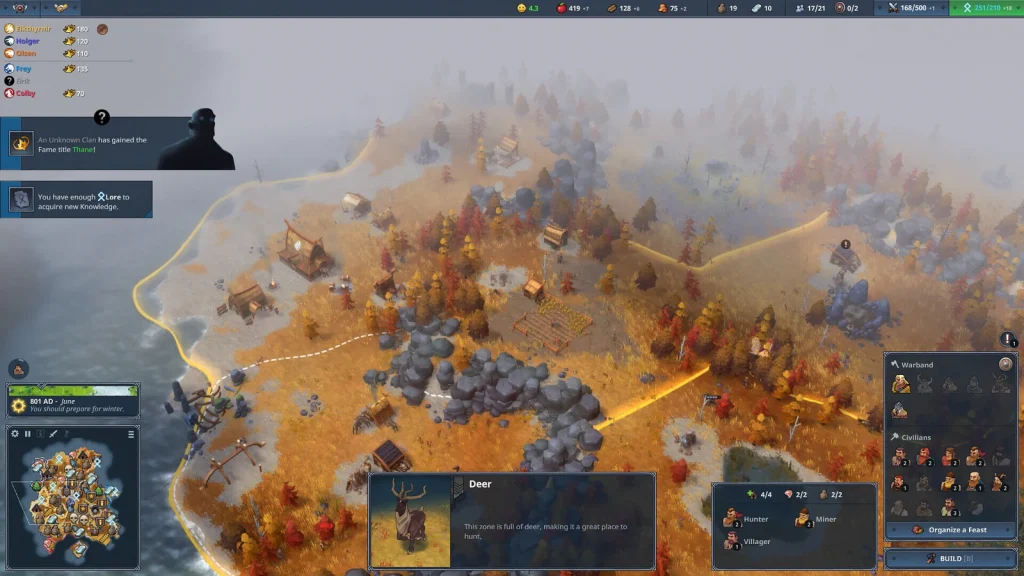
TL;DR: This Northgard beginner guide starts with a settlement you can keep alive: scout the nearby zones, secure a useful food source, staff wood production and leave enough people gathering food to reach winter with reserves. Expand when the next zone solves a real problem, then choose a victory route your economy and defenses can support.
First-session answer: Keep food gathering active while a scout identifies the next useful zone and a staffed lodge supplies wood. Clear, colonize and staff that zone as one project; save enough food and wood to keep those workers functioning through winter.

The early challenge is deciding what each person should do. A new building does little while it stands empty, and converting several workers into soldiers can turn a healthy food balance into a shortage. Learn that relationship before copying a long build order.
These instructions cover ordinary Viking-clan settlement play on PC. Campaign missions, Conquest rules and specialized clans can change the opening. The official Northgard description identifies worker assignments, winter survival and several victory routes as the core loop. Use the requirements displayed in your match for prices and objectives.
On this page
Start with a short, flexible opening
- Build a Scout Camp and assign a scout to reveal the zones touching home. Identify a food zone and whether enemies block it.
- Build a Woodcutter’s Lodge and give it a worker. Keep the remaining flexible villagers gathering food while wood funds the next essential building.
- Clear and colonize the first useful zone when the force and food reserve permit it. A revealed field with no building and no farmers is still only potential production.
- Construct and staff the appropriate food building. Watch the new food balance before sending the next villager to mining or sailing.
- Add housing before capacity blocks growth, then use summer to prepare the food and wood reserve for winter.
This is a teaching sequence, rather than a timestamped competitive build. A hostile first food zone can move the military camp earlier; an imminent housing limit can move the house earlier. Complete the reason for a building before adding the next one. The expected result is a settlement with actual workers producing the resources its next expansion consumes.
Northgard beginner guide: read the settlement before building
Look at the resource bar and population display. Separate the amount in storage from the rate at which it changes. Plenty of stored food can disguise a deficit; a small stock with a positive balance may still need time before it can fund expansion.
Select a production building and inspect its workers. When a job is understaffed, assigning someone may solve the shortage sooner than constructing another copy. When every available worker is already doing something useful, a new building creates a staffing decision rather than free output.
Keep food, wood and Kröwns visible. Food sustains the population and usually pays for colonization. Wood funds much of the settlement’s construction and helps with winter needs. Kröwns support expenses and military recruitment. Stone, iron and Lore become useful for specific improvements; they don’t replace the basic resources.
Write down the immediate bottleneck in one sentence: “I need food for the next zone,” or “I need wood to finish a working food building.” That sentence gives the next worker an actual purpose. It also prevents spending scarce resources on a building whose benefit arrives after the crisis.
Scout for a useful first expansion
A Scout Camp lets you turn a villager into a scout and reveal surrounding territory. Inspect nearby zones for food resources, forests, minerals, Lore and hostile inhabitants. The best first expansion depends on that map, rather than on a compass direction from another player’s opening.
Prioritize a zone that supports an immediate task. A food zone can provide a place for specialized production; a forest may support the wood economy; a Lore source can help future research. A distant valuable landmark may be interesting without being affordable or defensible right now.
Read the zone information before ordering civilians across the border. Revealing a zone doesn’t make it yours, and discovering wildlife doesn’t remove it. Plan any necessary clearing with military units, then inspect the colonization cost and available building space.
Scouting also costs labor. If two scouts reveal territory you cannot use while the settlement runs short of food, reduce that commitment. Once you know the next useful objective, you can send a worker back to a productive job and resume broader scouting when the economy permits it.
Build around staffed food and wood production
Match a specialized food building to the resource actually present in its zone. Fields, deer and fish are different opportunities. Select the building after construction and assign workers; don’t assume the builder automatically fills every production position.
Keep some villagers gathering food while the new economy takes shape. Every scout, miner, sailor or soldier has a job, but that job may remove someone from food production. Move people deliberately and watch how the displayed resource balance changes.
Staff a Woodcutter’s Lodge early enough to support the buildings you intend to finish. Building a long queue with your remaining wood can leave no reserve for an essential house or recovery project. Decide which completed building will matter next, and fund that before adding several optional projects.
Check housing capacity alongside happiness and food. Housing provides room for population growth; it doesn’t ensure that new people arrive quickly or that the settlement can feed them. If growth has stalled, inspect the population and happiness information before assuming another house is the solution.
As a hypothetical example, suppose your next food building needs both construction resources and two workers. Calculate the staffing change before committing: which existing jobs will lose those people, and will food improve enough to justify it? Compare the resulting balance after assignment rather than judging the plan by the building count.

Prepare for winter while there is time to change jobs
Use the calendar and event information. Winter can change production and consumption, so a comfortable summer balance doesn’t establish a safe winter. Save food and wood before the seasonal change and reassess after it arrives.
Delay discretionary spending if it consumes the reserve supporting survival. Colonization, feasts and additional recruitment can all compete with resources you need at home. A desirable expansion can wait when the immediate result would leave the settlement unable to recover from an attack or illness.
Look for a deficit you can actually address. If food is falling because too many people are mining or scouting, reconsider those jobs. If wood is running down, check the staffed lodge and current spending. Moving another person to a job only helps when that job addresses the shortage.
Leave room for an interruption. Injured workers, a hostile event or damage to an important building can disrupt a plan that just barely balances. You don’t need a universal stockpile target; you need a reserve appropriate to the visible seasonal deficit and the risks around your settlement.
Clear territory with a small force you can maintain
Recruit for a defined clearing job before growing an army for its own sake. Examine the defenders, the route and your units’ health. Opening access to the food zone you need is a more useful early objective than fighting every creature the scouts find.
Watch the fight and withdraw damaged units when continuing would waste them. After clearing, check health and the cost of recovery before choosing another target. A successful fight can still leave the force unready for an immediate second one.
The released Winds of Fate military update introduced a clearer relationship between warriors, shield bearers and axe throwers. Unit type, upgrades and positioning matter; a larger number of one type isn’t automatically the right answer to every opponent.
Don’t count military strength without its economic cost. Recruits leave civilian jobs, consume resources and need replacement when lost. Keep enough production at home to maintain the force, repair damage and survive the season while it performs the task.
Choose a victory route before the settlement becomes aimless
Open the victory information for the match. Identify which routes are enabled and what each requires. Campaign and Conquest objectives can differ from ordinary games, so the name of a mode is a useful first check.
For conquest, plan the economy and force needed to reach and defeat enemy settlements. For Fame or Lore, identify the required progress and any additional objectives. For trade, read the current influence and relationship system instead of relying on an old guide’s commercial-influence meter.
The released Trade & Prestige update changed trade victory around influence toward Miklagard. That change is a reason to inspect the current victory panel before committing to a familiar name.
Choose a route that fits the territory, resources and opponents. You can change direction when the map demands it, but every new commitment should have a reason. A Lore-focused settlement still needs defenses; a military settlement still needs food and money.
Use a short recovery checklist when progress stops
| What you see | What to inspect first | Useful next action |
|---|---|---|
| Food keeps falling | Season, staffing and population consumption | Restore appropriate food jobs and pause optional spending |
| New buildings do little | Workers, resource access and prerequisites | Staff the useful building before adding another |
| Population stops growing | Housing and happiness information | Address the actual limit before expanding jobs |
| Army cannot keep advancing | Health, opponent type and replacement cost | Recover or change the objective before recruiting blindly |
| Resources accumulate without progress | Victory requirements and next unlock | Fund the project that advances the chosen route |
After changing a job or finishing an upgrade, compare the situation again. Did the food balance improve? Did the house create needed room? Did the cleared zone become a staffed resource source? This small check turns an action into a lesson you can use in the next match.
Keep a simple note after the game about the first shortage that changed your plans. If wood stopped your food project, prepare that construction reserve earlier next time. If a large army emptied the settlement, convert fewer workers until production improves. Change one part of the opening so you can understand its effect instead of replacing the entire plan after every loss.
For a first practice game, aim to reach the next spring with a functioning food economy, staffed wood production and one affordable expansion objective. Once that loop feels manageable, use your chosen clan’s bonuses to decide how aggressively to expand and which victory route deserves the next investment.
Use the Northgard guides collection to choose the next focused lesson once the food, wood and first-expansion loop is working.
FAQ
What should I build first in Northgard?
A Scout Camp and a staffed Woodcutter’s Lodge form a useful starting pair for ordinary Viking clans. Scout the available resources, then fund and staff a food building. Move housing or military construction forward when the visible map creates that need.
Why does my food fall after I recruit soldiers?
Those recruits no longer perform their previous civilian jobs. Inspect the food rate after converting them, especially near winter, and keep enough food workers at home to support travel and recovery.
Should I colonize every cleared zone?
Colonize the next zone that supplies a needed resource, building space or route. Paying for territory you cannot staff can delay the food economy that would make later expansion affordable.
Does this guide cover Northgard Battlegrounds?
No. This opening concerns the settlement game Northgard on PC. Battlegrounds is a separate game, and campaign or Conquest scenarios can impose their own starting rules and objectives.
Sources and further reading
- https://store.steampowered.com/app/466560/Northgard/
- https://steamstore-a.akamaihd.net/news/externalpost/steam_community_announcements/1818118366173340
- https://steamstore-a.akamaihd.net/news/externalpost/steam_community_announcements/1797185861607802
- https://steamstore-a.akamaihd.net/news/externalpost/steam_community_announcements/1783238125217583
- https://northgard.net/game/
Keep exploring
Northgard vs Manor Lords: clan objectives or settlement planning?
Choose Northgard for clan-specific strategy and explicit victory routes; choose Manor Lords for the placement, households and production of a medieval settlement.
Games Like Northgard: 4 Picks by Strategy Style
Games like Northgard: compare Banished, Against the Storm, Age of Empires IV and They Are Billions by economy, challenge structure and combat.
Northgard Review: Settlement Strategy, Clans and Co-op
Northgard review: decide whether its worker economy, winter pressure, clan variety and solo or co-op Conquest fit the strategy game you want.