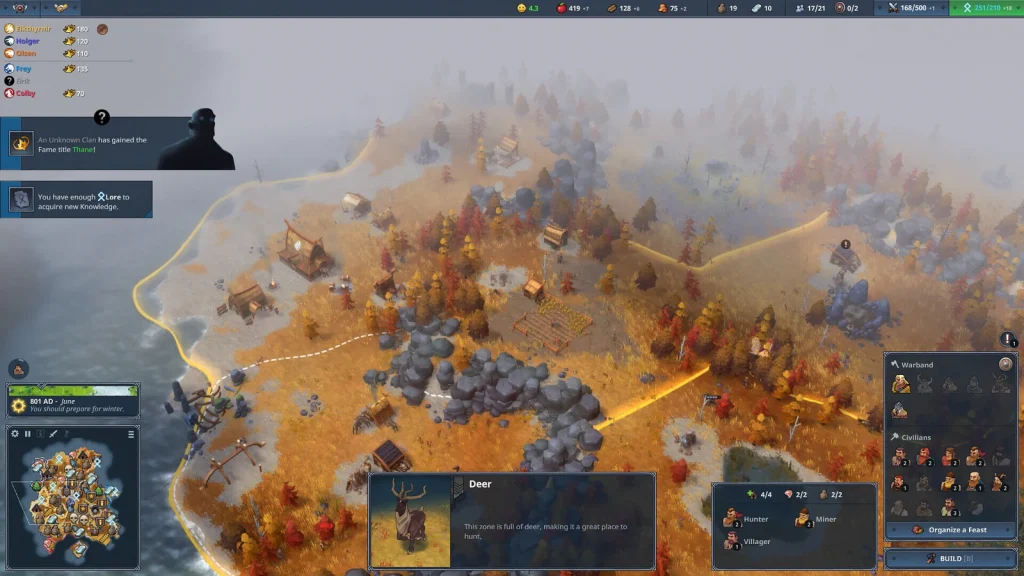
TL;DR: Northgard Stag clan strategy turns an economic start into useful expansion and Fame. Spend starting supplies on a settlement you can staff, use cultural production to support growth and choose territory that strengthens the next stage. Keep a defensive budget while pursuing the current victory requirements.
Stag’s attraction is how several kinds of progress can reinforce each other. A stronger economy can fund more useful territory; useful territory can support additional workers and buildings; those gains can support the clan’s Fame direction. The loop breaks when expansion consumes the food, money or workers needed to make the new land productive.

The official clan overview describes Eikthyrnir as ambitious expansionists valuing wealth and Fame. The original Stag introduction connects starting supplies, territory and cultural strength. This guide uses those identities without treating historical bonus values as current rules.
On this page
Northgard Stag clan strategy: give starting supplies a job
Read the starting bonuses in the clan panel before spending. Decide which resource project needs help first: food for expansion, wood for buildings, Kröwns for expenses or the staffing capacity to use the resulting settlement.
Extra supplies can make an opening feel less constrained than it really is. They are a stockpile, not necessarily a lasting improvement to income. If you finish several buildings without the workers to staff them, the initial advantage can disappear into construction while the basic economy remains weak.
Choose one useful first expansion and the building it should support. Scout its defenders, resource and space, then reserve what you need to clear, claim and develop it. That sequence makes the starting stock useful at every stage instead of spending it all at the first opportunity.
Leave a reserve for the next essential project. Housing, a working food building or recovery from an attack can matter more than an early optional improvement. The opening should get a productive settlement running sooner, rather than produce an impressive but empty collection of buildings.
Work through the first expansion as a complete project
Start with a scout, a working wood economy and a food reserve. Pick one adjacent food zone, arrange the clearing if required and decide which villagers will staff it. Stag’s starting resources can shorten this process, but the claim only becomes an economic advantage after the food building has workers.
Once those jobs are functioning, compare housing room with the happiness display. Build the Hall of Skalds when its cultural work addresses the actual constraint on growth. Reserve the next worker for a job you can fund, such as food production or the Lore source required for your planned knowledge. Avoid letting starting supplies persuade you to fill every specialist job simultaneously.
Use a Fame milestone to trigger a practical review: can its benefit finish the next food project, improve the border defense or support a necessary upgrade? The goal is to reach the next stage with a working economy. Merely racing the Fame display while home jobs remain empty does not turn the clan’s advantages into a sustainable position.
Use cultural production to support a growing settlement
A Skald is a civilian assigned to the Hall of Skalds. Its cultural work supports Happiness and Fame, so a staffed Hall can help population growth while advancing Stag’s clan milestones. It is not a Lore-producing job. The official March 2021 balancing notes describe the Hall’s cultural production separately from the extra Kröwns granted by The Value of Great Deeds. Treat those as different outputs when choosing the worker.
Fund one Skald job before adding the next
When housing has room, Food is sustainable and Happiness is limiting new arrivals, assign one available villager to a vacant Hall of Skalds worker slot. Keep the food workers needed for the existing population. After the assignment, confirm that the villager became a Skald, that Happiness and Fame production changed, and that Food remains sustainable. Do not read the existence of an empty slot as a reason to move another food worker immediately.
The next arrival needs a funded job as well. For example, if your claimed food zone already has an open production position, send that new villager there before adding a second Skald. The first cultural worker helps create the arrival; the food worker supports the larger population. If Food starts falling before anyone arrives, restore the necessary gathering job and postpone the extra cultural staffing.
When Kröwn income is the limiting factor instead, compare The Value of Great Deeds with the knowledge needed for your food project. The released July 2021 balancing patch specifies 1.5 Kröwns from each Skald with that Lore and removes the former extra upgraded-Hall payout. It also lists free Skald tools with half the forging time. These are dated patch values; use the installed Lore and forge descriptions for the current rates and costs.
Choose that route when you can keep the Hall staffed and the added income funds a named next expense, such as a defensive recruit. After unlocking it, compare the Kröwn production before and after rather than budgeting the Lore’s extra income from unstaffed slots. The September 2022 patch also explicitly allows Skald Kröwn production to benefit from production bonuses such as Feast. A temporary bonus is useful during its active period, not permanent income after it ends.
The historical Raven release patch removed the Hall’s Town Hall-upgrade prerequisite. That is another reason to fund the job shown by your current building menu rather than copying an old prerequisite. Building access, worker availability and affordable staffing remain separate checks.
Expand toward territory you can actually develop
Rank nearby zones by the job they can perform. A food source that supports more workers, a forest that funds construction or minerals needed for a planned upgrade may have more immediate value than a distant zone chosen solely for its Fame contribution.
Budget the whole acquisition. Clearing costs health and recruitment resources; colonization consumes a resource stock; development requires building materials and workers. If only the claim is affordable, you may need to improve home production before adding the zone.
Inspect building space before committing. A territory containing a valuable resource still needs room for the relevant project. Place buildings with the next stage in mind so an optional structure doesn’t force a costly workaround when you later need production or defense.
Use borders and routes to compare two otherwise attractive zones. One may strengthen the economy while exposing a long frontier; another may provide a smaller benefit from a position easier to protect. The territory’s value includes the resources required to retain it.
For a hypothetical choice, compare a nearby deer zone with a distant landmark. If the deer zone helps maintain the additional workforce your current plan needs, it may improve the eventual landmark attempt. Taking the landmark first can leave both the claim and the settlement underfunded.

Turn Fame milestones into the next useful action
Stag’s named Supplies milestone begins at 200 Fame in the released Sword & Solace rework of May 2022. That update replaces an annual delivery with a delivery for each 200 Fame: 50 Food, 50 Wood, 50 Kröwns, 25 Lore and 5 Stone. This matters because a calendar year ending and another Fame threshold being reached are different triggers. Use the installed Supplies description for present reward amounts.
Give the next delivery a job before chasing it. If the staffed food economy is stable and Supplies is close, keeping one Skald working can advance the threshold while the rest of the settlement funds the next project. Choose the receiving project now: Food for a useful claim, Wood for its production building, Kröwns held for defense, or Stone saved toward an upgrade. Avoid committing all those resources before the delivery has actually arrived.
After the milestone triggers, confirm the resource changes, then carry out that project. For a food-zone expansion, check the colonization cost, claim the zone, build the food structure and assign its planned worker. Compare the Food balance afterward. A reward that stays unused while population consumes the remaining food does not complete the expansion; neither does a new unstaffed building.
The same published rework names the 500-Fame milestone Annexation, replacing Dedication. Its listed effect reduces colonization price by 5% and increases unit production by 3% for each 200 Fame. The strategic distinction is a cheaper claim plus improved production, rather than the old annual Supplies schedule or a guaranteed match victory. Before choosing another zone after unlocking it, compare the displayed claim requirement and the output of jobs that are already staffed.
If a border claim is affordable only because of Annexation, reserve its building and defense costs too. A discount on colonization does not construct the food building, provide its workers or protect it from a counterattack. Take the zone when the entire project works; otherwise use the improved existing production to restore the reserve first.
The released Trade & Prestige notes later adjusted Glory of the Clan for the trade rework. Keep clan milestones, Lore modifiers and the enabled match victory conditions separate. Reaching Supplies or Annexation gives you a specific tool for the next investment; it does not by itself meet every Fame-victory requirement.
Research for the economy you are building
Open the knowledge tree and identify the next bottleneck. A food improvement, construction saving, income option or military effect can each be useful in a different position. Select the branch for the job it will unlock rather than for a universal order of names.
Read prerequisites and the time your current Lore production needs. If the desirable effect is far away, inspect whether the route’s intermediate unlocks help the settlement. An approaching winter or attack may justify a shorter route to an immediate benefit.
Keep the economy’s staffing cost visible. A Lore-producing worker contributes to future progress while giving up another job now. Make that commitment when the remaining food and wood economy can support it; don’t let a research plan collapse because its workers cannot be fed.
Coordinate unlocks with funded projects. If research makes an upgrade useful, reserve the resources for that upgrade. If it favors a military role, inspect the recruitment and forge requirements. A knowledge effect that never reaches a practical project can leave the Stag economy growing without a clear purpose.
Keep defense available while investing in growth
Check where an opponent or hostile event could reach the important production zones. Concentrating the economy behind one vulnerable border can make a single lost zone more damaging than its size suggests.
Reserve resources for a defense suited to the threat. A tower, healthy clearing units and room to recruit are different tools; the right combination depends on the route and opponent. Don’t assume a Fame-focused clan can postpone military decisions indefinitely.
The Definitive Edition changelog adjusted Stag’s Einherjar alongside other combat changes. Read current unit effects and upgrades before planning a response around an older comparison with ordinary warriors.
If growth exposes a frontier you cannot protect, pause expansion and consolidate. Staffing the claimed food zone, healing the force and keeping money for recruitment can make the next claim safer. Losing a developed border while buying another undeveloped zone rarely preserves the intended economic advantage.
Choose the finish that matches the map
Read the enabled victory conditions and the current requirements. Stag naturally encourages attention to Fame and territory, but the map still determines what is accessible and how much defense the attempt needs.
Separate your economic direction from the final objective. Cultural production can strengthen the settlement even when another route becomes the practical finish. Conversely, a large economy can still be far from victory if you haven’t met the specific conditions in the panel.
Watch opposing progress while deciding the next investment. A rival close to an enabled victory can make intervention more urgent than another efficient building at home. In team play, agree whether your economy is funding pressure, defending progress or preparing the team’s finishing objective.
If an expansion fails, distinguish an affordability problem from a defense problem. Claiming territory before its workers and buildings are funded requires a smaller development plan. Losing a fully working zone to pressure requires a stronger border response. Merely collecting more Fame doesn’t address either cause, so use the failure to change the next concrete investment.
| Current constraint | Stag decision to compare |
|---|---|
| Starting reserves are shrinking | Staff the completed economy before adding projects |
| Population growth is restricted | Inspect housing, happiness and cultural worker benefits |
| Fame is rising but territory is weak | Develop and defend useful zones before another claim |
| A milestone is close | Compare its benefit with the cost of reaching it now |
| A rival approaches victory | Reassess intervention and the remaining finishing requirements |
Return to the Northgard settlement basics if resource staffing is the limiting factor. For the next Stag investment, identify the useful zone or worker it enables and how that result supports a defended path toward victory.
FAQ
Should Stag always pursue Fame victory?
Fame and expansion suit its official identity, but a clan Fame milestone and a match victory are different events. Read enabled objectives, compare the map and keep defenses available if another finish becomes more practical.
When should I staff Skalds?
Staff cultural production when its benefits solve the current growth or Fame task and the remaining workers can sustain food and wood. If converting a food worker creates a survival shortage, finish that production base first.
Is Glory of the Clan unchanged from old guides?
No. The released November 2024 Trade & Prestige notes adjusted it for the new trade model and reduced its Fame-gain modifier from 30% to 15%. Verify the installed tooltip before treating an old calculation as current.
Should I spend all the starting resources immediately?
Fund the first useful expansion and its staffed building, then keep a reserve for housing, defense and seasonal recovery. Starting stock buys an earlier project; it does not supply workers or permanent income on its own.
Sources and further reading
- https://northgard.net/clans/
- https://steamstore-a.akamaihd.net/news/externalpost/steam_community_announcements/75834707995814446
- https://steamstore-a.akamaihd.net/news/externalpost/steam_community_announcements/75839596809286743
- https://steamstore-a.akamaihd.net/news/externalpost/steam_community_announcements/1818118366173340
- https://steamstore-a.akamaihd.net/news/externalpost/steam_community_announcements/1783238125217583
- https://store.steampowered.com/app/466560/Northgard/
- https://northgard.net/game/
- https://steamstore-a.akamaihd.net/news/externalpost/steam_community_announcements/1797185861607802
Keep exploring
Northgard vs Manor Lords: clan objectives or settlement planning?
Choose Northgard for clan-specific strategy and explicit victory routes; choose Manor Lords for the placement, households and production of a medieval settlement.
Games Like Northgard: 4 Picks by Strategy Style
Games like Northgard: compare Banished, Against the Storm, Age of Empires IV and They Are Billions by economy, challenge structure and combat.
Northgard Review: Settlement Strategy, Clans and Co-op
Northgard review: decide whether its worker economy, winter pressure, clan variety and solo or co-op Conquest fit the strategy game you want.