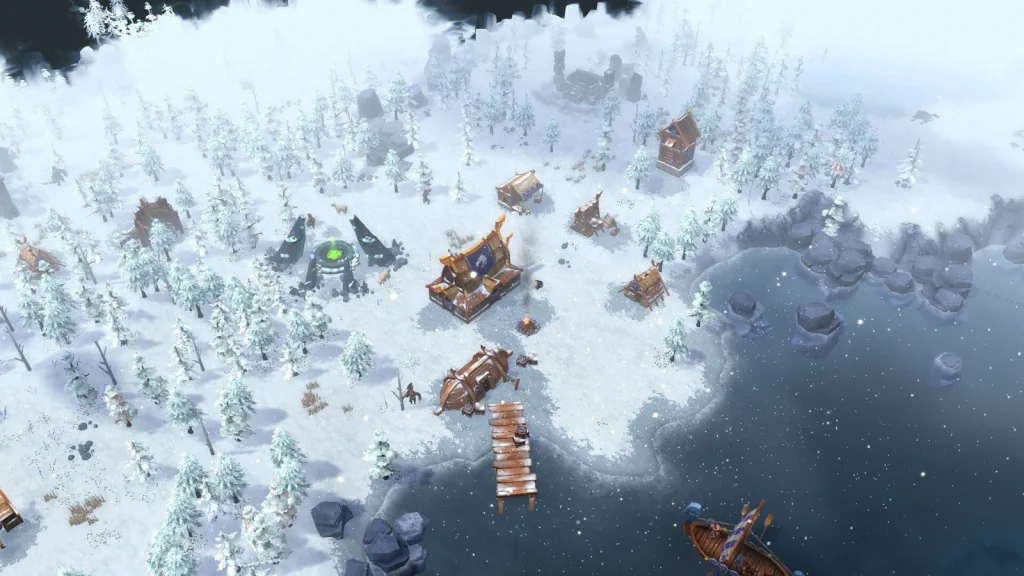
TL;DR: Northgard winter preparation means saving enough food and wood for the seasonal deficit while keeping the settlement productive. Read the calendar, finish essential resource projects and reconsider jobs that remove too many food workers. Delay optional colonization, feasts or recruitment when they would consume the survival reserve.
A large summer surplus is only part of the picture. Population growth, unfinished buildings, military conversions and an approaching event can change what the settlement needs before spring. Prepare for those changes while there is time to act.

On this page
Northgard winter preparation: read the coming season
Use the calendar and event information to see what approaches. Check the current clan bonuses and any special map rules. Ordinary winter, a severe event and a Conquest modifier need not create the same resource problem.
The official game description makes winter survival part of resource management and worker assignments. Treat it as a recurring planning decision rather than waiting for the first shortage warning.
List the projects that must function before the change: staffed food production, wood supply, necessary housing and recovery for important units. A long list of buildings under construction is less useful than finishing the project that prevents the expected shortage.
Choose a reserve according to the actual settlement. A small population with strong seasonal production differs from a large force supported by a reduced civilian workforce. Another player’s stockpile number doesn’t describe either one automatically.
Separate stored food from the seasonal balance
Read the food stock and its change separately. Positive summer income can help build a reserve, but it doesn’t tell you how quickly that reserve will fall under winter conditions. Recheck the balance when the season begins.
Inspect food workers before assuming you need another building. An understaffed food source may respond sooner to one assignment than to construction elsewhere. If all suitable positions are filled, compare an upgrade, another accessible source or a reduction in optional commitments.
Remember the people moved into other jobs. More scouts, miners, sailors and soldiers can reduce the workers gathering food. Decide which of those jobs must continue through winter and which can wait until the settlement’s balance improves.
Don’t spend the reserve twice in your plan. Food allocated for a claim or a feast is no longer available for the seasonal deficit. Make the expense first in a hypothetical budget, then check what remains for survival and interruptions.
Keep wood supply and construction under control
Read the wood balance, the staffed Woodcutter’s Lodge and the construction you intend to finish. Spending the last reserve on optional buildings can leave the settlement short when seasonal needs or repairs arrive.
Prioritize projects with a near-term result. A working food source or needed house may solve an immediate problem; an upgrade whose benefit arrives much later may be affordable only after spring. The right choice depends on the current constraint and completion time.
Reserve resources for damage and recovery. A hostile event that interrupts a key building can make a narrow budget fail. Keeping some flexibility is useful when the settlement relies on only one working production route.
When construction needs extra labor, check which job loses it. The released Winds of Fate update lets specialized workers directly build or repair. That convenience doesn’t remove the output they give up while doing the task.

Budget the deficit in consistent units
Use the displayed balance and remaining season as an estimate, then leave room for change. Be careful that the rate and duration use the same time unit. Don’t multiply a figure from one interface by a duration measured in another.
As a purely hypothetical example, suppose food falls by 20 units during each observed interval, and ten comparable intervals remain. That would use 200 food if the workforce, consumption and conditions stayed the same. These are invented example inputs, not measured Northgard rates.
The example explains why 200 stored food would provide no interruption reserve under those assumptions. Population growth, injury or an event could increase the need; changed staffing or a new production effect could reduce it. Observe the game again after either change.
Use the estimate to choose an action. If the current reserve cannot cover the apparent deficit, restore suitable food jobs, reduce optional commitments or complete the production project that can contribute in time. A calculation that doesn’t change the next decision adds little.
Read clan effects before following a generic plan
Some clans handle seasonal conditions differently. Read their current starting bonuses and knowledge instead of applying a universal penalty or staffing pattern. Bear’s winter identity, for example, is useful without making every Bear settlement self-sufficient.
The Claws & Jaws notes changed Bear’s Winter Festival from increasing food production to reducing consumption. Those effects influence the budget differently, so an older calculation may start from the wrong premise.
Check every effect you rely on in the current interface. If a bonus needs a knowledge unlock, milestone or building, don’t count it before that condition is met. Planned improvements can’t protect the reserve until they actually operate.
For unusual clans, campaigns or Conquest rules, use the relevant mission information first. A scenario that changes recruitment, resource production or attacks can make an ordinary settlement checklist incomplete.
Keep sheep where their winter saving is useful
The released April 2024 Claws & Jaws notes increased a sheep’s winter wood-consumption reduction in its zone from 30% to 50%, with additional sheep stacking multiplicatively. This is a zone effect, so move a sheep to a populated zone where the saving addresses actual consumption. A sheep sitting in a remote zone with little relevant demand does less for the immediate budget.
Compare keeping it through winter with sacrificing it for immediate food. Sacrifice can help an urgent shortage, but it removes the animal that would provide the continuing seasonal saving. Do not count the same sheep as both the future wood reduction and the food you already spent. Some clans give sheep distinct additional effects; read those before applying the generic choice.
For a practical autumn check, select the staffed food zone, inspect its workers and then inspect the wood reserve. If food is adequate and wood is the likely constraint, retaining sheep may fit the problem. If food is about to fail and no staffing change can fix it in time, weigh the immediate sacrifice against the remaining wood budget. Afterward, update both resource estimates.
Prepare a response instead of spending everything on survival
Inspect the likely approaches to the settlement and the health of your important units. Keep the means to defend a food or wood zone that the winter budget depends on. Losing production during the season can matter more than the resources spent on a modest defensive preparation.
After an attack, recheck jobs and output. Workers may be injured, displaced or repairing a building; the pre-attack estimate may no longer apply. Restore the useful production before resuming discretionary mining or scouting.
| Warning | What to inspect | What to change |
|---|---|---|
| Food reserve falls quickly | Seasonal balance and food staffing | Restore useful food jobs and pause optional spending |
| Wood is nearly exhausted | Lodge staffing, construction and repairs | Prioritize essential projects and rebuild reserve |
| Units are injured before an event | Recovery and exposed production zones | Heal or strengthen the necessary response |
| An expected bonus is absent | Knowledge, milestone or building requirement | Budget from current effects until it activates |
Return to the Northgard settlement basics if the same shortage returns every season. Before winter begins, finish the essential project, check its workers and preserve the reserve that will keep it functioning until spring.
FAQ
How much food should I store before winter?
Estimate from the actual deficit and remaining season, then leave a recovery reserve. Population, jobs, clan effects and events vary, so one universal food number can be unsafe.
Should I stop every non-food job during winter?
Keep the jobs needed to sustain wood, income and defense, then reduce optional commitments when the reserve cannot cover the deficit. Restore useful food jobs before adding another empty food building.
Do sheep produce a universal food bonus?
The generic released sheep rework supplies winter wood saving within their zone. Clan-specific effects can add a different benefit; the generic effect should not be mistaken for every clan’s food rule.
Sources and further reading
- https://store.steampowered.com/app/466560/Northgard/
- https://steamstore-a.akamaihd.net/news/externalpost/steam_community_announcements/5759616966664557837
- https://steamstore-a.akamaihd.net/news/externalpost/steam_community_announcements/1818118366173340
- https://steamstore-a.akamaihd.net/news/externalpost/steam_community_announcements/1797185861607802
- https://northgard.net/game/
- https://steamstore-a.akamaihd.net/news/externalpost/steam_community_announcements/1783238125217583
Keep exploring
Northgard vs Manor Lords: clan objectives or settlement planning?
Choose Northgard for clan-specific strategy and explicit victory routes; choose Manor Lords for the placement, households and production of a medieval settlement.
Games Like Northgard: 4 Picks by Strategy Style
Games like Northgard: compare Banished, Against the Storm, Age of Empires IV and They Are Billions by economy, challenge structure and combat.
Northgard Review: Settlement Strategy, Clans and Co-op
Northgard review: decide whether its worker economy, winter pressure, clan variety and solo or co-op Conquest fit the strategy game you want.