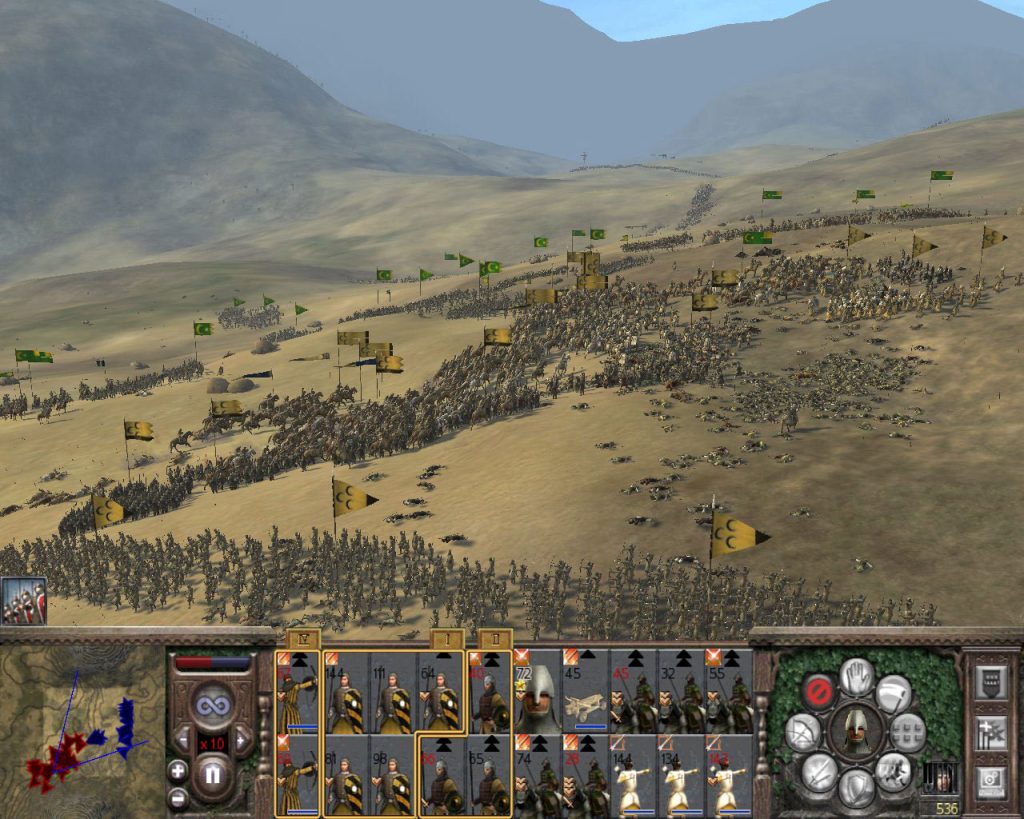
Medieval II: Total War is the first pick for commanding medieval armies directly; Crusader Kings III fits wars driven by dynasties and vassals; Manor Lords fits a settlement whose workers also become its militia. The best medieval war strategy games differ most in what your army exists to protect and what you control when it fights.
Start with the consequence you want to manage. In a battlefield campaign, a bad maneuver loses troops. In a dynasty game, a ruler’s death can change who controls the realm. In a settlement game, losses can remove the people who farm and produce your supplies. These are distinct forms of medieval strategy, not interchangeable knight-themed RTS games.

On this page
Best Medieval War Strategy Games: For direct battlefield command, start with Medieval II
Total War: MEDIEVAL II – Definitive Edition joins a turn-based territorial campaign to real-time battles. It is the clearest match here if the attraction is organizing infantry, missiles and cavalry, then watching the resulting formations fight under your orders.
The campaign spans Europe, Africa and the Middle East, with expansion beyond them. You develop cities, recruit armies and use diplomacy while choosing where to attack next. Religious politics, including the Pope and Crusades, add pressures to expansion. The campaign supplies reasons for the battles rather than only offering a menu of isolated encounters.
The Definitive Edition’s official description includes Kingdoms, with Britannia, Teutonic, Crusades and New World campaigns. Their smaller regional focus can be useful when you want a particular conflict rather than the main campaign’s broad conquest. Choose the setting first; a regional campaign changes the strategic context as well as the map.
A typical question for this game is whether the army you can afford now can take and hold the next city. That connects the tactical roster to campaign spending. On the battlefield, formation and cavalry use are central attractions; between battles, the problem becomes replacing losses and keeping the expansion useful.
Who should pass: a player wanting modern interface conveniences or a detailed character-centered dynasty simulation. Its age is visible in the supplied screenshots and controls. Check recent compatibility guidance for your machine instead of assuming that an older game always runs without adjustment.

For wars shaped by people, choose Crusader Kings III
Crusader Kings III makes a noble house the continuing subject of the campaign. Your ruler dies and the dynasty carries on through an heir. Warfare sits alongside marriage, diplomacy, intrigue, titles and relations within the realm.
This is the better choice if the question you want to answer is why a war is possible, who supports it and what happens after the current ruler is gone. You can assemble men-at-arms and knights and use mercenaries or Holy Orders. Those military choices are embedded in the wider political structure rather than a separate tactical battle arena.
The official description emphasizes character traits, education and lifestyle choices. Those systems matter to a war-minded player because a strong ruler’s success does not automatically produce a stable next generation. Preparing an heir and managing the people who hold titles can be as consequential as the current conquest.
Choose a starting ruler whose immediate position you understand. A smaller realm can make it easier to see how one title, relationship or war changes the situation. The goal need not be maximum territorial growth. Preserving a workable succession or recovering a family position can make a satisfying campaign objective.
The limit: you do not directly maneuver regiments in a Total War-style real-time battle. If watching cavalry execute your flank order is the main reason you want a medieval game, return to Medieval II. Also inspect the current base-game and expansion descriptions before buying for a specific starting date or specialist feature.

For the cost of arming your village, consider Manor Lords
Manor Lords is a settlement-building choice with real-time tactical combat. Its description centers on growing a village, organizing production chains and expanding into new regions. Warfare is one demand placed on that economy rather than the only activity on the screen.
Food, housing, raw materials and finished goods need to work together. Soil fertility informs farming, while deposits and forests influence where production belongs. Producing arms competes for resources and labor with keeping the settlement supplied. That makes the preparation for war concrete rather than a detached recruitment timer.
The military design includes town militia, a retinue and mercenaries. Raising militia takes people away from civilian work; casualties remove subjects from the settlement. Paying for mercenaries presents a different cost. The appealing decision is therefore how much economic disruption a threat justifies, not simply which unit has the largest combat number.
Its tactical description includes fatigue, weather and equipment. These are reasons to examine an actual battle as well as a scenic village tour before choosing it. The game is a narrower fit than a whole-medieval-world conquest title, and settlement development should be something you enjoy in its own right.
The purchase check: verify the current development status and implemented feature list. A store’s broad description can include ambitions whose details change during development. Choose it for its visible settlement-and-militia loop, and confirm any specific rival-settlement or campaign feature you consider essential.
Three questions settle the shortlist
- Do you want to command the battle directly? Medieval II and Manor Lords supply that attraction at different campaign scales. Crusader Kings III focuses on the realm and characters around the war.
- What should make a defeat hurt? Choose an army campaign for lost military strength, a dynasty campaign for political consequences, or a village economy for the loss of working residents.
- What do you want to do between fights? Territory and army development favor Medieval II, inheritance and relationships favor Crusader Kings III, and resource production favors Manor Lords.
This selection uses official descriptions and real game screenshots to establish the advertised systems. It does not assign invented review scores, promise historical accuracy or claim equal feature completeness. For the most direct medieval war experience, begin with Medieval II. Move to Crusader Kings III when political causes matter more than battlefield orders, or Manor Lords when supplying and protecting a community is the central attraction.
If you mainly want a larger political map, compare the historical grand strategy choices before committing. Whichever title you select, verify requirements and the specific edition rather than buying a bundle for features you will not use.
Sources and further reading
Keep exploring

Hearts of Iron 4 occupation laws: control resistance without draining reserves
Match occupation policy to resistance, compliance and a garrison you can actually supply; use stronger control only when the situation justifies its cost.
wargame red dragon radar anti air management: coverage and weapon-state decisions
A source-backed guide to managing specific radar-related weapons within a complete Wargame Red Dragon air defense.
wargame red dragon sead aircraft: choose a mission that helps
A concise source-backed guide to choosing and reassessing a useful SEAD mission in Wargame Red Dragon.