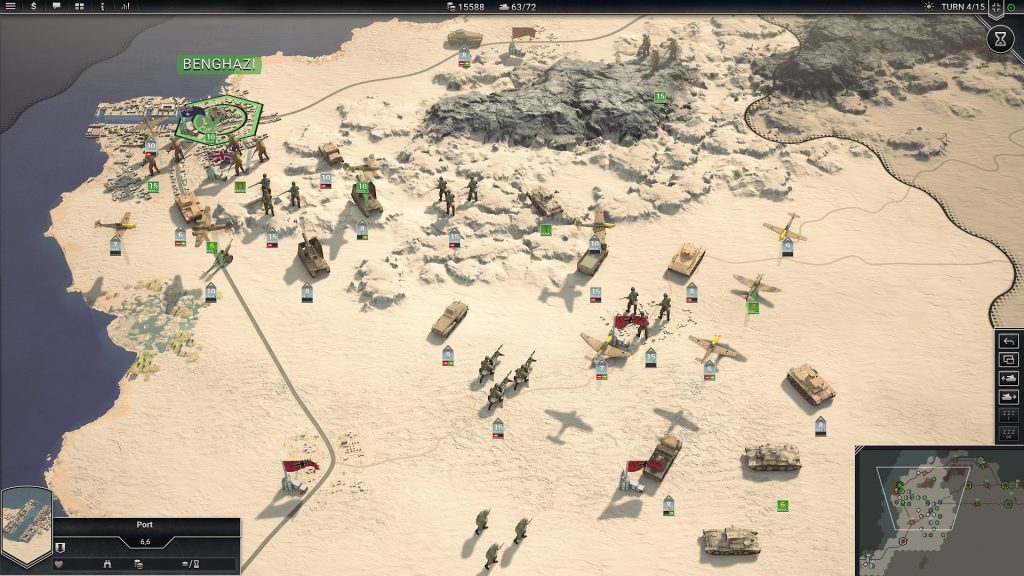
For the best turn based war games on PC, start with Panzer Corps 2 for a persistent World War II army, Unity of Command II for divisions and supply lines, or Field of Glory II for ancient formation tactics. All three give you time to think, but the information that deserves your attention is different.
This selection is about commanding military units during discrete turns. A huge political map is not required, and a game is not included simply because its campaign has an end-turn button. The recommendations follow official advertised systems; no measured AI contest or hands-on benchmark is claimed.

On this page
Panzer Corps 2 rewards a force you can carry forward
Panzer Corps 2 is the straightforward first inspection if you want a branching World War II campaign with veterans carried from one scenario to the next. Its official description lists around sixty campaign scenarios and a broad roster of European-theater units.
The recurring pleasure is building a force whose history matters. A veteran unit is useful beyond the encounter in which it gained experience, so an expensive victory can leave a problem for the following mission. That continuity gives individual purchases and losses more meaning than a fresh, unrelated army on every map.
Its advertised mechanics cover movement, spotting, encirclement, weather and captured equipment. You have time to choose an order, but that does not make the order trivial. Finding a route, revealing an enemy and choosing a sequence of attacks are separate parts of the turn.
It also offers a random-map skirmish generator with multiple map and mission types, a scenario editor, and multiplayer options including hotseat and server-assisted play by email. Choose the campaign for a sustained army career or skirmish for another battlefield; do not confuse a random individual map with a fully procedural historical campaign.
Buying limit: the base campaign and separately sold campaigns are different products. Confirm the side and theater included in the package you select. The large unit roster does not mean that every desired historical operation belongs to the base campaign.

Unity of Command II makes the supply route part of the attack
Unity of Command II is the stronger fit when the shape of an operation interests you more than collecting individual vehicles. The base description focuses on Western Allied divisions in World War II and connects their advance to headquarters, supply and logistics.
Headquarters can reorganize formations, support bridging and resupply, and use abilities such as emergency supply. Theater assets add reconnaissance, bombing and air supply. Those tools create questions that an ordinary attack-strength comparison does not answer: can the next advance remain supported, and what must the headquarters do before it begins?
Fog of war requires obtaining information, including through reconnaissance and captured stragglers. The official description also emphasizes cutting enemy supply and conducting deep operations. Choose it if planning around an exposed flank, an unknown position or a threatened route sounds more interesting than moving every available unit forward.
The campaign branches and includes optional objectives that can change its course. Its limit is scale: these are divisions and operational relationships, not detailed orders for every soldier or a national political simulation. Preview an ordinary objective with its supply overlay visible to see whether that abstraction suits you.

Field of Glory II keeps the decision on the ancient battlefield
Field of Glory II uses tile-based turns and cohort-sized units for ancient warfare. Its base description covers 280 BC to 25 BC, with armies using Roman infantry, pikes, warbands, horse archers, elephants and other troop types.
The appeal is understanding different formations and tactical doctrines. Historical scenarios include Cannae, Zama and Carrhae, while custom battles allow hypothetical matchups on generated terrain. You can investigate a named encounter or choose a fresh tactical problem without first running a whole empire.
Named generals influence combat and morale, and campaign victories improve core units. The campaign’s strategic decisions are described as quick routes to the next battle. That is a useful boundary: a linked sequence of tactical engagements does not provide the population, production and diplomacy of a grand strategy game.
Inspect a full turn, including movement choices and the results of combat, rather than a close-up of the troop models. The compromise is deliberate tile-based presentation. It suits a player who wants to study formations; it will not replace the continuous cavalry charge of a real-time battle game.
A practical way to narrow the choice
Choose Panzer Corps 2 if you want to retain a force across World War II missions. Choose Unity of Command II if supply and headquarters define the operation you want to solve. Choose Field of Glory II if ancient unit matchups are the reason you are searching. The ancient warfare comparison also separates those tactical battles from state management and real-time command.
Then check one complete session in the mode you will actually use, its current system requirements and the required content pack. Slow input removes click-speed pressure; it does not remove the need to understand what a unit, a turn or a campaign represents.
Sources and further reading
Keep exploring

Hearts of Iron 4 occupation laws: control resistance without draining reserves
Match occupation policy to resistance, compliance and a garrison you can actually supply; use stronger control only when the situation justifies its cost.
wargame red dragon radar anti air management: coverage and weapon-state decisions
A source-backed guide to managing specific radar-related weapons within a complete Wargame Red Dragon air defense.
wargame red dragon sead aircraft: choose a mission that helps
A concise source-backed guide to choosing and reassessing a useful SEAD mission in Wargame Red Dragon.