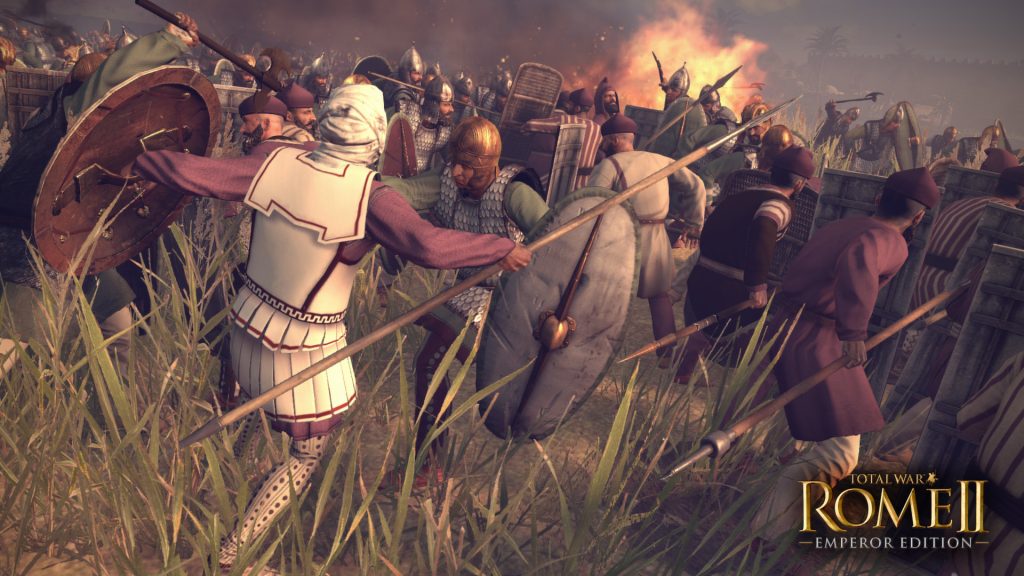
For ancient warfare, choose Total War: ROME II if you want to command a battle and then conquer provinces, Field of Glory II if you want deliberate turn-based army tactics, or Imperator: Rome if you want to govern the state behind the armies. These are the best ancient warfare strategy games to compare when scale matters more than an arbitrary overall ranking.
All three cover the classical world, but an army means something different in each. It can be a formation you maneuver directly, a collection of tactical units on a tile map, or a military instrument tied to population and political loyalty. Decide which of those problems you want to solve before comparing faction lists.

On this page
ROME II makes conquest and battlefield control one loop
Total War: ROME II – Emperor Edition combines a sandbox turn-based campaign with real-time land and sea battles. It fits a player who wants territorial ambitions to produce encounters, then wants personal control over how the troops fight them.
The official description includes military, economic and political ways to pursue power. You raise armies, manage development and contend with loyalty and intrigue. That is the useful campaign connection: gaining ground is only part of the task, because the empire and forces supporting the advance must remain workable.
The battlefield roster includes heavy infantry, cavalry and siege engines across rival civilizations. Those differences are a reason to choose a faction that interests you, rather than always treating Rome as the only valid campaign. Direct battle control makes deployment and the use of complementary troop types part of the appeal.
Emperor Edition includes the Imperator Augustus campaign set after Caesar’s death. Its factions include the rival Roman leaders and outside powers seeking opportunities. This offers a different political starting situation from the main campaign while keeping the same broad campaign-and-battle structure.
Best fit: you want both army spectacle and a reason to care about the next province. Limit: it splits your attention between campaign management and live battles. If one of those halves sounds like work you would repeatedly skip, a more focused game below may suit you better.
Check edition contents carefully. Emperor Edition’s inclusion of free updates and Imperator Augustus is not a claim that every separately sold campaign or faction pack is included. Buy a specific extra only after verifying that it unlocks the setting or army you intend to use.

Field of Glory II isolates the tactical question
Field of Glory II is a turn-based tactical game whose base description covers Rome’s rise from 280 BC to 25 BC. It is the clearest choice if you want time to evaluate an army’s deployment and subsequent moves without managing a whole state between encounters.
The army lists include Roman infantry, Hellenistic pikes, warbands, horse archers, elephants and other troop types. Their differing tactical doctrines are central to the selection. A particular army should appeal because of how it fights, not merely because its uniforms differ from another faction’s.
Historical scenarios include battles such as Cannae, Zama and Carrhae, with either side playable. Custom battles offer hypothetical matchups and generated terrain. This lets you choose between exploring a named encounter and testing a fresh army problem without requiring a vast empire campaign.
Its campaign mode follows battlefield careers and carries core-unit experience onward. The official description emphasizes quick strategic decisions that move you to the next battle. That is an important boundary: a sequence of connected battles is different from governing a map full of populations, roads and political offices.
Best fit: your enjoyment comes from unit matchups, formation choices and careful tactical turns. Limit: there is no Total War-style continuous real-time battle to direct. The tile-based presentation is purposeful, but it will not satisfy someone buying chiefly for cinematic cavalry charges.
Check which era and armies the base purchase covers before adding expansions. The listed base period is narrower than the phrase “ancient warfare.” Choose the game for a desired matchup or tactical system, then confirm the content pack required for that specific army.

Imperator: Rome asks whether the state can sustain the army
Imperator: Rome focuses on empire building in the classical era. Its official features tie characters, populations, government, trade and provincial improvements to the growth and stability of a state. It fits the player who wants war to be part of a political economy.
Characters govern provinces and command armies and fleets. Their loyalty can become a military concern when governors or generals turn against the state. The decision is therefore more than selecting the next target: the person trusted with a force is part of the risk.
Populations have cultures, religions and different roles in the realm. Trade goods provide benefits, while buildings, roads and defenses develop provinces. This offers a concrete alternative to pure battlefield tactics: successful conquest needs a state that can absorb and support its gains.
The military features include choosing battle tactics and culture-linked military traditions. You influence the preparation and approach to war, but do not personally maneuver battlefield units in a separate 3D tactical arena. That distinction should decide whether Imperator stays on your shortlist.
Best fit: population, internal power and provincial development are the questions you want to manage. Limit: the extra state systems stand between you and the next military result. Look at current-version gameplay and the relevant edition contents; the description alone cannot establish present balance or a promised development schedule.
A simple test for your first purchase
Imagine finishing a difficult battle. If you want to rebuild the army and choose the next conquest, start with ROME II. If you want to examine the tactical result and try a different army on another map, start with Field of Glory II. If you want to deal with the conquered population and the victorious commander’s influence, start with Imperator.
These recommendations are based on official product descriptions and actual screenshots, rather than claimed play sessions or invented realism scores. Confirm system requirements and the exact historical content you need. For a broader state-level comparison, continue to the historical grand strategy selection.
Sources and further reading
Keep exploring

Hearts of Iron 4 occupation laws: control resistance without draining reserves
Match occupation policy to resistance, compliance and a garrison you can actually supply; use stronger control only when the situation justifies its cost.
wargame red dragon radar anti air management: coverage and weapon-state decisions
A source-backed guide to managing specific radar-related weapons within a complete Wargame Red Dragon air defense.
wargame red dragon sead aircraft: choose a mission that helps
A concise source-backed guide to choosing and reassessing a useful SEAD mission in Wargame Red Dragon.