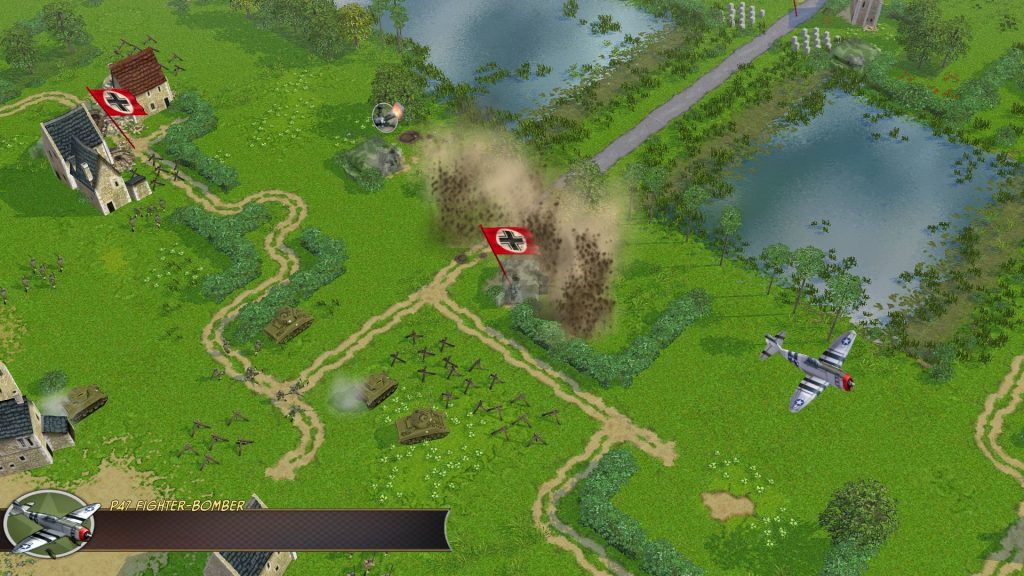
The best war strategy games for low end PC start with modest published requirements, rather than a promise that every old laptop will work. Battle Academy and Panzer Corps Gold are good WWII candidates for very limited hardware. The Battle for Wesnoth offers fantasy warfare with a modern 64-bit requirement, while the original Company of Heroes is worth considering if you want real-time squad combat.
Check your processor, RAM, graphics hardware and operating system before choosing. A small download does not guarantee a smooth battle, and an old Windows version in a store listing does not mean the current Steam client supports that version. The figures below are official requirements, not benchmarks or results from a laptop test.

On this page
Best War Strategy Games For Low End Pc: The simplest hardware shortlist
- Battle Academy: older turn-based WWII tactics; published minimum uses a 128 MB DirectX 9 graphics card.
- Panzer Corps Gold: a large turn-based campaign collection; minimum lists a 64 MB video card and notes 2 GB RAM for operating systems newer than XP.
- The Battle for Wesnoth: fantasy armies and campaigns; current Windows minimum specifies 2 GB RAM and a 64-bit system.
- Company of Heroes: real-time WWII squads; older requirements need extra care on current hardware and software.

Battle Academy: prioritize readable tactical decisions
Battle Academy is the first game to examine if your PC is basic and your preferred setting is WWII. The store lists a Pentium 4 or Athlon XP class processor, 512 MB RAM, a 128 MB DirectX 9-compatible graphics card and 500 MB storage. Its additional note raises memory to 1 GB for Vista or later.
The turn-based design lets you spend time on line of sight, suppression, morale and flanking instead of constantly tracking a busy front. Its base campaigns contain more than 30 battles, making it a practical choice for someone who wants a substantial single-player tactical game without a modern 3D battlefield’s published requirements.
The compromise is an older visual and interface style. Confirm that it launches correctly on your current Windows installation before investing time in extra scenarios. The published minimum describes the developer’s listed requirement; it does not certify every integrated GPU or current driver combination. Choose it for tactics you can inspect carefully, not a contemporary visual showcase.
Panzer Corps Gold: many campaigns in a modest package
Panzer Corps Gold puts you in charge of a core army carried through WWII scenarios. Its official description identifies it as the edition containing the series’ expansions and hundreds of scenarios. This suits a low-end machine owner who would rather develop a roster over many evenings than chase a new graphics-heavy release.
The requirements list a Pentium 4-class processor, 1 GB RAM, a 64 MB video card and 500 MB storage, with a separate note specifying at least 2 GB RAM on operating systems newer than Windows XP. Read that note along with the headline requirement. Do not reduce the decision to the lowest number shown.
The main tradeoff is the older design. You are choosing a classic campaign structure and presentation rather than Panzer Corps 2’s newer engine. That can be a sensible exchange on weak hardware. Keep your first purchase focused on the game you can run, rather than assuming the newer sequel inherits the same requirements.

Wesnoth: light fantasy warfare with current OS limits
The Battle for Wesnoth is an open-source, turn-based fantasy strategy game with campaigns, multiplayer factions and a map editor. It is a useful alternative when historical tanks are optional and the attraction is recruiting and preserving an army across adventures.
Its Windows minimum is more current than the other older listings: Windows 10 version 1903 or later, a dual-core 2.0 GHz processor, 2 GB RAM and 800 MB storage. The store explicitly says 64-bit only. A PC can have enough memory and still fail this check if its operating system is unsuitable.
There is no basis here for promising a particular frame rate or compatibility with every inexpensive laptop. Check the complete listing against your machine. The fantasy setting is also a real fit limitation: it answers the desire for low-demand strategy warfare, but it will not satisfy a reader specifically seeking WWII operations or a modern military simulation.

Company of Heroes: the real-time option needs a closer check
The original Company of Heroes offers a WWII single-player campaign, squads that use cover and destructible terrain. Its official requirements are far lower than those published for Company of Heroes 3, which makes it a candidate for players who specifically want real-time combat.
The listing names a 2.0 GHz Pentium IV-class processor, 512 MB RAM and a DirectX 9.0c-compatible graphics card with Pixel Shader support. Those are old specifications, including old operating systems and particular excluded GPUs. Treat them as a historical compatibility description, not proof that any new budget computer or old netbook will behave well.
Compared with the turn-based choices, you also have more action to monitor. Try a modest battle and conservative visual settings before assuming large fights will perform equally. If the game is unstable or difficult to read at a comfortable resolution, choose Battle Academy instead of making every session a troubleshooting exercise.
Decide with your machine beside you
For a very limited Windows PC, compare Battle Academy and Panzer Corps Gold first. For fantasy campaigns on a current 64-bit system, check Wesnoth. Consider Company of Heroes when real-time squads matter enough to justify checking an older game’s compatibility. If the rules are also unfamiliar, the beginner selection guide explains which command style is easier to start with.
Sources and scope
Requirements and game features come from the linked official storefronts. No measured frame rates, hands-on hardware tests or blanket guarantees for integrated graphics are claimed. Current client and operating-system support must be checked separately.
Sources and further reading
Keep exploring

Hearts of Iron 4 occupation laws: control resistance without draining reserves
Match occupation policy to resistance, compliance and a garrison you can actually supply; use stronger control only when the situation justifies its cost.

wargame red dragon radar anti air management: coverage and weapon-state decisions
A source-backed guide to managing specific radar-related weapons within a complete Wargame Red Dragon air defense.
wargame red dragon sead aircraft: choose a mission that helps
A concise source-backed guide to choosing and reassessing a useful SEAD mission in Wargame Red Dragon.