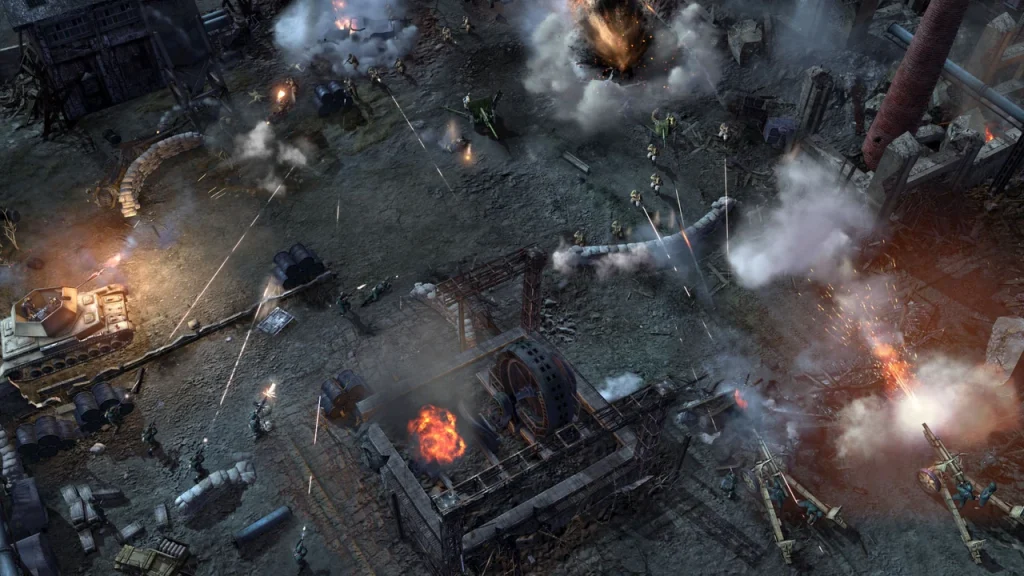
Verdict: This Company of Heroes 2 review recommends considering the game if you want a World War II RTS built around squad positioning, connected territory and combined-arms decisions. Its documented systems reward preserving useful units and creating a supported attack. Players mainly seeking a slow empire campaign or a simple build-and-rush loop should examine those demands before choosing it.
Review method: This is a document-based evaluation of official product information, faction mechanics and campaign walkthroughs. It does not claim a new hands-on playthrough, hardware benchmark or measurement of current matchmaking. The strengths and drawbacks below are editorial judgments grounded in those sources.

Evidence reviewed: The official Steam page defines the product and content; Tomy’s beginner guide explains practical mechanics. The campaign index and Mission 4 walkthrough support scenario discussion. Valve’s Workshop explanation supports community-content access. Reviewed November 9, 2026; prices, server activity and performance figures are not inferred from archived documentation.
On this page
Company of Heroes 2 review: what the base game offers
The official description identifies two multiplayer armies in the base game: the Soviet Red Army and Wehrmacht Ostheer. It also includes the Soviet single-player campaign. Those are the starting purchase boundaries, rather than a promise that every faction and campaign shown on a store page belongs to the cheapest listing.
The Western Front Armies content adds US Forces and Oberkommando West. The British Forces adds its own multiplayer army. Ardennes Assault is a separate US-focused single-player campaign built around the Battle of the Bulge. A bundle can combine products, but the contents of the actual purchase determine which armies and campaigns you receive.
The main gameplay proposition is tactical RTS warfare. You control squads, support weapons and vehicles while contesting a battlefield. Territory and resources support your army, and movement and preservation determine how effectively the units use those resources.
| Content | Officially described role | Relevant buyer |
|---|---|---|
| Base game | Soviet campaign, Soviet and Ostheer multiplayer armies | Eastern Front campaign or base-faction play |
| Western Front Armies | US Forces and OKW multiplayer armies | Players seeking those faction options |
| British Forces | British multiplayer faction | Players choosing its documented tech approach |
| Ardennes Assault | US campaign with persistent company consequences | Campaign-focused players wanting that structure |
1. The strongest design feature is the interaction between units
Cover, sight and weapon roles create decisions that a recruitment list cannot resolve alone. The official description emphasizes TrueSight, directional placement and combined arms. The beginner guide explains how a squad’s useful protection depends on where incoming fire originates.
For example, putting infantry behind a wall helps only against relevant firing angles. If the opponent moves around that wall, the squad must respond. This makes positioning an ongoing task rather than a one-time action performed when the unit arrives.
A machine gun adds a suppression arc, but infantry must screen routes around it. An anti-tank gun adds a different engagement function, while a tank needs sight, repair support and protection from hostile counters. The value comes from the arrangement of the force as well as the number of units purchased.
Why that appeals to tactical players
The documented structure gives each purchase a practical question: which role is missing, where can it operate and what will keep it alive? An additional squad can help capture, but it does not automatically remove an enemy gun blocking the approach. Indirect fire or a different attack angle may change that fight more.
That is the main reason for this review’s favorable assessment of the tactical design. The systems connect production to battlefield decisions. This is an evaluation of the rules and their implications, not a claim that a newly tested match produced a particular balance outcome.
2. Territory creates pressure beyond the immediate fight
Resource sectors need a connection to the base. A distant captured fuel point can therefore stop delivering its normal income when the linking territory is taken. This creates a reason to defend a connector even when the far point still displays your control.
In a hypothetical layout, a single central sector joins your base to a forward resource route. Moving every squad farther forward leaves that connector open to attack. The next tech purchase can be delayed by the lost connection, even if your army wins a different fight nearby.
This structure favors players who can divide attention between the frontline and tactical map. It also explains one learning difficulty: a visible territorial advantage does not necessarily equal a sustainable economic advantage. You need to understand which captured areas are actually contributing.
Victory-point pressure changes how long you can wait
The beginner guide describes victory-point control as a separate match-winning pressure. Saving for a stronger vehicle must happen while the existing army remains able to contest the map. A plan that gives away the battlefield until the intended tank arrives can run out of opportunity.
The resulting pace is less suitable for someone who wants unlimited time to build a complete army before engaging. Defensive play can be meaningful, but the documented objective systems still require a reasoned response to territory and victory pressure.
3. Squad preservation adds depth and learning friction
Surviving squads retain an identity and gain veterancy. Reinforcement restores missing models, while healing addresses damage to those who remain. Keeping a useful squad alive can preserve experience and avoid the cost of replacing an entirely lost unit.
The distinction between healing and reinforcement is important for new players. A squad at full model count may still return to combat injured. Sending it back without appropriate recovery can create another manpower loss instead of restoring the opening force’s intended pressure.
Weapon teams and vehicles also require different recovery decisions. Some support weapons need manual repositioning rather than the same retreat behavior as infantry, and vehicles need repair attention. Learning one movement habit does not solve every unit class.
The drawback is attention cost
From the documented mechanics, this review expects substantial attention demands: choosing cover, watching flanks, maintaining connections and recovering different unit types. That is a design tradeoff. Players who enjoy managing a small force carefully may welcome it; those wanting a forgiving passive army may find it less appealing.
The answer is not to describe the game as automatically inaccessible. The base campaign and guides offer ways to learn specific functions. However, the rules provide several ways for a poorly supported force to lose value, so a buyer should expect to learn those interactions.

4. The Soviet campaign and Ardennes Assault serve different goals
The archived campaign guide lists fourteen Soviet missions. Its walkthroughs document scripted situations such as reaching warmth, using provided sniper squads and capturing a base before defending it. These examples support the view that the campaign teaches and explores particular tactical problems rather than reproducing a standard multiplayer opening every time.
The Miraculous Winter is a concrete example. Its documented route begins with cold exposure and shelter, then moves through outposts and an open fuel approach. A final counterattack includes a tank on ice that the mission handles through mortar fire. Those details make the environmental systems part of an objective sequence.
The official page describes Ardennes Assault differently: eighteen scenarios, company customization and persistent company-health consequences between missions. A campaign player who wants continuity across a map should examine that separate product, rather than assuming the base Soviet campaign supplies the same structure.
Weather claims need a campaign boundary
The official marketing highlights ColdTech weather. The linked mission evidence supports temperature meters, shelter and ice hazards in specific campaign situations. It does not establish that every present-day ranked multiplayer map uses identical freezing and blizzard rules.
This review therefore values the documented campaign use of the environment while keeping that claim separate from current competitive play. The actual mission and mode determine which environmental behavior matters. A snowy screenshot alone is not proof that a particular survival mechanic is active.
Faction variety is useful, but ownership and tech details matter
The official descriptions distinguish faction approaches: US Forces combined-arms options, OKW specialized units and a British tech tree balancing mobility and defense. These are broad product descriptions, not proof of a current tier list or a particular faction winning more often.
The faction guides and later patch records show why a buyer should learn the army actually owned. A Soviet opening uses different first production tools from Ostheer, while OKW has its truck and upgrade arrangement. Copying another faction’s recruitment sequence will not supply the same counters.
Dated guides need care. The 2021 patch record, for example, merges Soviet grenade access and splits OKW Battlegroup upgrades. An old article can describe a useful role while giving superseded access instructions. This is a maintenance concern for learning resources, not evidence that a specific faction is currently unbalanced.
Workshop content extends custom play
Valve documents ready-to-use Workshop items installed through subscription and made available on game launch. The game’s Workshop includes maps alongside tuning, modes and cosmetic content. This gives custom-match players a route to community battlefields and alternative setups.
The benefit depends on choosing the right item and mode. A skin will not appear as a battlefield, and a scenario can use the Modding Hub mission path. Curated submissions are also different from ready-to-use subscribed items. The variety is useful, but the installation and selection workflow still needs attention.
Workshop availability does not guarantee balance, active support or ranked-pool inclusion for every upload. Evaluate a particular map’s description and requirements before planning a group game. This review recognizes the official content mechanism without assigning unverified quality to the entire library.
Check performance and multiplayer fit separately
This review does not include a hardware benchmark. Historical minimum requirements and platform support are not measurements of how the game will run on your current machine. Examine the current listing for the purchased product and compare its requirements with your system before relying on a performance assumption.
Likewise, multiplayer categories do not reveal current queue times, skill distribution or server population. Those conditions need current evidence. No numerical activity estimate is invented here merely because the title supports online matches.
For cross-platform groups, Feral’s official FAQ states that Steam Mac and Linux players can play together, while neither can play with Windows players. Confirm the platforms of the people you intend to join before purchasing around that plan.
Who should consider it, and who should inspect it more closely?
Consider CoH2 if your preferred decisions involve covering an infantry approach, preserving an experienced squad or funding the counter that changes a specific fight. The documented systems support those goals, and the base Soviet campaign provides mission-based context for learning them.
Inspect it more closely if your priority is a slow empire map, unrestricted base building or a large army you can leave unattended. This tactical design asks the player to keep responding to position, income and recovery. Also inspect the exact bundle when a particular faction or Ardennes campaign is the main reason to buy.
Frequently asked questions
Is Company of Heroes 2 still worth considering?
For tactical RTS players, its documented cover, sight, territory and preservation systems remain a clear reason to consider it. Current performance, pricing and online activity need separate verification; this document-based review does not measure them.
Does the base game include every army?
The official base description identifies Soviets and Ostheer. Western Front Armies, British Forces and campaign products have separate content boundaries. Verify the actual edition or bundle rather than relying on the franchise’s full roster.
Is this review based on a fresh playthrough?
No. It evaluates official product material and sourced mechanics and walkthroughs. There are no claimed match results, completed personal campaign runs or measured FPS figures.
Which campaign should I examine first?
Examine the base Soviet campaign for its scripted Eastern Front missions. Examine Ardennes Assault separately for the described US company customization and persistent campaign consequences. Choose by the structure you want and the content included in your purchase.
Sources and further reading
- https://store.steampowered.com/app/231430/
- https://www.coh2.org/guides/110897/tomy-s-beginner-guide
- https://www.gamepressure.com/companyofheroes2/
- https://www.gamepressure.com/companyofheroes2/mission-04-the-miraculous-winter/z2518d
- https://steamcommunity.com/workshop/about/?appid=231430
- https://www.coh2.org/topic/4307/coh2-changelog/page/8
- https://www.feralinteractive.com/en/support/mac/companyofheroes2/#faqs/cross_platform_support
Keep exploring
Company of Heroes 2 vs Men of War Assault Squad 2: squads or direct control?
Company of Heroes 2 vs Men of War Assault Squad 2: compare cover and combined arms with direct soldier control, skirmishes and the right game package.
Company of Heroes 2 vs Gates of Hell Ostfront: what should carry the battle?
Company of Heroes 2 vs Gates of Hell Ostfront: choose squad cover and counters or switchable direct control with a developing Conquest army.
Company of Heroes 2 Reinforcement Economy: 8 Manpower Choices
Plan squad recovery as part of the army budget, with a labeled manpower example and practical ways to reduce repeat casualties.