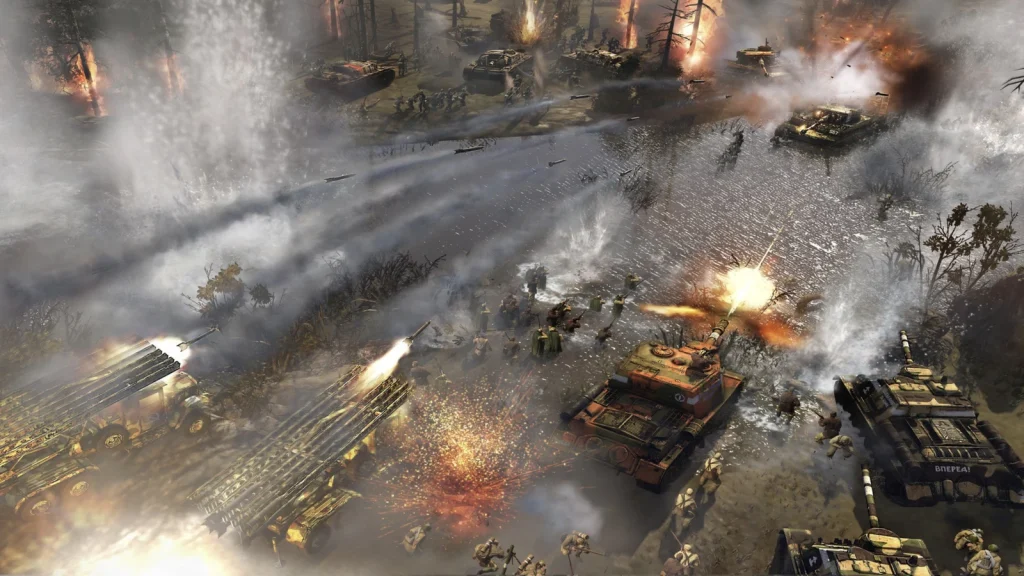
Choose Company of Heroes 2 for squad coordination built around sightlines, cover and combined arms. Choose Gates of Hell: Ostfront if you want to switch between RTS orders and direct unit control, with Conquest offering an army you develop across a dynamic campaign. Company of Heroes 2 vs Gates of Hell Ostfront comes down to how closely you want to intervene in a unit’s actions and whether the next battle should connect to a developing force.
Both use a World War II setting. Their documented systems give you different reasons to return: improving the way squads support one another, or combining detailed unit control with the choices behind a continuing army group.

On this page
Company of Heroes 2 begins with the relationship between units
The Company of Heroes 2 store identifies TrueSight, its line-of-sight system, along with cover and combined-arms counters. These mechanics make position and support useful foundations for a tactical plan. The question is not simply whether you have another infantry squad, but whether that squad can see its target, occupy useful ground and receive the support the opposition demands.
For a hypothetical attack, think in terms of coordinating roles before pushing forward. Cover may be useful for the infantry, while a different threat calls for a different supporting unit. That is a way to frame the documented systems, not a tested recipe for winning a particular mission. Choose Company of Heroes 2 if directing that wider squad interaction is the part you want to learn.
Its base game also includes a Soviet single-player campaign. That gives a clear content path if you want a historical campaign alongside the game’s tactical systems. Other Company of Heroes 2 products add different armies and campaign material, so decide what you want to play before comparing package prices.
Ostfront lets you change how you control the engagement
Gates of Hell: Ostfront documents instantly switchable views: classic RTS top-down, direct control of one unit, third-person views for infantry and vehicles, and first-person vehicle gunner views. Choose it if the ability to move closer to an individual action is a central attraction. This is a specific control option, not just a different camera for watching the same orders.
The official description also names modeled vehicle armor layouts, internal components and historical ammunition loadouts. It lists tactical tools such as smoke, medics, mines, obstacles and foxholes. Those features create reasons to care about the equipment and actions available to your force. They do not independently prove the publisher’s promotional claim to be the most realistic RTS.
For someone who enjoys both observing the overall battlefield and handling one unit, the control options are the strongest buying argument. Be prepared to divide your attention between those levels. A close view can make one encounter engaging, but selecting that view does not eliminate the needs of the rest of your army.

Conquest gives Ostfront a second decision layer
Ostfront’s Conquest mode supports solo and cooperative play. The store describes composing an army group, researching units and advancing along different paths through a dynamic campaign. This is the clearest reason to choose it if you want decisions between battles about the force you are developing.
Picture the choice after an engagement: what should your army group add next, and which path should it follow? Those questions differ from selecting another standalone match. The source describes campaign lengths ranging from short to unlimited, so you can investigate a scope that suits your plans without assuming every campaign takes a fixed number of hours.
Company of Heroes 2’s Soviet base campaign should not be confused with the separate Ardennes Assault product. The latter has nonlinear US campaign choices and persistent company health. If campaign continuity is the reason you are considering Company of Heroes 2, make sure you are looking at the relevant product rather than assuming that feature belongs to every edition.
Make the buying decision around your preferred responsibility
Pick Company of Heroes 2 if you want to concentrate on where squads stand, what they can see and how their roles combine. Pick Ostfront if you want direct-control options, equipment detail and Conquest army development to be central parts of your sessions. For cooperative play, name the exact mode first and check its current requirements with your friend.
If you are choosing between two games with direct control, the Assault Squad 2 and Ostfront comparison narrows the choice through missions and campaign structure.
Sources and scope
The official stores for Company of Heroes 2 and Gates of Hell: Ostfront support these mechanics and mode descriptions. This is a feature-based comparison without firsthand testing, FPS measurements or current population estimates. Specific expansions and editions remain separate purchasing checks.
Sources and further reading
Keep exploring
Company of Heroes 2 vs Men of War Assault Squad 2: squads or direct control?
Company of Heroes 2 vs Men of War Assault Squad 2: compare cover and combined arms with direct soldier control, skirmishes and the right game package.
Company of Heroes 2 Veterancy Mechanics: 7 Squad Decisions
Understand what veterancy changes, why surviving squads retain value and how to use infantry, weapon-team and vehicle experience in real decisions.
Company of Heroes 2 Beginner Guide: 9 Essential Decisions
Learn the CoH2 match loop through territory, cover, recovery and combined-arms decisions, with a worked early-game example.