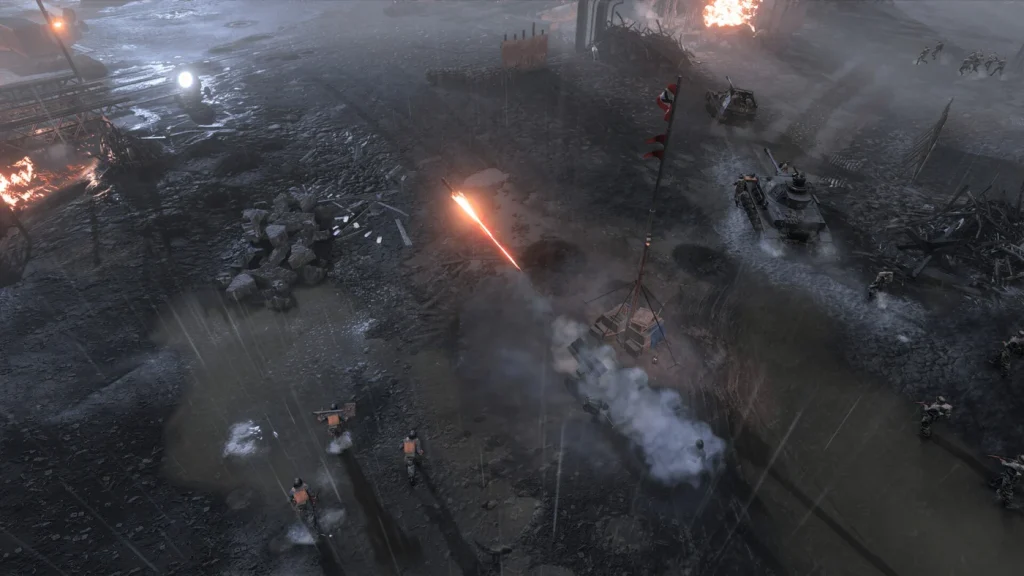
TL;DR: The most useful games like Company of Heroes 2 depend on the part you want to keep. Consider Company of Heroes 3 or the original Company of Heroes for a related squad RTS. Choose Men of War: Assault Squad 2 or Gates of Hell: Ostfront for direct control, Steel Division 2 for a larger army and deck planning, or Iron Harvest for cover-based combat with dieselpunk mechs.
These recommendations compare official product descriptions. They do not claim fresh personal playtests, current matchmaking measurements or a numerical ranking of balance.

On this page
Games like Company of Heroes 2: choose the similarity that matters
CoH2 combines infantry squads, support weapons, vehicles and contested territory. However, a player who enjoys preserving individual squads can want something different from a player primarily interested in the Eastern Front setting. A useful alternative should preserve the particular decision you enjoy, not just display World War II equipment.
Start with one priority: familiar squad RTS controls, a persistent campaign, manually aiming a vehicle, planning a battlegroup or a different fictional setting. Then use the comparison below to narrow the choice. None of these games is presented as an identical copy of every CoH2 mechanic.
| Game | Main reason to examine it | Important difference |
|---|---|---|
| Company of Heroes 3 | Related tactical squad RTS | Mediterranean setting and dynamic campaign layer |
| Company of Heroes | Earlier series-style squad warfare | Normandy-led campaign and earlier design |
| Assault Squad 2 | Manual control of soldiers and vehicles | Direct-control and skirmish focus |
| Gates of Hell: Ostfront | Detailed vehicle combat and Conquest | Armor, ammunition and switchable control views |
| Steel Division 2 | Army planning and larger tactical battles | Division decks and strategic campaign scale |
| Iron Harvest | Cover, resource points and campaign co-op | Alternate-history mechs rather than historical WWII |
1. Company of Heroes 3: examine the closest series continuation
Company of Heroes 3 retains the series’ tactical focus while moving to Italy and North Africa. Its official description identifies infantry breaching, flanking, elevation-sensitive sight and destructible environments. Those features make it a direct candidate when CoH2’s appeal is the interaction between cover, movement and combined forces.
The campaign structure is a separate attraction. The product describes a dynamic campaign map with supply lines, company upgrades and air or naval support. That layer can appeal to someone who wants decisions between tactical engagements rather than only a sequence of scripted battles.
Full Tactical Pause is described for single-player action, allowing attacks and orders to be planned before resuming. Treat that as a relevant campaign or skirmish feature, not an assumption that online opponents must wait while you plan. The intended mode changes how the feature helps.
Choose this candidate when you want a related control language with additional campaign options. Compare the actual product and content listing before buying, especially if a named faction or expansion is your priority. The series connection supports a recommendation to investigate; it does not prove current multiplayer balance or performance on your machine.

2. Company of Heroes: return to the earlier squad RTS
Company of Heroes is useful when your priority is the series’ earlier World War II tactical foundation. The official description begins with the Normandy invasion and emphasizes Allied squads, environmental destruction and units using cover. This is a more direct series comparison than recommending an unrelated game solely because it includes tanks.
Its campaign can be the deciding factor if you want the Western Front narrative identified in the listing. Buildings and terrain remain part of the tactical proposition, with destruction changing the environment used by troops. That gives a reason to consider it for cover-oriented battles.
Do not assume the earlier title shares CoH2’s exact faction technology, unit access or current online infrastructure. A guide written for one game is not automatically a build order for the other. Examine the edition and associated content through its own product information.
The current listing also points readers toward the Legacy Edition page for additional reviews and total conversions. Follow the appropriate product’s documentation when exploring mods. Choose the original when the earlier campaign and series approach are the attraction, rather than expecting it to be a cheaper substitute with identical systems.

3. Men of War: Assault Squad 2: add direct control
Men of War: Assault Squad 2 offers a different connection: detailed World War II tactics with Direct Control of soldiers or vehicles. The official page describes manually controlling a unit in an action-style view. This is relevant if your favorite CoH2 moments involve one gun, vehicle or specialist squad solving a specific engagement.
Its description includes single-player skirmishes, co-op support and multiplayer battles. The skirmish emphasis makes it worth examining for players who enjoy repeatedly solving tactical situations with a chosen force. Direct control adds a distinct form of attention within those battles.
That attention is also the main reason to inspect it carefully. Manually operating a selected unit can be attractive while the remaining force still needs orders. Someone seeking less micromanagement should compare the workflow rather than assuming direct control makes the whole game simpler.
Choose Assault Squad 2 when you want to combine command-level tactics with hands-on control of a soldier or vehicle. Verify the desired mission or faction content in the actual edition. The recommendation does not extend to every Men of War product merely because the franchise names are similar.

4. Gates of Hell: Ostfront: prioritize vehicles and Conquest
Call to Arms – Gates of Hell: Ostfront is an Eastern Front alternative with switchable RTS, direct-control and vehicle views. The official description identifies modeled vehicle components, armor layouts and historical ammunition loadouts. This makes it a strong candidate to investigate when vehicle engagement details matter more than preserving the precise CoH2 production structure.
Its Conquest mode supplies a dynamic campaign in which you compose an army group, research units and advance through different paths. The listed single-player and co-op options connect tactical battles to a continuing force-development plan. That offers a different reason to return between engagements.
Detailed control and equipment systems require their own learning. Do not transfer a CoH2 rule about a tank’s role into an assumption about armor penetration or ammunition here. Use the game’s documented systems to evaluate what the selected unit can actually do.
Choose this candidate for Eastern Front battles, direct control and the described Conquest progression. Inspect the current product’s requirements and content dependencies before purchase. A recommendation based on its features does not certify a specific bundle, DLC roster or live multiplayer population.

5. Steel Division 2: move toward an army-level plan
Steel Division 2 changes the scale of the comparison. Its official description combines real-time tactical battles with turn-based strategic campaigns and division-based deck building. The attraction is planning which units form a battlegroup and how they serve a wider operation.
The setting centers on the Eastern Front in 1944 and Operation Bagration. Campaign decisions include battalion movements and supply, while the real-time layer handles the battles. This can suit a CoH2 player who wants the relationship between tactical forces and a larger campaign to become more prominent.
It is less direct as a replacement for a small squad’s repeated capture-and-recovery loop. Choosing and managing a division deck asks different questions from adding one infantry squad to a current frontline. Examine whether that change in planning scale is the reason you want another game.
Choose Steel Division 2 when division composition, strategic movement and large tactical engagements are the priority. Treat unit-count and map marketing as product descriptions rather than a promise of easy mastery. Its official co-op and multiplayer features also need to be considered in the particular mode you intend to play.

6. Iron Harvest: keep cover and resource points, change the setting
Iron Harvest offers an alternate-history 1920+ setting with dieselpunk mechs. The official description identifies cover, destructible buildings, capturable resource points and base production. Those are concrete reasons to investigate it for a CoH2-style tactical interest even though it does not recreate historical World War II forces.
The campaign and co-op emphasis can appeal to players primarily seeking authored battles with a friend. Its mechs change the visual and unit fantasy, so choosing it should be a decision to explore that setting rather than a substitute for historical faction rosters.
Check the edition when specific campaigns or add-ons matter. The official description distinguishes Deluxe content, including Rusviet Revolution and Operation Eagle, from the broad game overview. A product page showing an add-on does not automatically include it in every purchase.
Choose Iron Harvest for the combination of squad-scale cover, resource contest and mechanical units. The fictional setting is its main departure here. This recommendation does not claim that every mech has a corresponding CoH2 vehicle role or that the two games share exact economy and balance rules.
Compare campaign fit before competitive fit
For a campaign priority, compare the actual structure you want: CoH3’s dynamic map, Gates of Hell’s Conquest progression, Steel Division 2’s strategic campaigns or the authored campaigns in the other candidates. A campaign label alone does not tell you whether decisions persist between battles.
For online play, check current evidence about the desired mode and the people you intend to join. Official multiplayer support cannot establish today’s queue times or skill distribution. Avoid buying around an invented population claim, and compare platform and edition compatibility separately.
Frequently asked questions
Which alternative is most directly connected to CoH2?
Company of Heroes 3 and the original Company of Heroes share the series’ tactical lineage. Choose between their documented setting and campaign features. That is a closer family comparison than assuming identical mechanics across unrelated WWII games.
Which games let me directly control a soldier or vehicle?
Assault Squad 2 and Gates of Hell: Ostfront explicitly describe direct control. Gates of Hell additionally describes several instantly switchable views. Compare those workflows if hands-on vehicle or infantry operation is the feature you want.
Which choice provides a larger strategic layer?
Steel Division 2 describes turn-based strategic campaigns, CoH3 a dynamic campaign map and Gates of Hell a force-building Conquest mode. Their structures differ, so choose the planning task you want between battles.
Is this list based on new playtests?
No. Each recommendation uses the linked official product description and a stated fit criterion. No current performance, matchmaking or numerical balance result is claimed.
Sources and further reading
Keep exploring
Company of Heroes 2 vs Men of War Assault Squad 2: squads or direct control?
Company of Heroes 2 vs Men of War Assault Squad 2: compare cover and combined arms with direct soldier control, skirmishes and the right game package.
Company of Heroes 2 vs Gates of Hell Ostfront: what should carry the battle?
Company of Heroes 2 vs Gates of Hell Ostfront: choose squad cover and counters or switchable direct control with a developing Conquest army.
Company of Heroes 2 Reinforcement Economy: 8 Manpower Choices
Plan squad recovery as part of the army budget, with a labeled manpower example and practical ways to reduce repeat casualties.