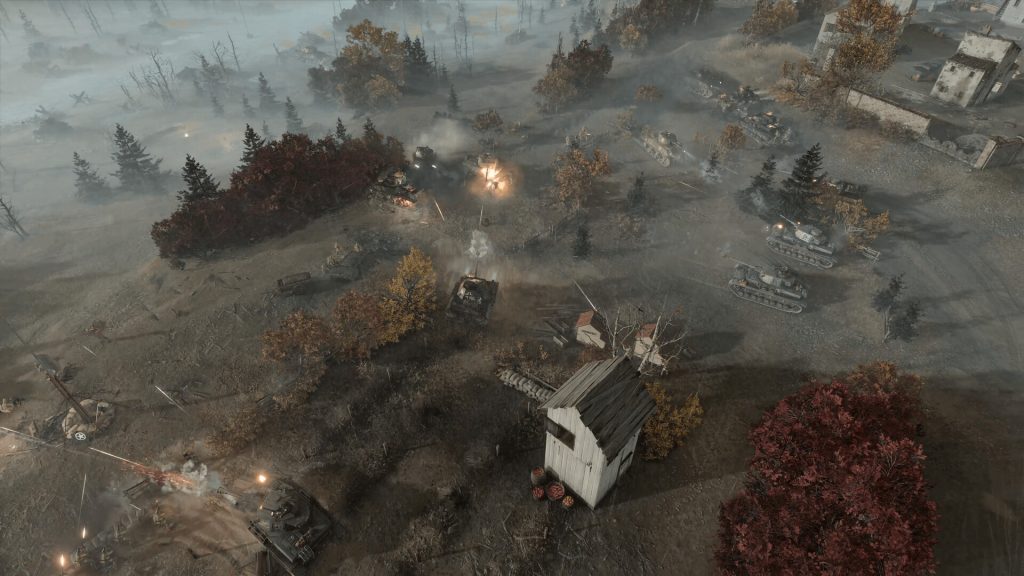
The best war strategy games with destructible environments are useful when damage changes your next decision. Company of Heroes 3 is the first choice here for buildings collapsing and ruins becoming cover. Call to Arms fits modern squad tactics with direct unit control and broadly destructible surroundings.
Both official descriptions explicitly advertise environmental destruction. This shortlist does not treat a burning tank or a large explosion as sufficient evidence: vehicle damage and changes to the battlefield are separate features. The practical comparison is how you want to command troops while the environment changes.

On this page
Company of Heroes 3: the position survives differently after bombardment
Company of Heroes 3 gives the clearest advertised example of destruction affecting infantry positions. Its official page describes fortified buildings crashing down and soldiers using fresh ruins as dynamic cover. That is a reason to consider it when you want terrain to change during a battle, rather than merely display scorch marks.
The setting moves between Italy and North Africa. Infantry breaching, flanking attacks against side armor and elevation affecting line of sight sit alongside the destruction system. A building is therefore part of a larger tactical question: who can observe it, approach it and remain protected after the fight changes its condition?
Imagine an enemy occupying a useful town position. The relevant buying question is whether you enjoy choosing between approaching with infantry, using a breaching action or applying heavier firepower. The official features establish those different tools, but they do not show that every building has the same resistance or that demolishing it is always the best answer.
The optional Full Tactical Pause lets you plan and queue actions in single-player play. It is worth inspecting if you want time to read a changed battlefield before acting again. The game also includes campaign, skirmish, multiplayer and co-op offerings, but the pause feature should not be assumed to apply to competitive online play.
The limit: destruction is one part of a squad-and-vehicle RTS. You still manage units and tactical objectives; this is not an open-ended demolition simulator. Preview an ordinary town engagement and watch what happens to cover after the shelling, rather than judging the system by the size of the particle effects.

Call to Arms: switch from commander to the unit doing the fighting
Call to Arms places its fighting in a modern setting and combines RTS commands with first- and third-person controls. Its official description names rural areas, factories, railway stations and towns, then states that cover is widespread and almost everything can be destroyed.
The distinctive attraction is the change in viewpoint. You can place squads in cover and support an advance from above, then take control of an individual soldier or vehicle. Choose it if the same tactical situation interests you both as a command problem and as an action you perform yourself.
The advertised RTS tools include claymores, fortified positions and mortars. Direct vehicle control extends to selecting ammunition. Those features give you several ways to approach an obstructed position, while the environment’s advertised destructibility adds a reason to reconsider where squads will stand afterward.
This hybrid also creates its main compromise. Time spent aiming or driving one unit is attention spent away from the rest of the force. Watch someone switch between direct control and the wider battle to judge that workload. Familiar weapons and a detailed vehicle model do not show whether you will enjoy the transition.
“Almost everything” is promotional wording, not a verified guarantee for every object on every map. The inspected screenshot shows modern infantry and an armored vehicle; it is not an object-by-object destruction test. If a particular wall, building or obstruction is your requirement, inspect that interaction in ordinary gameplay before buying.
What to look for in a destruction demonstration
- Does the damaged object change cover, movement or observation, or only its appearance?
- Can the attacker explain why the destruction helps achieve the objective?
- What happens to infantry sheltering near the object afterward?
Start with Company of Heroes 3 for explicitly advertised building-to-ruins cover changes. Choose Call to Arms for modern environmental destruction coupled to direct control. The modern warfare selection offers a broader command-scale comparison if destruction is only one of your buying priorities.
Sources and further reading
Keep exploring

Hearts of Iron 4 occupation laws: control resistance without draining reserves
Match occupation policy to resistance, compliance and a garrison you can actually supply; use stronger control only when the situation justifies its cost.

wargame red dragon radar anti air management: coverage and weapon-state decisions
A source-backed guide to managing specific radar-related weapons within a complete Wargame Red Dragon air defense.
wargame red dragon sead aircraft: choose a mission that helps
A concise source-backed guide to choosing and reassessing a useful SEAD mission in Wargame Red Dragon.