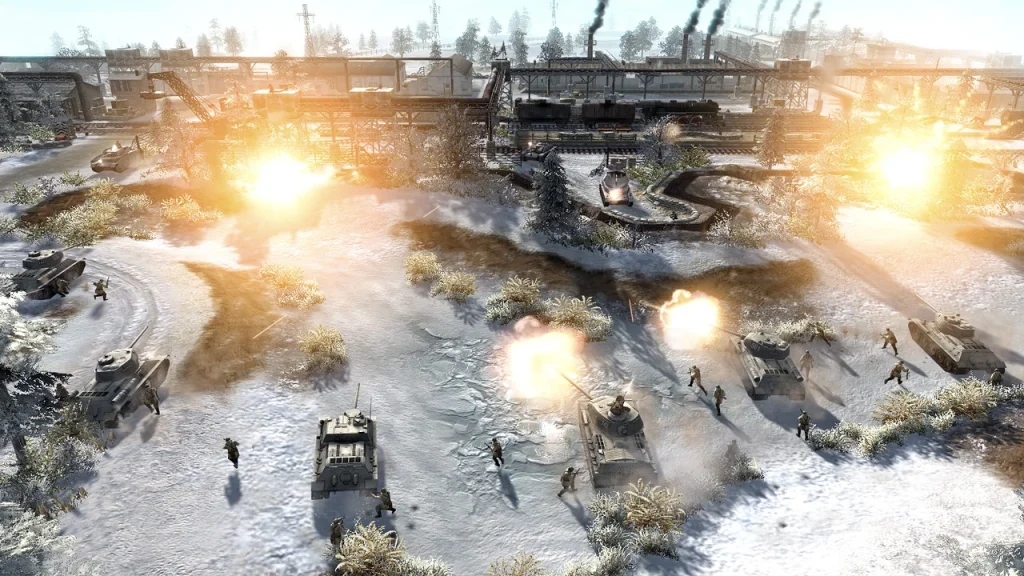
Choose Men of War: Assault Squad 2 for varied WWII skirmish missions and direct control of soldiers and vehicles. Choose Gates of Hell: Ostfront if you want its switchable control views and a Conquest campaign built around developing an army group. Men of War Assault Squad 2 vs Gates of Hell Ostfront is a closer comparison than either game’s matchup with a conventional squad-focused RTS, because direct unit control is part of both games’ appeal.
Start with the activity you want to repeat. Do you want another tactical scenario with a different setup, or another battle in a dynamic campaign whose army you have been building? That question does more useful work than declaring one game a replacement for the other.

On this page
Assault Squad 2 suits a menu of tactical situations
Assault Squad 2’s official store describes single-player skirmishes ranging from large tank assaults to precise sniper infiltrations. It lists multiple WWII theaters, including Europe, North Africa and the Pacific. That breadth is a good reason to investigate it if changing mission situations and settings is your main source of replay interest.
Direct Control lets you manually steer a soldier or vehicle. Its value is the option to handle an individual action while remaining responsible for a larger force. Choose it if you like the relationship between tactical planning and personal intervention. The feature does not mean every mission is designed to be played as a single-character action game.
The current listing also documents cooperative skirmish support and multiplayer modes. For friends who want to tackle scenarios together, that is a concrete mode to check. Separate mission packs, community content and Deluxe Edition extras should be examined individually. A Deluxe badge or experience bonus is a different benefit from an additional campaign or a new control system.
Ostfront makes view switching a deliberate part of the choice
Ostfront also combines RTS control with direct intervention, but its official description spells out several views. You can switch between classic top-down orders, direct control of a unit, third-person infantry or vehicle views, and first-person vehicle gunner views. Choose it if those options are a central part of how you want to experience the engagement.
Its feature list includes detailed vehicle armor layouts and internal components, along with historical ammunition loadouts. Smoke, mines, obstacles, medics and foxholes are among the documented tactical tools. They offer a basis for investigating equipment and battlefield preparation, without requiring you to accept a universal claim that one game is more realistic in every respect.
The named Ostfront setting focuses on the Eastern Front between Germany and the USSR. That gives it a different base-game historical focus from Assault Squad 2’s listed range of theaters. If a particular nation or later expansion is the reason you want Ostfront, check the relevant DLC rather than assuming it is part of the named base listing.

Want a force that develops between fights? Look at Conquest
Conquest is Ostfront’s clearest distinguishing feature for this buying decision. The official description says you compose an army group, research units and follow different paths through a dynamic campaign. It supports solo and cooperative play, with campaign length options from short to unlimited.
That structure suits someone who wants to consider the next addition to an army as well as the next battlefield maneuver. A useful planning question is what your force should develop toward, not merely which separate mission to select. This is an interpretation of the documented mode, not a claim about specific research costs, optimal unit choices or guaranteed survival between battles.
Assault Squad 2’s skirmish variety remains a different reason to play. Do not assume that a collection of missions creates the same dynamic army-development system. Conversely, do not assume choosing Conquest removes Ostfront’s historical missions or other modes. Select the mode you want to spend time in before deciding which product gives better value.
Two routes to a decision
If the phrase “a new tactical situation” describes your ideal next session, begin with Assault Squad 2’s skirmish offering and Direct Control. If “continue developing my army” is more appealing, begin with Ostfront’s Conquest and then examine its control views. Both can interest a player who likes detailed unit management, so the difference in session structure may be decisive.
For a comparison against squad cover and combined arms, see Company of Heroes 2 vs Assault Squad 2.
Sources and scope
The official descriptions for Men of War: Assault Squad 2 and Gates of Hell: Ostfront support the modes, controls and base-game distinctions. No comparative playtest, current online population, price or hardware benchmark is claimed. Product totals and expansion access should be checked on the current listing.
Sources and further reading
Keep exploring
Gates of Hell Ostfront vs Ultimate General Civil War: which army campaign?
Choose Ostfront for a researched WWII force and direct control; choose Ultimate General: Civil War for brigade command and a campaign shaped by surviving soldiers and officers.
Gates of Hell Ostfront vs Steel Division 2: Conquest or Army General?
Pick Ostfront for researching and developing a Conquest army with switchable unit control; pick Steel Division 2 for battalion-map planning and battlegroup decks.
Company of Heroes 2 vs Gates of Hell Ostfront: what should carry the battle?
Company of Heroes 2 vs Gates of Hell Ostfront: choose squad cover and counters or switchable direct control with a developing Conquest army.