TL;DR: For WARNO vs Wargame Red Dragon, choose WARNO if you want its alternate-history 1989 European setting, explicitly described Army General campaigns, division-based preparation and named online formats. Choose Red Dragon if its 1991 Asian scenario, national equipment catalog and advertised dynamic campaign are the attraction. Shared developer lineage does not make ownership, campaign content or multiplayer compatibility interchangeable.
Quick verdict: The specific setting and campaign framework are the clearest reasons to choose. WARNO being described as a spiritual successor does not prove a universal improvement in balance, performance or personal enjoyment.

Checked November 8, 2026. This is an editorial comparison of WARNO’s official Steam description, Wargame: Red Dragon’s official Steam description and verified DLC listings. It is not a hands-on test. No current prices, online populations, numerical ratings, performance measurements or learning-hour estimates are assigned.
On this page
WARNO vs Wargame Red Dragon: which experience do you want?
This comparison serves a buyer choosing one Cold War RTS or deciding whether to add another to an existing library. You may want WARNO’s European campaign and formation framework. Alternatively, you may want Red Dragon’s Asian setting and national roster catalog. Those are concrete competing uses for your next sessions.
| Criterion | WARNO | Wargame: Red Dragon |
|---|---|---|
| Base scenario | Alternate-history 1989 in Europe | 1991 Asian confrontation |
| Strategic solo description | Turn-based Army General campaigns | Dynamic campaign system advertised |
| Preparation emphasis | Parent divisions and detailed Armory | National equipment catalog |
| Online formats described | Ranked 1v1, team formats, 10v10 | Up to twenty simultaneous players |
| Separate content example | SOUTHAG campaigns and LANDJUT divisions | Nation Packs such as Italy |
| Steam platform data | Windows | Windows with retained Mac/Linux labels |
1. Choose the historical scenario and region
WARNO describes an alternate-history Cold War conflict in 1989, with NATO and Warsaw Pact forces in divided Germany. That European scenario is a direct reason to consider it if the period and region are the attraction.
Red Dragon’s base description presents a 1991 Asian confrontation. Japan, China, North Korea, South Korea, Australia and New Zealand are among the named countries in the wider setting. This is a different regional and historical premise.
The shared Cold War label does not make these settings equivalent. A player attracted to WARNO’s German and wider European framework has a specific purchase reason. A player attracted to Red Dragon’s Asian scenario has another, without needing either game to win every other category.
Keep the fictional scenarios distinct from real events. The product descriptions establish advertised settings, not a verified model of real-world outcomes. This comparison does not award either title a simulation-accuracy score or claim that one era makes a more serious game.

2. Compare the named campaign formats
WARNO explicitly describes turn-based Army General campaigns and scripted Operations. Its core description advertises five campaigns and eight Operations. Those are base-description figures, not an audited total across every later expansion or update.
Red Dragon advertises a dynamic single-player campaign system. That is a reason to investigate its solo offering. The material used here does not establish that its campaign uses WARNO’s specific framework or supplies the same missions and content.
Choose by the format you actually want. If Army General is the named attraction, WARNO provides direct product evidence for that choice. If Red Dragon’s campaign setting is the attraction, inspect its current campaign rules and ownership requirements.
A scripted Operation and a continuing strategic campaign are also different sessions inside WARNO. Identify which you would play first. Counting every mode together can obscure whether the exact purchase adds a campaign, an individual scenario or a roster.
This comparison does not estimate campaign length or promise replay value in hours. A campaign’s advertised scale does not measure personal enjoyment. The useful buying question is which setting and format you want to return to.
3. Decide which preparation framework interests you
WARNO describes parent divisions and brigades as the basis for a customized group. Its Armory lets units be inspected and compared. The core listing advertises more than one thousand units, expressing its catalog-oriented product pitch.
Red Dragon’s base description advertises seventeen nations and a selection of 1,450 units. These are figures in the base product description, rather than a new count of all later Nation Packs. Its national equipment roster is the direct advertised attraction.
Do not choose by comparing those totals alone. A larger advertised catalog is not automatically the better purchase. The relevant question is whether the particular nation, division or preparation framework interests you and what product grants it.
WARNO’s division description also prevents a misleading expectation about the Armory: a total catalog does not mean every division uses every unit. Inspect the formation you want. For Red Dragon, inspect the national content and any Pack relevant to the intended roster.
For a returning owner, one specific addition can be more useful than the complete store list. Existing familiarity may help explain your preference, but it does not establish that habits, controls or content purchases transfer unchanged between separate games.
4. Confirm the specific solo or cooperative activity
WARNO identifies standalone Skirmish as playable solo, cooperatively or in multiplayer. That is useful mode-specific evidence. It should not be generalized to every Army General campaign or Operation without checking the exact current mode.
Red Dragon’s Steam categories include online co-op, while its description advertises a dynamic single-player campaign. Those facts establish different pieces of product information. They do not together prove that every campaign is cooperative.
If playing with friends is the reason to buy, name the activity first. Cooperative Skirmish, a particular strategic campaign and a modded scenario are different plans. Confirm current support, game builds and content requirements for the intended one.
The shared Eugen developer relationship does not supply those compatibility rules. Owners of one title should not assume they can join the other or use its DLC. The specific game and mode documentation are the relevant evidence.

5. Compare documented online formats without ranking communities
WARNO advertises ranked 1v1, team matches from 2v2 through 4v4 and 10v10 battles. These are concrete formats to investigate. Choose around the mode your group actually wants rather than assuming the largest format is best.
Red Dragon’s developer description advertises up to twenty simultaneous multiplayer participants. That is not a complete specification of every lobby or mode. This comparison does not turn the headline limit into a claim that every session uses the same structure as WARNO.
A player attracted to an explicitly described ranked 1v1 format has a direct reason to investigate WARNO’s current conditions. A group attracted to Red Dragon’s setting and advertised larger sessions has a different reason to investigate that product.
Maximum player counts do not establish present population, queue speed or the availability of opponents at your preferred time. Nor does a release date establish the quality of matchmaking. These questions require current, mode-specific evidence.
Agree on the game, versions, platforms and mode before arranging a purchase together. The strongest group reason is a shared desire for the documented format, rather than one person’s interest in a particular roster or an unsupported popularity claim.

6. Buy the content that adds your intended experience
WARNO’s verified SOUTHAG listing describes two Army General campaigns, four Operations and ten divisions, including Canada, Spain and Czechoslovakia additions. That is a combined campaign, mission and roster package.
The verified LANDJUT listing describes eight new divisions for its Denmark-related theater. Their use in Skirmish, Ranked and online multiplayer is stated. Do not assume the package makes the same campaign-content promise as SOUTHAG.
Red Dragon’s verified Italy Nation Pack describes a national roster with 104 units and nineteen new models. South Africa describes another national roster addition. These should not be presumed to add a new strategic campaign merely because they are expansions.
This provides a useful purchase test. A WARNO owner wanting another Army General campaign has a specific campaign list to inspect. A Red Dragon owner wanting Italy’s roster has a different product to inspect. Neither needs every add-on to serve that first activity.
Red Dragon also offers more specific roster choices than a general “extra nations” label suggests. The verified Israel Nation Pack describes ninety-six units and emphasizes domestic equipment alongside modified imports. The Netherlands Nation Pack describes eighty units and a coalition connection with West Germany. Those are catalog identities to compare, rather than rankings of competitive strength.
For example, a player already satisfied with Red Dragon’s campaign but curious about the Dutch catalog can investigate that national Pack before considering another whole game. A player specifically wanting WARNO’s Denmark-related divisions can inspect LANDJUT. A player wanting additional Army General campaigns has a different stated reason to investigate SOUTHAG. Matching the product to that missing experience makes the decision more precise than collecting every expansion carrying a Cold War label.
Check included items, base-game requirements and existing library access. A pass or bundle contains a stated collection, not every current or future release by default. This comparison does not decide value through an unverified current-price calculation.
7. Check current platforms, tools and personal requirements
WARNO’s Steam data lists Windows support and an included level editor. Red Dragon’s appdata retains Windows, macOS and Linux labels. These are facts about the store records, not proof that every listed platform has an equivalent current supported branch.
For Mac or Linux, verify present build availability, OS requirements and multiplayer compatibility before buying around a legacy label. Do not infer update parity or compatibility from another Eugen title. The relevant version is the intended installation.
If a custom map or modification decides the purchase, inspect that project’s current requirements and installation method. General creator-tool availability cannot prove that a particular item works with the latest build, chosen DLC or another game’s content.
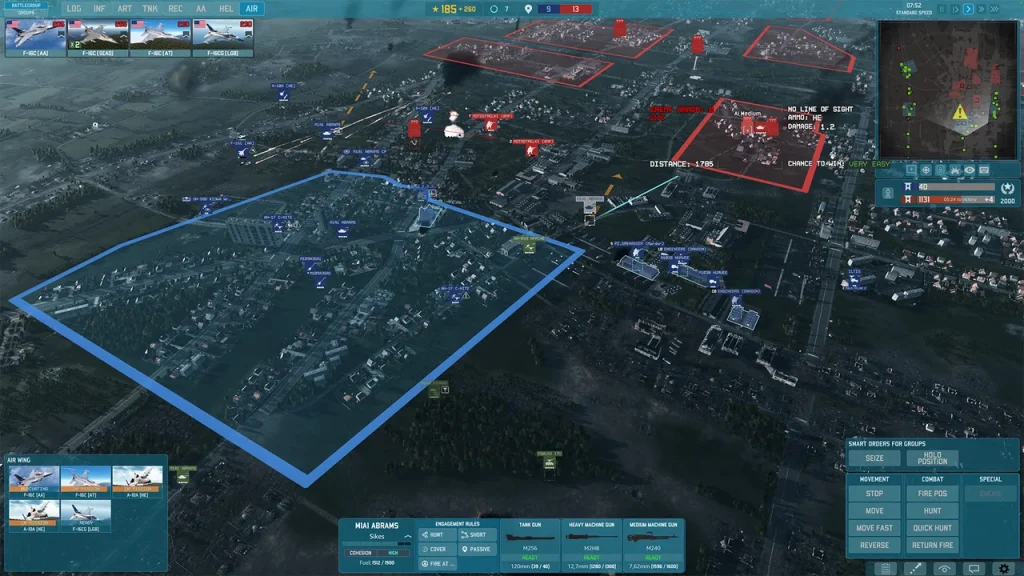
The official screenshots illustrate tactical and campaign interfaces in WARNO and vehicle or maritime scenes in Red Dragon. They are copyrighted promotional game assets, not this author’s gameplay captures. They do not establish current performance or personal control comfort.
Use current requirements and a relevant device-specific report if hardware, readability or input arrangements decide the choice. This source-based comparison does not invent a learning-time, stability or frame-rate advantage for either game.
WARNO’s published requirements specify a sixty-four-bit processor and operating system, four gigabytes of memory at minimum, eight gigabytes recommended and fifty gigabytes of available storage. Broadband is also listed. Treat these as the publisher’s entry conditions for the software, then inspect the full processor and graphics requirements for your device. They are not a promise that a particular laptop will run your chosen match comfortably.
Choose the setting and mode you will use first
Choose WARNO for its specifically described European framework. Army General, Operations, division preparation and named online formats are the documented reasons. Inspect a particular DLC when it adds the campaign or roster you want.
Choose Red Dragon for its advertised Asian setting and national catalog. Its dynamic campaign description and larger online limit are separate formats to investigate. Check a Nation Pack for the exact national addition that interests you.
Keep an existing game when its content still matches your plans. The official spiritual-successor description does not require replacement or transfer ownership. The other product can be assessed as a different experience to add.
The final WARNO vs Wargame Red Dragon decision follows setting, campaign framework and the activity you want to repeat. Shared lineage makes the comparison relevant while their documented content supplies the reason to choose.
Continue with the WARNO hub, the Red Dragon hub, the WARNO review or the Red Dragon review for a closer product assessment.
Sources and further reading
- https://store.steampowered.com/app/1611600/
- https://store.steampowered.com/app/251060/
- https://store.steampowered.com/app/2978630/
- https://store.steampowered.com/app/3594460/
- https://store.steampowered.com/app/3025360/
- https://store.steampowered.com/app/1575820/
- https://store.steampowered.com/app/529390/
- https://store.steampowered.com/app/443730/
Keep exploring
wargame red dragon sead aircraft: choose a mission that helps
A concise source-backed guide to choosing and reassessing a useful SEAD mission in Wargame Red Dragon.
wargame red dragon radar anti air management: coverage and weapon-state decisions
A source-backed guide to managing specific radar-related weapons within a complete Wargame Red Dragon air defense.
wargame red dragon artillery smoke: screen one useful movement
A practical wargame red dragon artillery smoke guide using the official manual, with explicit assumptions and the limits of archived game information.