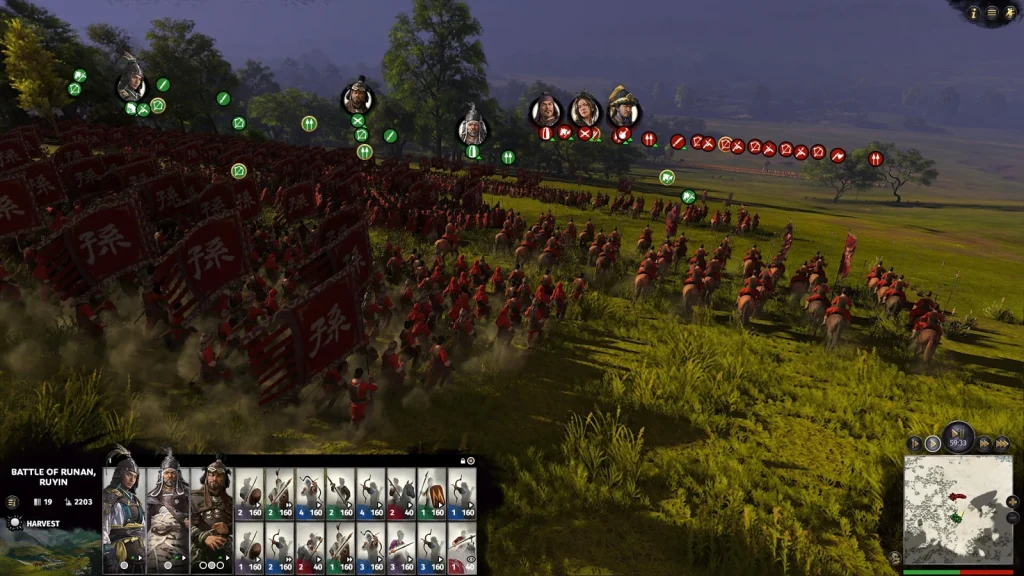
ROME II is the better fit for a classical empire campaign; THREE KINGDOMS is the better fit for a campaign built around Chinese warlords and their relationships. Both combine turn-based expansion with real-time armies, but they give you different reasons to care about the next turn. In Total War Rome 2 vs Total War Three Kingdoms, start with whether you want to identify primarily with an ancient state or with the people trying to unite a fractured China.
That choice does not reduce ROME II to a map painter or THREE KINGDOMS to a character story. Both official descriptions include conquest, politics and economic ambitions. The distinction is what their documented systems put at the center of those ambitions.

On this page
In ROME II, imagine the state you want to build
ROME II’s official description presents domination through military, economic and political means. It offers a turn-based sandbox campaign and real-time land and sea battles, with Rome and rival civilizations supplying different campaign identities. Choose it when the ancient world itself is the attraction: the state you govern and the armies associated with that civilization give expansion its meaning.
Emperor Edition describes an improved politics system and overhauled building chains. These are concrete reasons to look beyond battles when comparing the games. Settlement development and political decisions belong to the empire-building pitch. They do not imply that every campaign can use one construction plan, or that managing characters is absent from ROME II.
Its described Imperator Augustus campaign places Roman leadership in dispute after Caesar’s death, in 42 BC. If Octavian, Marc Antony and the divided Republic are the history you want to explore, that premise may be more persuasive than a list of technical features. The campaign appears in the archived Emperor Edition description; verify the current package before purchasing.
See the official ROME II Emperor Edition listing for the civilizations, campaign framing and included content currently advertised.
In THREE KINGDOMS, ask whom you want beside you
THREE KINGDOMS begins in China in 190 CE. Its official description presents a fractured land to unite under a new emperor, with legendary warlords and a supporting cast of characters. Those characters command armies and govern provinces. Prefer it when choosing and retaining people sounds as interesting as choosing the next region to conquer.
The Guanxi system gives that preference a specific mechanical basis. The description says characters have personalities, motivations, likes and dislikes, and form positive or negative relationships with each other. Friendships, alliances and betrayals are therefore central to the game’s stated campaign identity. Your interest can lie in how a group of individuals functions inside a growing realm, rather than solely in the territory that realm holds.
This is a useful distinction for a player who likes following named leaders. You have a reason to remember who governs a province or commands an army beyond the position itself. It is less persuasive if character rivalries distract you from the historical civilization and battlefield formations you came to manage. That is a preference about campaign focus, rather than a claim that one game has deeper politics in every respect.
The official THREE KINGDOMS product page explains the characters and Guanxi system.

A battle can lead to different kinds of unfinished business
The shared turn-based and real-time rhythm matters because neither choice ends at the battle result. In ROME II, its campaign description directs attention back to conquest, political ambitions and the empire’s development. A useful question after a victory is what it enables your state to do next.
THREE KINGDOMS explicitly connects battle actions with characters’ relationships toward you, and with the friendships and rivalries they develop with others. That gives you another reason to care about what happens during a battle. The official description supports the connection, but this comparison does not claim a particular action always produces a specific relationship change.
Imagine choosing an army for your next campaign objective. If you mainly want to picture the civilization’s forces advancing your imperial plan, ROME II has the clearer appeal. If you also want to consider the commanders as people with relationships, THREE KINGDOMS has the more relevant documented emphasis. This hypothetical decision is a way to compare interests, rather than a report from a playtest.
Choose the campaign you would want to talk about afterward
- Choose ROME II if your story would be about classical conquest, a rival civilization, settlement development or the struggle for Roman leadership.
- Choose THREE KINGDOMS if your story would be about a warlord, the people serving them, alliances and rivalries, and the attempt to unite China.
- Check the current listing before buying if a particular campaign, edition or add-on is essential to that story.
If both settings appeal, use the unfinished business test: would you rather return to the state you are building or to the relationships you are managing? That answer ties the campaign and battles together more usefully than declaring a universal winner.
Sources and scope
This comparison uses archived official Steam descriptions and personally inspected official screenshots. It does not report hands-on play, measured performance, current prices or multiplayer population. Check the linked product pages for current editions and campaign access.
Sources and further reading
Keep exploring
Total War Rome 2 Diplomatic Expansion: protect your next conquest
Use diplomacy to support an expansion plan through reputation, understood treaty obligations and bounded allied war coordination.
Total War Rome 2 vs Total War Shogun 2: empire or clan?
ROME II suits classical empire building; SHOGUN 2 suits a focused Japanese clan campaign with growing generals and agents.

Total War Rome 2 vs Total War Attila: build an empire or survive?
Choose ROME II for classical empire growth; choose ATTILA for late-antique survival, a vulnerable Western Roman Empire and destruction mechanics.