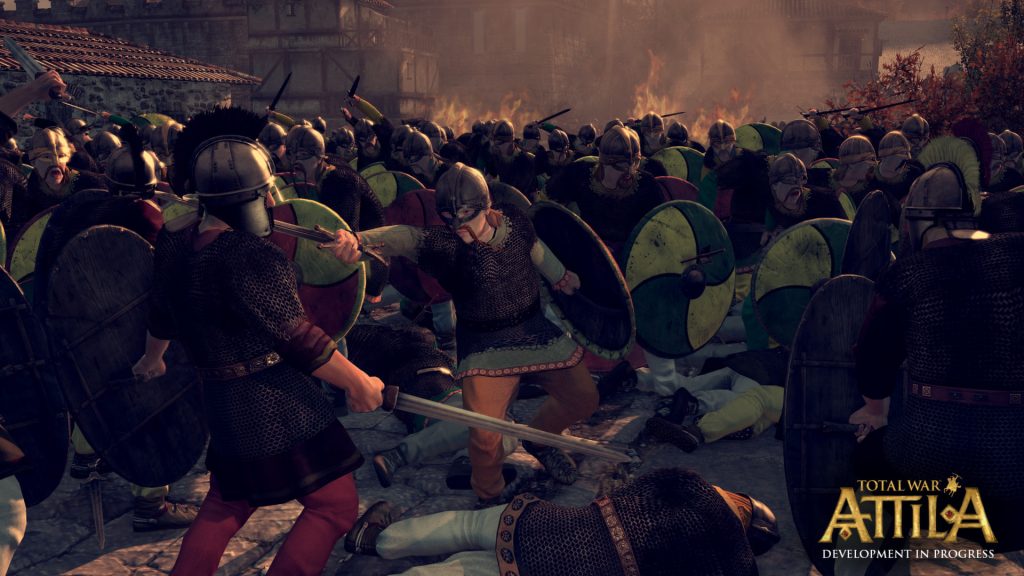
ATTILA suits a player drawn to late-antique turmoil, threatened empires and destructive warfare. SHOGUN 2 suits a player who wants to lead a Japanese clan toward national unification. Total War Attila vs Total War Shogun 2 is a choice between campaign stories built around the same broad rhythm: plan on a turn-based map, then command troops in real-time battles.
The useful starting question is what you want a victory to accomplish. Would it help an endangered realm endure another turn, or move your Daimyo closer to becoming Shogun? Neither historical premise makes every faction or battle play alike, but each gives the campaign a distinct purpose.

On this page
If holding territory sounds more interesting than acquiring it
Consider ATTILA, especially its Western Roman Empire start. The official description says that this faction begins with extensive territory, weakened by political infighting and threatened on all sides. A large realm is already your responsibility. The appeal is having commitments to judge before you have created a new empire through conquest.
That makes a useful buying test: do you enjoy deciding which obligations an empire can sustain? ATTILA’s 395 AD setting is a strong fit if the fate of Roman power interests you. A player who wants a small clan’s rise may find this specific starting situation less appealing, though the game also offers the prospect of building other kingdoms. Do not treat the Western Roman Empire as a description of every faction.
ATTILA lists politics, a family tree, civic management and technological progression. Survival therefore has a governing layer as well as a battlefield layer. If managing people, territory and development sounds like an unwanted interruption before the next battle, the campaign premise deserves careful thought before buying.

If a clan’s rise gives you a clearer goal
SHOGUN 2 starts from competing Daimyo clans in sixteenth-century Japan. You use military engagements, economics and diplomacy to reunite the country under your command. Its official description makes becoming Shogun the central ambition, giving an expansion campaign a historical destination you can keep in mind.
The game highlights skills and experience for generals and agents. That offers a different reason to care about the next turn: an established commander or useful agent belongs to a longer campaign plan. Spies and assassins appear in the documented toolkit alongside fire and siege tactics. They help explain why clan competition involves more than choosing an army and clicking a neighboring province.
Choose SHOGUN 2 if samurai-era warfare and a clan’s identity are the main attraction. Its drawback in this pairing is thematic rather than a claim about quality: it does not provide ATTILA’s late-Roman crisis. Someone fascinated by the Western Roman Empire’s predicament will not get that story by choosing another game merely because both belong to Total War.
Destruction matters, but distinguish the actual mechanics
ATTILA explicitly documents fire that sets buildings ablaze in battle and a campaign-map raze mechanic that removes cities and regions. Those are concrete reasons to choose it when settlement destruction is part of the warfare you want to consider. The description supports those mechanics without proving that burning or razing is always the best move.
SHOGUN 2 also lists fire and siege tactics, so it would be misleading to say that fire belongs exclusively to ATTILA. The narrower distinction is ATTILA’s advertised combination of battle fire and campaign-map razing within its survival setting. SHOGUN 2 instead directs your attention toward Japanese land and sea battles, developing generals and agents, and multi-stage sieges.
Picture the return to the campaign map
For ATTILA, imagine a battlefield victory followed by a decision about what a vulnerable empire can keep supporting. For SHOGUN 2, imagine that victory strengthening your clan’s next diplomatic or military move. These are decision exercises based on the documented systems, not reports from a played campaign or fixed opening instructions.
Choose ATTILA for the late-antique setting and the governing problems it places around warfare. Choose SHOGUN 2 for the Japanese clan campaign and its goal of becoming Shogun. Keep Fall of the Samurai separate if later Japanese warfare is your real interest; this comparison covers the base sixteenth-century campaign.
The ATTILA beginner guide and SHOGUN 2 beginner guide can help with the next step. Pick the campaign question you actually want to answer, then learn its opening systems.
Sources and further reading
Keep exploring

Total War Warhammer 3 vs Total War Attila: fantasy or survival?
Choose WARHAMMER III for fantasy races and Legendary Lords; choose ATTILA for late-antique survival, vulnerable territory and destructive warfare.
Total War Rome 2 vs Total War Attila: build an empire or survive?
Choose ROME II for classical empire growth; choose ATTILA for late-antique survival, a vulnerable Western Roman Empire and destruction mechanics.
Total War ATTILA Mod Installation: Workshop to Launch
Install one ATTILA Workshop mod with its required dependencies, confirm the download and launcher selection, then verify the intended change in a fresh session.