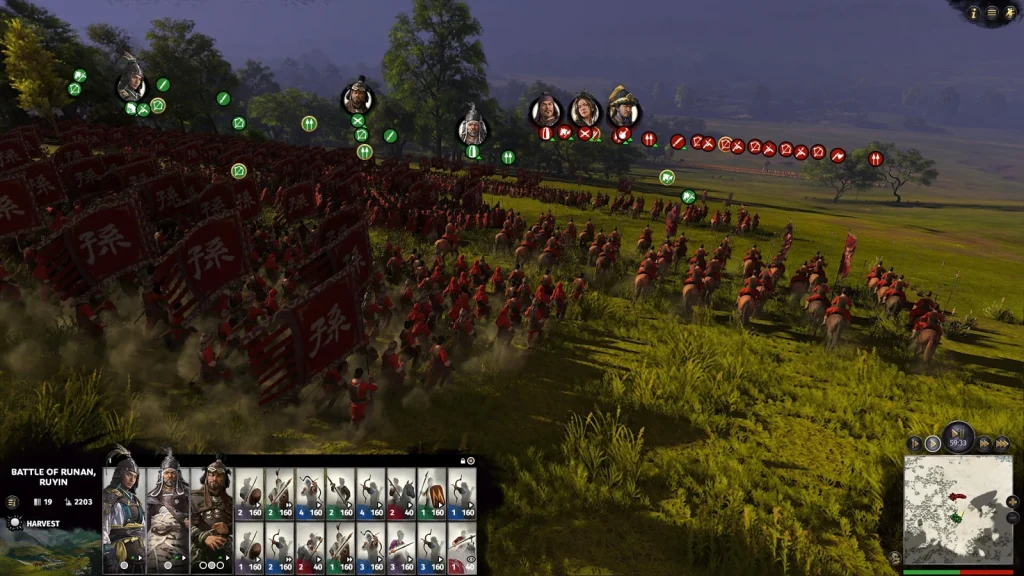
Choose THREE KINGDOMS when heroic characters and their relationships are your main interest. Choose SHOGUN 2 when a Japanese clan’s rise gives your campaign a clearer purpose. Total War Three Kingdoms vs Total War Shogun 2 is not a choice between having characters and having none. Both games develop people alongside armies; the distinction is the role those people play in each historical campaign.
Both combine a turn-based campaign with real-time battle command. If that rhythm is already what you want, focus on the decisions between battles: whom you employ, how you use their abilities, and why their success matters to the realm you are building.

On this page
Who do you want to remember after the battle?
THREE KINGDOMS makes named heroes central to its recreation of China in 190 CE. The official description gives recruited characters several jobs: command armies, govern provinces and strengthen the empire. A character can therefore matter outside the moment you deploy their troops in battle.
Its Guanxi system models dynamic relationships. Characters have personalities, motivations and likes or dislikes, and form positive and negative relationships with one another. Choose this game if you want staffing and military decisions to involve people whose connections are part of the campaign story. The attraction is more specific than simply seeing famous names on unit portraits.
That emphasis also creates a commitment for the buyer. If you want commanders to be useful pieces but have little interest in their relationships, a character-centered campaign might not be your strongest fit. Guanxi is a reason to engage with THREE KINGDOMS, not a feature you should automatically assume you will enjoy because you like tactical battles.

Give a general and an agent a long-term job
SHOGUN 2’s official description highlights skills and experience for generals and agents. It also names spies and assassins among the tools used throughout your kingdom. That gives you a practical reason to think beyond the next engagement: people develop while helping a Daimyo pursue control of Japan.
The historical frame is sixteenth-century Japan, divided among competing clans. Your goal is to reunify the country and become Shogun through warfare, economics and diplomacy. Choose this game if that destination helps you connect a developing commander, an agent’s assignment and a new territorial objective into one campaign plan.
SHOGUN 2 still has hero units, generals and character development. Calling it a game without characters would erase documented features. The more useful distinction is that its official pitch centers the clan leader’s campaign and developing generals or agents, while THREE KINGDOMS explicitly presents heroic relationships as a system shaping the future of the realm.
The battle affects what happens next
THREE KINGDOMS explicitly connects battle actions to heroes’ relationships with you and with other characters. That is a concrete reason to prefer it if the aftermath of combat should include personal consequences alongside changes to territory. The official passage establishes that connection; it does not justify promising that every battle produces a dramatic betrayal.
SHOGUN 2 emphasizes direct land and sea combat, fire and siege tactics, and multi-stage sieges. Its armies and fleets serve the Daimyo’s economic, political and military ambitions. If Japanese battlefield and castle warfare are the attraction, those are relevant features to inspect instead of choosing from a broad claim that one game has better battles.
Neither official product description supplies a measured comparison of AI, performance or difficulty. Historical preference and the kind of character management you want are firmer grounds for a recommendation than a universal ranking drawn from their release order.
A first-campaign decision you can make now
Imagine having two plausible people for an important job. Would you enjoy considering personalities and relationships as part of the decision? THREE KINGDOMS makes that question closely connected to its documented design. Would you rather keep the focus on a developing general or agent advancing a clan’s next objective? SHOGUN 2 supplies that different campaign frame. This is a preference exercise, not a tested opening or a claim that either game has only one kind of decision.
Choose THREE KINGDOMS for ancient China’s heroes, Guanxi and the relationship between character choices and conquest. Choose SHOGUN 2 for a Japanese clan-unification campaign with generals, agents and land or sea battles. This comparison covers base SHOGUN 2 rather than importing Fall of the Samurai’s later warfare.
Once the setting is settled, follow the THREE KINGDOMS beginner guide or SHOGUN 2 beginner guide to turn that preference into a workable first campaign.
Sources and further reading
Keep exploring
Total War Shogun 2 Naval Bombardment: check the campaign first
The queried coastal bombardment and land-battle naval support belong to Fall of the Samurai, rather than base SHOGUN 2 naval combat.
Total War Rome 2 vs Total War Shogun 2: empire or clan?
ROME II suits classical empire building; SHOGUN 2 suits a focused Japanese clan campaign with growing generals and agents.
Total War Shogun 2 vs Crusader Kings 3: conquest or a dynasty?
SHOGUN 2 suits Japanese clan conquest with direct battles; CK3 suits a medieval house managed across generations.