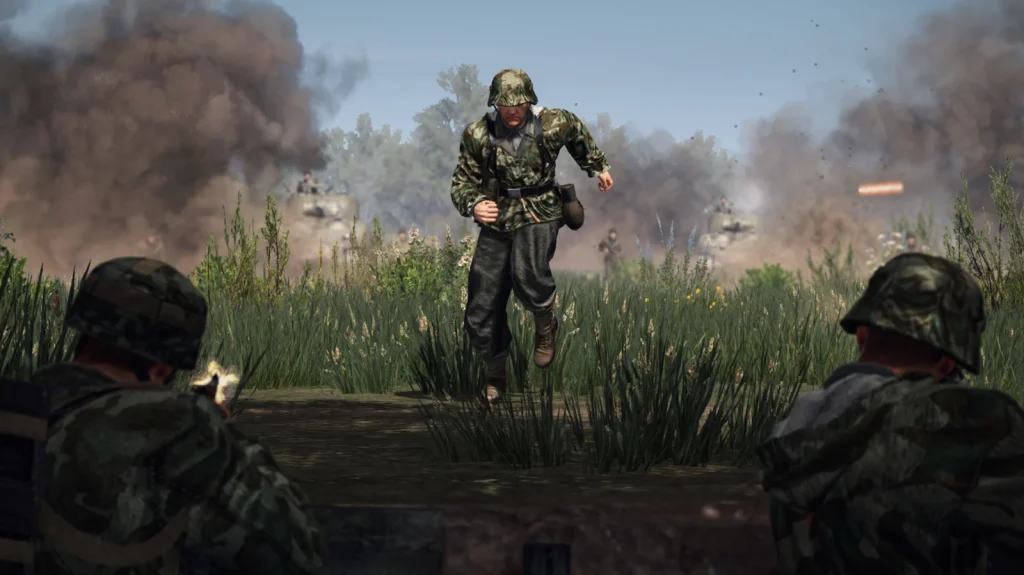
Gates of Hell: Ostfront suits players who want to develop their own Conquest army and switch into direct unit control. Steel Division 2 suits players who want battlegroup decks and an Army General campaign built around battalion movement and supply. In Gates of Hell Ostfront vs Steel Division 2, choose the campaign loop and command scale before choosing between battlefield screenshots.
Both official descriptions place their warfare on the Eastern Front. Ostfront describes the conflict from 1941 to 1945, while Steel Division 2 centers its campaign setting on 1944 and Operation Bagration. A shared theater helps explain the armies, but it does not make their campaign systems interchangeable.

On this page
Ostfront Conquest develops your own army group
Ostfront’s Conquest mode lets you compose an army group, research new units and advance along different paths. The official description names both single-player and co-op versions of that dynamic campaign. Prefer it when the appeal is deciding how your own force develops through an ongoing series of battles.
Research gives you a useful buying question: would you enjoy considering what the army needs next, then selecting units to support that plan? This is more specific than simply wanting a long campaign. You are looking for interest in the development decisions between engagements, alongside the fights themselves.
The listing also separates historical missions from Conquest and from PvE/PvP modes. If you intend to play with a friend, preview the co-op mode you actually want. A multiplayer battle is not evidence of the Conquest progression you will share, and a historical mission does not demonstrate the entire dynamic campaign.
Steel Division 2 links battalions to an operational map
Steel Division 2’s Army General campaign asks you to plan battalion movements, manage supply and decide which battalions take part in battle. You can then fight the engagement in real time or use autoresolve. Choose it if arranging forces on the campaign map is part of the military problem you want to solve.
This differs from choosing the next unit to research for your own Conquest army. The useful Army General preview follows one battalion movement through to its effect on a potential battle. That shows why the map matters, instead of presenting it as a menu before a tactical match.
Steel Division 2 also documents division-based deck building for tactical battlegroups. Keep that decision separate from Army General’s battalion layer. A deck-building tutorial can show the appeal of selecting units for tactical play without explaining how an operational campaign moves and supplies its formations.

How close do you want to get to one unit?
Ostfront explicitly offers instantly switchable control views. Its description distinguishes first-person gunner views for vehicles, third-person views for vehicles and infantry, direct control of a single unit, and a conventional top-down RTS view. It therefore supports a buyer who wants to change the level of interaction during a battle.
Those distinctions matter if you are attracted by a trailer showing a gunner view. The documented first-person option is specifically a vehicle gunner view; that should not become a blanket promise about infantry first-person play. Watch the type of unit and camera interaction you actually expect to use.
Steel Division 2’s documented attraction here is directing a selected battlegroup in real-time combat. Evaluate footage showing several unit roles and the orders connecting them. If stepping into a single vehicle is the main reason you are shopping, Ostfront’s explicit control options provide the clearer match.
Choose one campaign question to investigate
For an Ostfront preview, ask the creator to explain an army composition decision, a research choice and a short direct-control sequence. You are testing whether development and individual intervention belong together in your ideal game. The example need not be an optimized opening build to answer that question.
For Steel Division 2, look for a campaign turn that connects battalion movement, supply and battle participation. Then watch tactical battlegroup preparation if standalone battles also interest you. These are separate checks with a shared purpose: discovering whether the game’s scale of responsibility matches yours.
For a closer look at the planning involved, read our gates of hell ostfront beginner guide.
Pick Ostfront when army growth and the ability to handle a unit directly are the draw. Pick Steel Division 2 when operational positioning and organized battlegroups sound more compelling. Confirm the current product listing and exact mode you intend to play; neither recommendation requires an unsupported claim about difficulty, realism or player population.
Sources and scope
Based on archived official game descriptions read on November 10, 2026: Call to Arms – Gates of Hell: Ostfront official Steam description; Steel Division 2 official Steam description. These are documented-system comparisons and editorial buying advice. Check the current listing for edition contents and requirements. Screenshots illustrate their archived builds.
Sources and further reading
Keep exploring
Gates of Hell Ostfront vs Ultimate General Civil War: which army campaign?
Choose Ostfront for a researched WWII force and direct control; choose Ultimate General: Civil War for brigade command and a campaign shaped by surviving soldiers and officers.
Company of Heroes 2 vs Gates of Hell Ostfront: what should carry the battle?
Company of Heroes 2 vs Gates of Hell Ostfront: choose squad cover and counters or switchable direct control with a developing Conquest army.
Men of War Assault Squad 2 vs Gates of Hell Ostfront: missions or Conquest?
Men of War Assault Squad 2 vs Gates of Hell Ostfront: compare varied skirmish missions, direct-control views and Conquest army development.