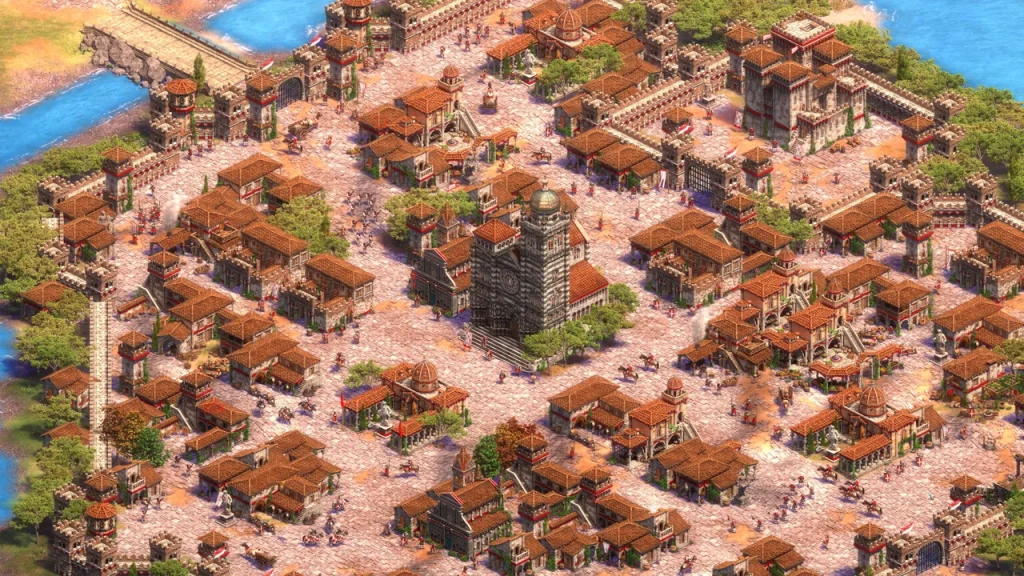
TL;DR: Use the closed-base start to keep worker production, gathering, and age purchases organized. Inspect the actual walls and gate access, fund the required building types and age reserve, then choose one Castle-age economy or production route whose construction and queues you can sustain.
This Age of Empires 2 Definitive Edition arena strategy guide focuses on economy and age planning rather than a universal army or fastest timestamp. A standard Castle advance requires 800 food, 200 gold, and two eligible Feudal building types. A Market and Blacksmith cost 325 wood together, but those buildings do not automatically produce the units or workers you want after advancing.

The examples refer to an Arena-style closed-map start in Age of Empires II: Definitive Edition. Selected costs and prerequisites were checked against the English technology tree. Read the actual map, rules, resources, and civilization panels; existing walls do not guarantee that every gathering or access problem disappears.
On this page
Age of Empires 2 Definitive Edition arena strategy: five economy checks
1. Inspect the base layout and useful access
Look at the starting buildings, walls, gate, and resource routes in the actual match. Check where Villagers can reach food and forests and where another House or Farm could fit. A closed-base layout still needs working movement paths. Do not surround the Town Center with new structures that make ordinary gathering unnecessarily awkward.
Test an important friendly-unit route when access is unclear. Gate controls and unfinished construction can affect your own movement as well as the perimeter. Keep the economy plan connected to the layout you have now rather than assuming that the map name supplies an identical base. The first objective is usable gathering and construction access.
2. Maintain Villagers, food transitions, and Houses
A standard Villager costs 50 food. Keep the Town Center producing when resources and capacity permit, and give each completed worker a useful job. Check natural food sources as they decline and assign workers to a usable replacement. The production loop remains important even when the base feels easier to manage than an open start.
A House costs 25 wood and gives five population spaces in the ordinary baseline. Watch the counter while workers and other units are queued. A missing House is a capacity problem, not a reason to move every worker to food. Reserve construction wood alongside the next age and production purchases, and return House builders to gathering afterward.
3. Fund the age prerequisites deliberately
The ordinary Feudal advance costs 500 food and requires two eligible Dark Age building types. Lumber Camp, Mining Camp, Mill, Dock, and Barracks appear in the checked list. Starting Town Center, Houses, and walls do not replace that requirement. A Mill and Lumber Camp can support gathering while meeting the two-type condition in a land-focused economy.
Castle Age then needs 800 food, 200 gold, and two eligible Feudal types. The checked list contains Archery Range, Stable, Blacksmith, and Market. Choose a pair from the actual follow-up plan rather than counting the earlier economic buildings again. Completed construction, the correct types, and the resource reserve are separate conditions to check.
4. Complete the chosen Feudal pair and Castle reserve
The Market-and-Blacksmith example costs 175 wood and 150 wood respectively. The Market requires the Mill already used in the economy route. This pair does not require a Barracks merely to construct the two buildings. Keep the 325-wood reserve separate from food, gold, Houses, and any optional research.
Continue producing workers while gathering for the 800-food and 200-gold Castle purchase. If a reserve is short, inspect inactive sources and temporary builders before abandoning the worker queue. An age click reached through a long production pause can leave the follow-up economy smaller than intended. Use the actual jobs and purchases to explain the delay.
5. Choose one funded Castle-age follow-up
Before the age finishes, decide which next building or production route you can support. Additional economy capacity requires construction and continued food for workers. A military production route needs its own building chain and unit resources. Having a Market and Blacksmith does not prove that a Stable or Range exists or that its queue can be funded.
Keep the first follow-up limited enough to review. One active route with clear income is easier to assess than several new buildings with empty queues. Return builders to gathering, inspect population, and record the purchase you chose. This guide does not claim that one follow-up is best for every civilization, team setup, or match situation.
Understand the cumulative advance budget
Feudal and Castle together consume 1,300 food in the standard profile, but you do not need that total stored at the beginning. The economy gathers between the two purchases. Villagers, optional research, and units are separate spending, so keep a record of those commitments when comparing the reserve with another attempt.
Castle’s 200 gold also competes with technologies and unit production. If a standard start provides 100 gold and you spend 50 on Loom with no other gold purchases, another 150 must be gathered to hold the 200-gold reserve. That arithmetic depends on those assumptions. Different starting resources, discounts, or additional spending change what the mine still needs to provide.
Use the current buttons and actual worker jobs instead of copying an unsupported age timestamp. A useful comparison records idle production, missed capacity, building completion, and resource transitions. Those details explain what the economy did. The map label alone does not establish the income or construction time of a particular civilization.

Expand the economy only when queues can run
The ordinary additional Town Center costs 275 wood and 100 stone when its construction is available in the current match. New Villagers still cost 50 food each. If three Town Centers are each intended to produce one worker, those three purchases consume 150 food before military units, technology, or another age reserve.
Keep construction capacity and production capacity separate. A completed second Town Center does not create the food for its worker queue. Adding two while foodworkers are inactive can leave several buildings idle. Inspect food gathering and future Farms before treating more production buildings as proof that the economy has already expanded.
A standard Farm costs 60 wood and requires a Mill. A batch of five costs 300 wood, which can compete directly with another Town Center or several Houses. Add Farms according to useful worker assignments and available reserves. The economic follow-up should leave workers collecting and buildings producing rather than converting the entire wood stockpile into unused capacity.
Build the missing production chain explicitly
A standard Barracks costs 175 wood and is the ordinary prerequisite for a Stable or Archery Range, each also costing 175 wood. If the Feudal pair was Market and Blacksmith, those military buildings may still be missing. Include the 350-wood chain when choosing that follow-up instead of comparing only the unit button’s price.
An ordinary Knight profile costs 60 food and 75 gold, while an Archer costs 25 wood and 45 gold before modifiers. Those units use different income streams and relevant research. Choose the route the current economy can support and check civilization availability. The age unlock and building foundation do not train a unit automatically.
Do not add both routes simply because Castle Age has arrived. Several construction tasks occupy workers and compete with gathering improvements. Fund the first intended queue, then decide whether another serves the actual match. No universal army composition or tested combat result is supplied here; the focus is a production plan with understandable expenses.
Spend research for a clear purpose
Economic research also belongs in the budget. The checked Double-Bit Axe costs 100 food and 50 wood and increases wood gathering speed by 20 percent. Horse Collar costs 75 food and 75 wood and improves Farm food capacity, with a larger stated increase for new Farms than existing ones. Neither research places a Farm or assigns its worker.
Military research should support the units being produced. Building a Blacksmith does not complete its attack and armor technologies, and a unit-line upgrade is a separate purchase from general research. Inspect the relevant building and effect before spending. A collection of affordable buttons is not a priority order by itself.
If optional research delays the next Town Center, Farm batch, or unit group, note that tradeoff during review. A deliberate purchase can be sensible, but it should be visible in the plan. Do not attribute the entire delay to gathering speed while ignoring resources spent outside the originally chosen route.

Keep gate access and camera checks practical
Inspect friendly access when workers move to a new resource or building location. A closed map can still have a locked or awkward route that interrupts your own tasks. Check the selected unit and available path before issuing the same movement order repeatedly. Buildings added inside the base can also change the route from the starting layout.
Use short checks between Town Centers, resource jobs, and the selected production building. A calmer opening is useful only if it helps maintain the economy loop. Watching one completed building while several sources run out can create the same idle-worker problem as a busier map. Keep the actual gathering and queues in view.

Troubleshoot the Arena economy
If an advance is unavailable, check the correct age’s eligible building list, completed state, and reserve. If workers are not being produced, check food and population before changing the entire plan. If more Town Centers remain idle, inspect whether the economy can support multiple food purchases and whether new workers received jobs.
If the military follow-up cannot begin, inspect the missing prerequisite chain and actual unit availability. If construction drains wood, compare Farms, Houses, drop-off buildings, and optional capacity as separate expenses. Correct the first repeated interruption before measuring whether the resulting advance or follow-up completed sooner.
Arena questions
Do existing walls guarantee an uninterrupted economy?
No guarantee is assumed. Check the actual map, access, resources, and changing match state. Walls do not maintain worker production, assign gatherers, or fund the next purchase.
Is Market plus Blacksmith the only Castle pair?
No. It is one valid ordinary example. Stable and Archery Range are also in the eligible Feudal list. Choose completed building types that fit the actual plan, with their prerequisites and resource costs included.
What should I practice next?
Use the AoE2 beginner guide to review worker and capacity checks, then browse the guide library for the chosen follow-up. Repeat the same map settings and correct one queue or gathering problem before adding another route.
Sources and further reading
- https://www.ageofempires.com/games/age-of-empires-ii-definitive-edition/
- https://store.steampowered.com/app/813780/
- https://aoe2techtree.net/
- https://raw.githubusercontent.com/SiegeEngineers/aoe2techtree/e56728e76b7d08301fba7b18d5f16bc8554c109a/data/data.json
- https://raw.githubusercontent.com/SiegeEngineers/aoe2techtree/e56728e76b7d08301fba7b18d5f16bc8554c109a/data/locales/en/strings.json
- https://raw.githubusercontent.com/SiegeEngineers/aoe2techtree/e56728e76b7d08301fba7b18d5f16bc8554c109a/data/trees/BYZANTINES.json
Keep exploring
Age of Empires 2 Definitive Edition vs Total War Rome 2: choose your scale
Choose a historical RTS scenario library or an ancient territorial campaign linked to real-time battles.
Age of Empires 2 Definitive Edition vs Age of Empires 4: where to start
Choose campaign breadth in AoE II DE or documented onboarding and newer presentation in AoE IV.
Age of Empires 2 Definitive Edition vs Total War Shogun 2: match or campaign?
A comparison of immediate RTS development and the continuing clan campaign in SHOGUN 2.