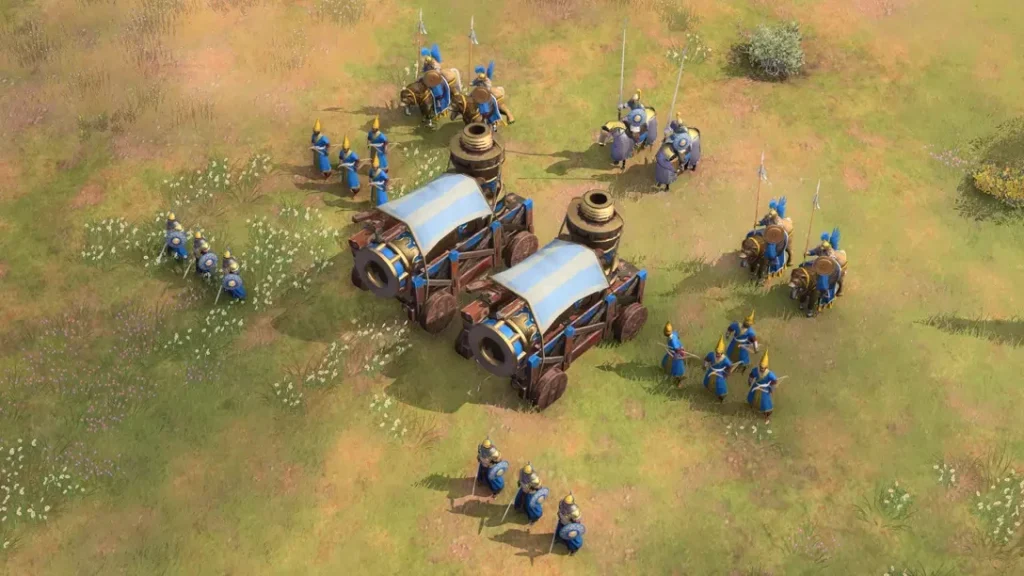
Age of Empires 4 siege unit counters depend on the current unit role, its listed weaknesses, and the army around it. Do not use an old rule that treats Springalds as the default answer to every siege engine. The checked English Springald is an anti-unit weapon with a bonus against melee infantry, while the Horseman’s weapon data includes a bonus against the siege class.
Different siege units also have different jobs. A Mangonel is described as effective against massed units, a Counterweight Trebuchet as a long-distance building unit, and a Battering Ram as a building-only unit vulnerable to melee attacks. Read those descriptions separately rather than assuming that sharing the Siege category makes the units interchangeable.

This guide explains original English menu and unit-role data for an AI practice comparison. It does not provide a guaranteed combat outcome or claim a recorded test. The Age of Empires 4 beginner guide covers the economy and production controls behind any funded unit choice.
On this page
Age of Empires 4 siege unit counters in 6 checks
The useful checks are the actual siege unit, current tooltip, relevant counter property, cost and age access, supporting composition, and observed game conditions. A familiar unit name is a starting point, not a complete counter decision. Updates can change a role even when the name remains the same.
1. Identify the specific siege unit
Read the selected unit’s name and description. A Springald, Mangonel, Ram, and Trebuchet have distinct functions in the checked data. If you describe the opposing group only as siege, you have not yet identified the property that makes one response relevant and another poorly matched.
Use the current entry for the selected civilization. The examples here are English original-civilization records; another civilization can have a unique unit or modifier. Keep the exact unit and age in any practice note so later conclusions refer to the situation you actually observed.
2. Replace outdated Springald assumptions
The retrieved English Springald description calls it an anti-unit siege weapon. It fires piercing bolts, does not require setup to fire, has bonus damage against melee infantry, and does trivial damage against buildings. Those are current-role statements from the source rather than an old generic anti-siege label.
Its checked weapon modifier names melee infantry, not a universal siege-target bonus. That distinction matters when reading older counter charts. Do not silently carry an old role into a current purchase comparison simply because the model or unit name is familiar. Inspect the selected unit’s current description before using it as the basis of a counter plan.
3. Read the Horseman’s relevant bonus and limits
The checked English Horseman weapon includes a bonus against the siege class. Its unit description also gives high movement speed, weakness against melee units, and Spearmen as a counter. Those properties must be read together. The bonus is useful information without establishing that a Horseman automatically resolves every protected siege group.
Keep the supporting composition in the comparison. A unit’s relevant modifier does not remove the weaknesses named in the same entry. This guide therefore treats the Horseman as a source-identified candidate with conditions, not a guaranteed result or a universal replacement for every other part of the army.
4. Separate anti-unit roles from building roles
The checked Mangonel description says it deals area damage and is effective against massed units, with setup required to fire. That identifies an anti-group role. It does not supply a general promise that the Mangonel is the dedicated counter to every other siege unit simply because both belong to the same broad category.
The Counterweight Trebuchet description instead emphasizes buildings and walls over long distance, with setup and inaccurate performance against units. The Ram entry says it can only attack buildings and takes bonus melee damage. Use the actual role and weakness when comparing them, rather than treating all siege descriptions as one combined unit profile.
5. Check production and purchase access
The English Springald and Mangonel entries are Castle Age units with listed production venues, including the Siege Workshop. The Horseman example is a Feudal Stable option among its venues. A relevant role is not a purchase you can make immediately if the needed age or building is unavailable.
Read the current building’s menu before planning the group. English production Landmarks can offer special functions, and venue modifiers can matter. The ordinary unit entry is the source of the basic comparison, while the selected building’s current card is the reference for what your particular production choice can actually provide.
6. Keep role evidence separate from test results
A description establishes a role or modifier; it does not establish a win rate for your proposed group. Unit counts, upgrades, available movement, support, and orders can affect observed performance. Record those conditions if you compare units in practice rather than reporting an outcome from an unperformed experiment.
Use a quiet AI exercise to learn the menus and identify which property is being compared. Keep one main variable clear. If the civilization, age, unit numbers, upgrades, and supporting composition all change, it becomes harder to say which property explains the result you observed.
A current purchase comparison
The checked English Springald costs 150 wood and 100 gold. A Mangonel costs 400 wood and 200 gold. An English Horseman costs 100 food and 20 wood. These are different resource commitments attached to different roles, not three prices for identical behavior.
For an illustrative group, two Springalds require 300 wood and 200 gold before the production building or other spending. Four Horsemen require 400 food and 80 wood. Those arithmetic examples show how the economy funds the candidate group; they do not claim the two groups produce equivalent combat results.
Population differs as well. The checked Springald uses two population, the Mangonel three, and the Horseman one. Include that capacity requirement when you plan a purchase. A production budget that counts only wood and gold can overlook the housing or available army room needed to finish the units.
Keep unit production separate from research and supporting buildings. The example totals exclude upgrades, construction, ordinary economy spending, and replacement needs. A low listed unit price does not establish the complete cost of fielding that role in your actual game state.

Why a counter label is not a full army description
The Horseman entry supplies a siege-class modifier and also names Spearmen as a counter. Both can be relevant in the same game. A chart that copies only the favorable modifier leaves out the condition under which the candidate might have difficulty serving its intended role.
The same issue applies to siege. A Mangonel’s massed-unit role, a Springald’s melee-infantry role, and a Trebuchet’s building role describe different relationships. Read the surrounding units and available production together with the selected engine’s role before reducing the decision to one familiar icon.
This guide does not calculate a fixed number of attacks to resolve a unit comparison. A complete calculation would need current upgrades, relevant resistances or armor, target properties, and the exact interaction being measured. The checked descriptions and costs give a useful starting point without inventing that result.
If you keep a personal counter sheet, record the source date and civilization beside each entry. That makes an older role assumption easier to spot after an update. A short current note explaining why Springald is listed as anti-unit is more useful than retaining a confident older anti-siege recommendation without checking it.
A focused role-learning exercise
In a quiet AI game, choose the English civilization and inspect the Horseman, Springald, and Mangonel menus at their relevant ages. Record the listed costs, population, and role descriptions. This is a proposed learning exercise, not a report of a measured match or a claim that every unit has been tested hands-on.
Compare a small funded group while holding the relevant conditions consistent. Write down which property you intended to observe and the actual supporting composition. If you save an image, describe only the visible unit and game state. A publisher screenshot used for context does not prove your practice comparison has already happened.
Afterward, update the personal note with what the game actually showed. Keep source-role statements separate from your measured observations. That lets you revise a counter choice without turning one quiet test into a broad promise about every opponent, map, or competitive composition.


Troubleshooting and quick answers
Why does an older guide call Springald anti-siege? Check its date against the current unit description. The retrieved English entry used here is anti-unit with a melee-infantry bonus. This guide follows that current role instead of carrying forward an older label.
Does the Horseman bonus guarantee a result against siege? No. The same unit description names weaknesses and Spearmen as a counter. A modifier identifies a useful relationship without supplying an automatic outcome against every supporting composition.
Are all siege units building specialists? No. The checked Springald and Mangonel have anti-unit roles, while the Trebuchet and Ram descriptions emphasize buildings. Read the individual unit rather than applying one purpose to the whole category.
Should I compare only unit prices? Include age access, production venue, population, role, and relevant supporting conditions. The cheapest candidate is not automatically the correct unit for an unrelated job.
Can one practice game establish the best counter? It can document the conditions actually tested. Keep that observation narrow and record the variables before making a broader conclusion.
Start with current unit descriptions and a funded group you can explain. Sources read on November 8, 2026 include English unit-role and weapon-modifier data and English production-building data. Current selected-unit cards control later changes.
Sources and further reading
Keep exploring
Games Like Age of Empires 4: economy, settlement or tactics?
Northgard fits resource and victory planning; Manor Lords fits settlement design; COH3 fits tactical combat with a campaign layer.
Age of Empires 2 Definitive Edition vs Age of Empires 4: where to start
Choose campaign breadth in AoE II DE or documented onboarding and newer presentation in AoE IV.
Age of Empires 4 Hotkey Setup: 6 Clear Profile Checks
A PC keyboard guide explaining separate layouts,context conflicts,gradual edits and verified save/profile checks.