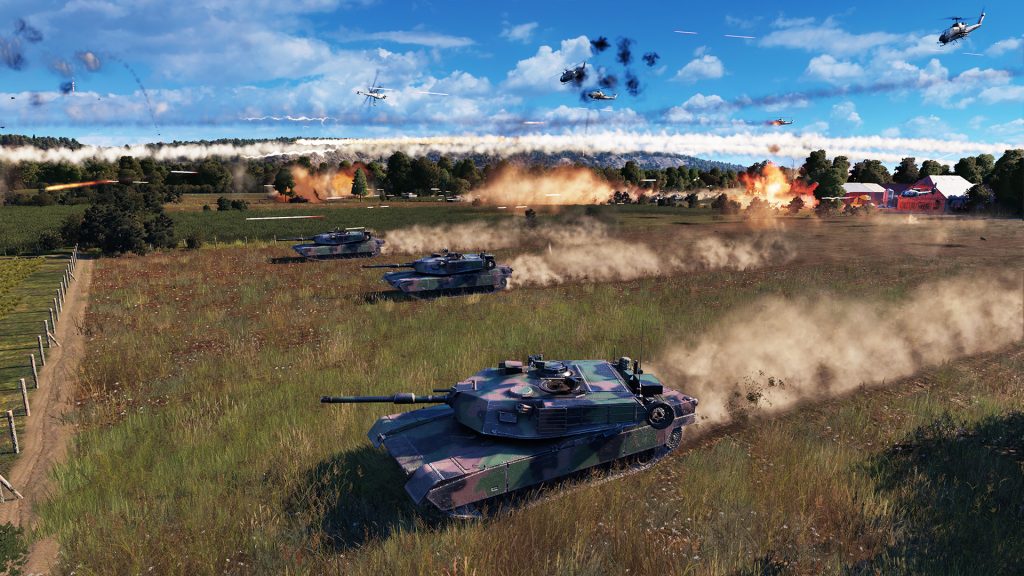
The best Cold War strategy games depend on the command job you want: WARNO for battlegroup battles and an operational campaign, Regiments for single-player platoon command, and Wargame: Red Dragon for an Asian theater with naval and amphibious forces. All three use Cold War equipment, but they ask you to manage it in different ways.
These picks cover conventional warfare rather than espionage or running a superpower’s government. Their conflicts are fictional or alternate-history versions of the period. Choose by the decisions you want to repeat during an evening of play, rather than treating a large vehicle roster as proof that a game fits you.

On this page
Best Cold War Strategy Games: Choose the command job before the arsenal
| Your main priority | Start with | What to check first |
|---|---|---|
| Western European battles plus operational planning | WARNO | Army General and your preferred multiplayer size |
| Solo operations without individual infantry control | Regiments | Its platoon command and operation structure |
| Cold War combat in Asia, including warships | Wargame: Red Dragon | Whether the naval layer belongs in your intended mode |
A tank-heavy screenshot does not reveal the workload. Watch how a battle handles scouting, reinforcements and several threatened positions at once. Then look at what happens between engagements. A sequence of tactical missions and a campaign of maneuvering military formations provide different reasons to return.
The recommendations below use the official product descriptions and screenshots. They are fit judgments, not measured realism rankings or reports from a claimed playthrough. No current player-count claim is needed to choose a solo game; for competitive play, investigate your intended mode’s activity separately.

WARNO: battlegroups and the wider operation
WARNO is the first candidate if you want NATO and Warsaw Pact forces fighting in Germany in a fictional 1989 conflict. It combines real-time tactical battles with turn-based Army General campaigns. That pairing matters if you want both immediate combat decisions and a reason for where the next battle happens.
You assemble a battlegroup from a formation’s available arsenal. The official description lists infantry, tanks, artillery, reconnaissance, helicopters, aircraft and air-defense systems. The attraction is the interaction among those roles: an armored attack needs information about what it is approaching, while aircraft need a plan for hostile air defenses.
Army General is the distinguishing campaign feature here. The advertised campaigns move military formations across an operational setting in Western Europe. Choose it when the next task you want is deciding which formations can support a battle, rather than returning immediately to an unrelated skirmish.
Standalone skirmishes, scripted Operations and multiplayer offer other entry points. The store lists ranked 1v1, smaller team matches and 10v10 battles. Smart Orders and deployment commands are useful features to inspect, though their presence does not remove the need to understand the force you built.
The tradeoff: this is a poor fit if you dislike building forces and interpreting many specialist unit roles. Large matches can also give you a different experience from solo operations. Buy for the mode you expect to use, and verify which content the specific edition includes.

Regiments: concentrate on the platoon fight
Regiments is the focused alternative for a player who primarily wants solo Cold War tactical command. Its fictional 1989 war also takes place around the Inner German border, but the product emphasizes a Platoon Command system instead of orders to every individual infantryman.
You choose a main regiment and expand its options with task forces during play. Those additions bring equipment and off-map support. This is a useful match for someone who enjoys adjusting a force to the current problem more than creating a broad competitive deck before every session.
The operation format connects several days of fighting with limited-resource decisions during the breaks. That gives losses and available support a context beyond a single encounter. The advertised skirmish modes provide an alternative when you want a standalone tactical problem instead of continuing the story.
Regiments still expects combined-arms thinking. Calling artillery or air support does not make positioning irrelevant. Its advertised maneuvers include breakthroughs, mobile defenses and retreats. If those battlefield decisions sound appealing but individual soldier handling does not, this is the strongest reason to shortlist it.
The tradeoff: do not select it expecting the same online team ecosystem as WARNO or Red Dragon. Its advertised strengths are the solo operations, AI opposition and platoon-level control. A preference for multiplayer should change your first choice, even if you like the screenshots.
Wargame: Red Dragon: Asia and a broader domain mix
Wargame: Red Dragon moves the confrontation to Asia around 1991. Its official description includes Japan, China, both Koreas, Australia and New Zealand alongside the competing blocs. Pick it when that regional equipment and theater interest you more than another German-front setting.
Its land and air roster is joined by warships and amphibious units. The maritime layer is a concrete distinction from simply comparing tank models. It is relevant if you want battles where coastlines and waterborne forces are part of the design, rather than assuming every map or mode uses them equally.
The store also advertises a dynamic single-player campaign and multiplayer supporting up to twenty participants. Those features make it more than a collection of vehicles, but their labels do not tell you whether your preferred rules or lobby are available at the moment you want to play.
The tradeoff: a broad arsenal adds a substantial amount to learn. Select it for its setting and domain mix, not because a unit-count comparison automatically makes it the better introduction. Check contemporary mode-specific footage if your priority is multiplayer onboarding.
Make the final choice with one representative session
For WARNO, inspect a complete Army General battle cycle if campaign command is the selling point. For Regiments, watch an operation transition and a platoon engagement. For Red Dragon, check a match using the theater and force types you actually want. Introductory cinematics will not answer those questions.
If you remain undecided, choose the repeated task: operational formation management points to WARNO, concentrated solo platoon tactics to Regiments, and Asian land-air-sea variety to Red Dragon. Check system requirements and edition contents before purchase. The site’s modern warfare strategy selection is the next comparison if you want to look beyond Cold War scenarios.
Sources and further reading
Keep exploring

Hearts of Iron 4 occupation laws: control resistance without draining reserves
Match occupation policy to resistance, compliance and a garrison you can actually supply; use stronger control only when the situation justifies its cost.
wargame red dragon radar anti air management: coverage and weapon-state decisions
A source-backed guide to managing specific radar-related weapons within a complete Wargame Red Dragon air defense.
wargame red dragon sead aircraft: choose a mission that helps
A concise source-backed guide to choosing and reassessing a useful SEAD mission in Wargame Red Dragon.